Data Strategy
How AI Enhances Real-Time Performance Analytics
AI is transforming how businesses handle performance analytics by enabling real-time data processing, prediction, and decision-making. Instead of relying on outdated methods that analyze past data, AI allows companies to predict issues, detect irregularities, and act instantly. Here's what you need to know:
Predictive Modeling: AI uses historical and live data to forecast events like equipment failures or demand surges.
Anomaly Detection: AI identifies irregularities that static systems miss, such as unexpected CPU usage or supply chain disruptions.
Real-Time Insights: Businesses can now process and act on data streams in milliseconds, improving operations and customer satisfaction.
Companies like United Airlines, Netflix, and Spotify have already seen measurable improvements, from higher revenue to fewer disruptions. AI tools like machine learning, neural networks, and real-time processing frameworks enable these capabilities. The future lies in autonomous systems that not only detect issues but also resolve them without human intervention. Businesses adopting these systems report faster ROI, higher efficiency, and better decision-making.
The time to integrate AI-driven analytics is now - delaying could mean losing a competitive edge.
Engineering Excellence: Platforms and Architectures for Real-Time AI Analytics - Sarath Gollapall
AI Technologies That Power Real-Time Performance Analytics
Today's real-time analytics are built on three key AI technologies that enable instant data processing, anomaly detection, and trend forecasting.
Machine learning algorithms play a pivotal role in understanding what "normal" means by studying historical data patterns. These algorithms flag deviations in real time, identifying anomalies that could be sudden, gradual, or dependent on specific contexts. For example, Isolation Forests detect outliers by randomly partitioning data, while autoencoders - specialised neural networks that compress and reconstruct data - send alerts when reconstruction errors exceed acceptable thresholds. Unlike static methods, machine learning can achieve accuracy rates as high as 95%. Together, these tools form the backbone of predictive and adaptive analytics.
Neural networks, especially Long Short-Term Memory (LSTM) models, excel at predicting future performance by capturing long-term patterns in time-series data. A real-world example of this is Dener Motorsport, which implemented real-time analytics for the Porsche Carrera Cup Brazil in May 2024. According to CEO Dener Pires, this technology reduced the time engineers spent analysing car performance issues from 30 minutes to just a few minutes, allowing for immediate tactical adjustments during races. By processing high-frequency data from IoT sensors and telemetry systems, these networks shift operations from being reactive to proactive, helping to anticipate and address potential failures.
Real-time data processing frameworks manage the infrastructure needed to support these analytics. Tools like Apache Kafka act as robust event logs for data ingestion, while Apache Flink handles complex computations with "exactly-once" delivery semantics. A striking example comes from September 2025, when Swiggy, an Indian food delivery platform, used Microsoft Fabric's Real-Time Intelligence to process millions of orders per hour. CTO Madhusudan Rao highlighted its impact:
"Fabric's Real-Time Intelligence empowers us to analyze clickstream and operational data instantly, helping us detect anomalies, and keep our promise of speed to millions of customers".
These frameworks often process data in as little as 10–50 milliseconds, a speed critical for environments where every second counts.
Looking ahead, the rise of "Agentic AI" is set to revolutionise the field. These systems go beyond merely reporting issues - they autonomously take corrective actions, transforming analytics into an active force in business operations. This evolution promises continuous optimisation without the need for human intervention. Up next, we’ll dive into real-world examples of how these technologies are reshaping performance analytics.
Case Studies: How Companies Use AI in Performance Analytics
These examples highlight how companies are leveraging AI to improve operational performance and achieve better outcomes.
Microsoft's AI-Powered Employee Feedback System
Microsoft has developed a system that uses Operations Agents within its Fabric Real-Time Intelligence platform to streamline the "observe → analyze → decide → act" process. These agents monitor key performance metrics and deliver actionable insights automatically. By integrating with Microsoft Teams, the system provides real-time feedback, allowing teams to respond quickly to operational changes.
Netflix and Spotify's Real-Time Monitoring Strategies

Netflix relies on AI-driven anomaly detection to monitor millions of data points in real time. This system identifies issues like server overloads or unexpected traffic spikes - problems that traditional static thresholds might overlook. Thanks to this approach, Netflix has reduced service disruptions by 35% during peak usage events.
Similarly, Spotify employs AI-based monitoring to evaluate server loads, response times, and network speeds across its global operations. By identifying and addressing potential bottlenecks early, Spotify has improved streaming reliability by 20%. According to Gartner, the use of AI-augmented testing and monitoring tools is expected to grow significantly, with 80% of enterprises adopting these tools by 2027, compared to only 15% in 2023. Companies like AWS and GitLab are also using AI to move from reactive to proactive operational management.
AWS and GitLab's AI-Driven Operational Improvements
AWS and GitLab are embracing "Agentic AI" to advance from traditional monitoring methods to autonomous, real-time decision-making. This approach combines Analytical AI, which detects patterns and anomalies, with Agentic AI, which can independently make decisions and take action. Modern real-time intelligence platforms now integrate advanced capabilities like geospatial reasoning, relational analysis, and causal reasoning. This allows businesses to gain deeper operational insights and optimise resource allocation without requiring constant human intervention.
Rebel Force's 4-Phase Approach to AI Enablement

The examples above highlight the possibilities of AI-driven performance analytics, but implementing these systems requires a clear, step-by-step plan. Rebel Force has developed a 4-phase approach to seamlessly integrate AI into real-time analytics, ensuring measurable results.
Diagnosing Constraints
The first step is identifying the specific obstacles that slow down real-time decision-making. Rebel Force examines issues like data latency, processing limitations, and storage bottlenecks that disrupt analytics workflows. Common inefficiencies include outdated, paper-heavy processes, redundant approval steps, and reliance on subjective decision-making. Additionally, many organizations grapple with outdated infrastructure, concerns over data privacy, and the steep upfront costs of adopting AI. These insights form the foundation for a customised AI strategy.
Designing Enablement Blueprints
Once the challenges are clear, Rebel Force creates a detailed roadmap tailored to align AI capabilities with the organisation’s goals. This phase prioritises building a modern data infrastructure that can handle the demands of real-time analytics. The blueprint directly addresses the bottlenecks identified earlier, ensuring the solution is both strategic and practical.
Execution and ROI Validation
In the execution phase, Rebel Force deploys real-time predictive models paired with adaptive feedback loops. These tools allow continuous monitoring and adjustment, ensuring that the return on investment (ROI) is validated throughout the process. Machine learning models estimate success probabilities, while feedback loops fine-tune performance based on actual outcomes. Instead of a one-time ROI assessment, this approach makes validation an ongoing effort, guaranteeing that AI investments deliver consistent and measurable benefits.
Research Findings on ROI and Best Practices
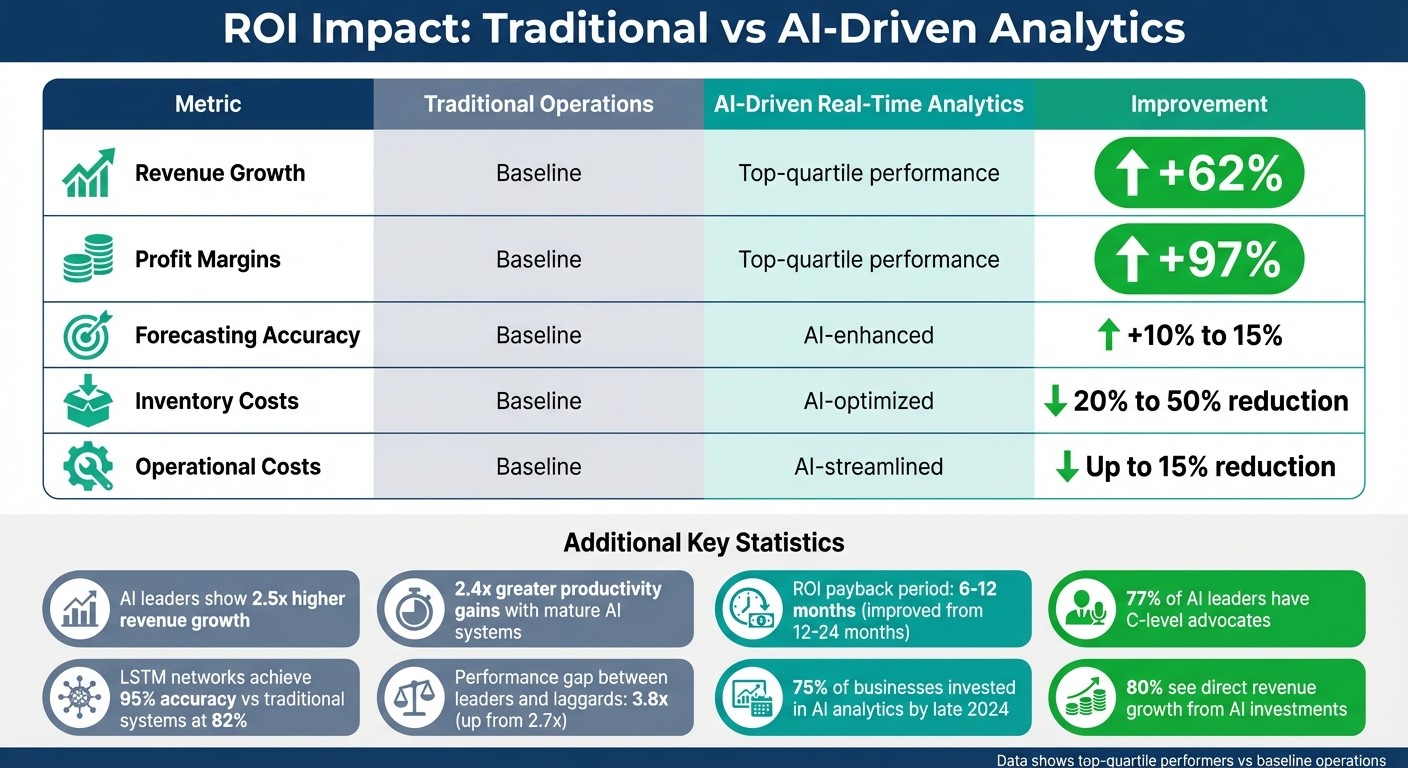
ROI Comparison: Traditional vs AI-Driven Real-Time Analytics Performance Metrics
ROI Comparison: Before and After AI Implementation
The financial benefits of using AI for real-time analytics are both measurable and impressive. Businesses in the top tier of real-time operations see 62% higher revenue growth and 97% higher profit margins compared to companies in the lowest-performing group. These leaders also enjoy 22% improved operational efficiency, 20% stronger innovation, and 17% better risk management.
The gap between AI leaders and those falling behind has grown significantly, now standing at 3.8 times, up from 2.7 times in prior years. Companies with mature AI systems report 2.5 times higher revenue growth and 2.4 times greater productivity gains. Advanced deep learning models, such as LSTM networks, achieve 95% accuracy in performance monitoring, far outperforming traditional threshold-based systems, which reach only 82%.
These numbers underscore how tracking ROI metrics helps businesses refine their AI strategies.
Guidelines for Successful AI Integration
To unlock these ROI advantages, companies need strong executive backing and carefully crafted data strategies. Executive sponsorship plays a pivotal role, with 77% of AI leaders having C-level advocates, and 44% receiving direct support from the CEO or board. Peter Weill, Chairman of MIT CISR, highlights the urgency of streamlined decision-making:
"There is no longer time to pass decisions up and down the traditional hierarchy to receive permissions or approvals".
Establishing a reliable data foundation is another key step. By eliminating the need for manual checks, companies can speed up decision-making processes. Starting small - focusing on critical data tied to customer and employee experiences - helps secure early wins and builds trust in AI systems. Cross-functional Centers of Excellence can standardize AI practices and connect data science with operational expertise. While scaling AI requires a centralized data architecture, only 16% of organizations currently demonstrate full readiness for such operations.
The return on AI investments is now faster than ever. Both industry leaders and late adopters report payback periods of 6 to 12 months, a sharp improvement from the previous 12- to 24-month range. For instance, a global pharmaceutical company used a generative AI tool to audit supplier invoices, uncovering over $10 million in value leakage within just four weeks, with an impressive 95% extraction accuracy.
Conclusion: The Future of AI in Real-Time Analytics
AI-powered real-time analytics are reshaping how businesses operate, far beyond being just another tech buzzword. The shift to these advanced systems offers a clear edge in the marketplace. By late 2024, 75% of businesses are expected to have invested in AI analytics, with 80% already seeing direct revenue growth as a result. The momentum behind this transformation is hard to ignore.
The future is all about Real-Time Businesses (RTBs) - companies that can react to opportunities or threats in milliseconds instead of days or weeks. This is a significant leap from traditional "Smart AI", which focuses on predictions, to Agentic AI - systems capable of making decisions and taking actions autonomously in real time. Tools like edge computing and natural language processing are making analytics more accessible, empowering employees without technical expertise to query data using everyday language and act on insights immediately. However, this shift isn't just about technology - it requires a rethinking of leadership and operational strategies.
For leaders, this means moving away from gut-feeling decisions to a culture rooted in evidence-based actions. Trusted data and empowered teams at every level are essential for this transformation. Starting with targeted initiatives, such as improving customer and employee experiences, can lay the groundwork for broader changes.
The clock is ticking for businesses looking to gain a competitive edge. The gap between early adopters and latecomers is closing fast. Companies like Rebel Force are helping businesses tackle this challenge, guiding them from identifying operational bottlenecks to implementing AI-driven systems that deliver measurable results.
The time to embrace AI-driven analytics is now - waiting could mean falling behind.
FAQs
How does AI enhance real-time decision-making for businesses?
AI enables businesses to make quicker and more informed decisions by examining live data streams and applying advanced predictive models. These tools deliver real-time insights that can be acted on immediately, bridging the gap between analysis and execution.
By automating decision-making, AI allows companies to react to opportunities or challenges almost instantly. This is especially useful in fast-paced industries where timely, data-driven actions are essential to staying ahead of the competition.
How does AI improve real-time performance analytics?
AI takes real-time performance analytics to the next level by using machine learning and deep learning models to spot trends and flag anomalies as they occur. These technologies handle massive datasets at lightning speed, delivering insights that empower businesses to make quick, informed decisions.
With generative AI tools, the process becomes even more efficient. These tools break down complex data into concise summaries and generate actionable insights almost instantly. Meanwhile, natural language processing (NLP) steps in to interpret and structure streaming data, making it easier to understand. Together, these AI-driven advancements allow businesses to keep a close eye on operations, seize new opportunities, and tackle challenges as they arise, all while boosting efficiency and achieving tangible results.
What advantages do businesses gain from using AI-powered real-time analytics?
Businesses that use AI-powered real-time analytics often see impressive results. For instance, some report up to a 62% increase in revenue growth and a 97% jump in profit margins. On top of that, these companies typically achieve around a 20% boost in innovation, a 22% improvement in operational efficiency, and a 17% enhancement in managing risks.
These gains come from AI's ability to quickly process massive amounts of data, identify patterns, and deliver actionable insights. By weaving AI into their performance analytics, businesses can make smarter decisions, refine their operations, and respond swiftly to shifting circumstances - leading to noticeable, game-changing results.