
AI Enablement
Ultimate Guide to Managing AI Resistance
Employees resist AI for three main reasons: fear of job loss, feeling unprepared to use the technology, and mistrust of AI. This resistance slows adoption and hinders organizations from realizing AI’s full potential. Despite 79% of leaders viewing AI as critical, only 20% of employees use it daily, and 95% of companies fail to see measurable returns from AI investments.
To overcome this, companies must focus on building trust, providing training, and involving employees in AI planning. Key strategies include:
Training: Break learning into stages (introductory, hands-on, and reinforcement) and encourage peer-to-peer learning.
Clear Communication: Explain how AI supports employees rather than replaces them. Avoid vague reassurances; instead, outline how roles will evolve.
Employee Involvement: Engage employees in planning, create AI advocate networks, and gather feedback regularly.
Tracking AI adoption with clear metrics - like usage rates and measurable outcomes - helps refine efforts. By addressing resistance early and supporting employees, businesses can transform AI into a tool that enhances productivity and job satisfaction.
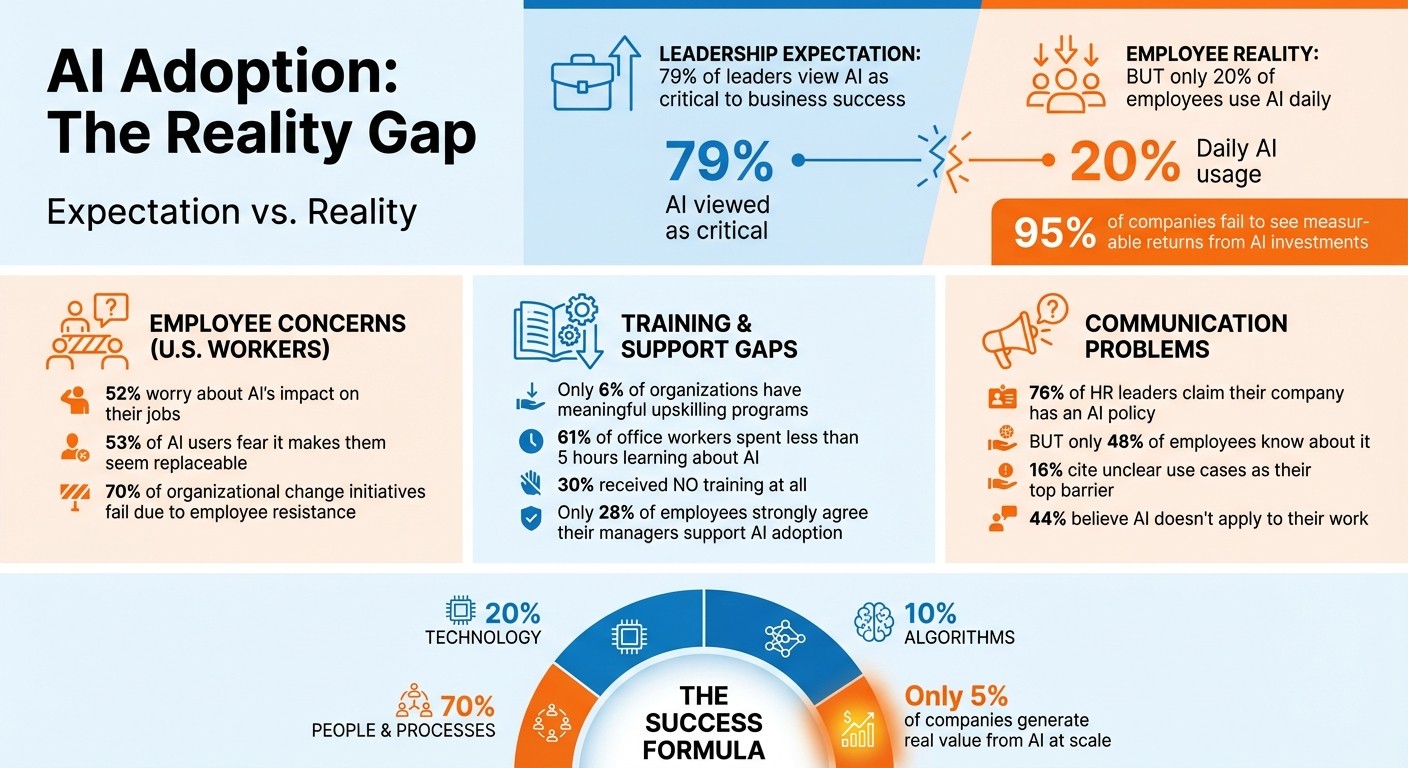
AI Adoption Statistics: The Gap Between Leadership Vision and Employee Reality
AI Change Management | Resistance to AI is Real - Here’s How to Succeed
Why Employees Resist AI
Resistance to AI in the workplace often has less to do with the technology itself and more to do with underlying psychological concerns and workplace dynamics. Research highlights three key dimensions of this resistance: fear (worry about potential threats), inefficacy (feeling unprepared or incapable), and antipathy (mistrust and ethical doubts). These factors, combined with workplace culture, create significant hurdles for organisations trying to implement AI successfully.
The numbers show just how widespread these concerns are. In the U.S., 52% of workers worry about AI’s impact on their jobs, while 53% of those already using AI fear it makes them seem replaceable. This creates a tricky paradox: employees need AI to stay competitive, but they also fear its consequences. This tension contributes to the failure of up to 70% of organisational change initiatives, often due to resistance from employees or insufficient management support.
Fear and Anxiety About AI
At the heart of AI resistance is a deep concern about job security. Tasks like data labelling, training models, or documenting workflows often make employees feel like they’re training their own replacements. This fear can lead to behaviours like minimal compliance or delaying critical implementation steps.
But the anxiety goes beyond the fear of losing a paycheck. AI challenges employees' sense of identity and professional pride. For example, some radiologists ignore AI-generated recommendations, seeing them as a threat to their expertise. Similarly, software developers may struggle to adapt. Julie Bedard, Managing Director and Partner at BCG, explains:
"It's an emotional process to bring employees through: 'I became a software developer because I like to code, and it's really hard for me to reimagine my identity if coding looks different in the future.'"
This struggle with "self-image" often leads workers to hide their use of AI or set unrealistic standards to delay its adoption. Research even shows that programmers are 16% to 18% less likely to recommend AI tools to their colleagues, viewing their specialised knowledge as a form of job security rather than a shared resource.
A striking example comes from Dingdong Maicai, a Chinese grocery e-commerce company. The company used AI to trace customer complaints back to specific departments, like procurement or delivery. While technically accurate, this "perfect accountability" created rigid, black-and-white judgments that ignored the complexities of real-world operations. The result? Escalated disputes and damaged morale. Ultimately, the company returned decision-making to humans to rebuild trust.
Workplace Culture and Communication Problems
Even when fear fades, poor communication and misaligned priorities can fuel resistance. Only 28% of employees strongly agree that their managers actively support AI adoption, and 16% cite unclear use cases or value as their top barrier. Without clear messaging, employees are left unsure about AI’s role and purpose in their work.
The problem worsens when leaders position AI solely as a tool for productivity. Deborah Lovich, Managing Director and Senior Partner at BCG, notes:
"Leaders who frame and promote AI purely as a productivity tool are essentially telling their employees not to engage with it."
This framing often signals looming job cuts rather than empowerment, triggering what experts call an "organ rejection" effect - where AI is technically implemented but culturally rejected.
Traditional workplace hierarchies further complicate AI adoption. For instance, when junior employees using AI outperform seasoned veterans, resentment can build among senior staff who feel their expertise is being undervalued. Similarly, managers whose authority depends on team size may resist automation if it threatens to reduce their teams. These cultural dynamics highlight the need for inclusive and thoughtful integration strategies. A standout example is OPPO, which hosted an "AI tournament" with department rankings. By giving all teams equal access to AI tools, the company reframed success, shifting the focus from managing large teams to achieving better results with AI. Managers were motivated to support adoption to avoid public embarrassment.
Another issue lies in training and knowledge sharing. Despite AI’s growing presence, 61% of office workers have spent less than five hours learning about it, and 30% have received no training at all. This lack of preparation, combined with competitive workplace cultures, often leads to what HR consultant Tony Deblauwe describes as a critical communication failure:
"When an employee is suddenly told to hand over parts of their job to AI, especially without context, it can feel like a prelude to being phased out."
Key Resistance Factors:
Fear of Replacement: Job insecurity leads to minimal compliance and delays in tasks like data labelling.
Self-Image Challenges: Workers may hide AI use or ignore recommendations to protect their professional identity.
Inefficacy: Employees avoid complex tools due to stress and a perceived lack of competence.
Accountability Issues: AI-driven blame can escalate disputes and erode trust when human nuance is ignored.
Knowledge Hoarding: Some employees withhold AI prompts or data to maintain a competitive edge.
Understanding these barriers is crucial for developing strategies that address resistance effectively.
How to Reduce AI Resistance
Overcoming resistance to AI adoption requires more than just providing tools - it’s about building skills, trust, and involvement. While only 6% of organizations have started meaningful upskilling programs, 62% of C-suite executives point to a lack of talent and skills as a major barrier to scaling AI. Bridging this gap involves three key strategies: tailored training, clear communication, and inclusive planning.
Training and Education Programs
Effective AI training isn’t one-size-fits-all. It works best when broken into three stages: Foundational (introducing concepts and vocabulary), Applied (hands-on integration), and Embedded (reinforcing behaviors with incentives). For example, a global biopharmaceuticals company segmented its 100,000 employees into four AI archetypes, boosting AI adoption from 20% to nearly 90%.
Peer-to-peer learning often outperforms traditional top-down methods. In 2024, CMA CGM, a global shipping company, launched an AI skills accelerator program. CEO Rodolphe Saadé personally attended the launch and joined training sessions alongside senior managers and teams, promoting a culture of shared learning.
Giving employees time to explore AI tools without fear of mistakes is crucial. Brad Strock, former CIO of PayPal, highlights:
"The real challenge with AI isn't the technology - it's getting people to trust it. If you don't build trust first, no AI initiative will succeed."
Gamification and rewards, like digital badges, can further boost engagement. The focus should be on showing employees how AI directly enhances their tasks. A European retail bank demonstrated this in 2025 by embedding an "Ops AI Agent" into workflows, cutting approval times from several days to under 30 minutes and achieving a 50% productivity gain.
Clear and Consistent Communication
Training alone isn’t enough - consistent communication is essential to keep employees engaged and informed. Resistance often stems from uncertainty. For instance, 16% of employees cite unclear use cases as a top barrier to AI adoption, while 44% believe AI doesn’t apply to their work. The solution lies in clear messaging that connects AI to both business goals and daily tasks.
AI should be framed as a tool for empowerment, not just efficiency. Deborah Lovich, Managing Director at BCG, warns:
"Leaders who frame and promote AI purely as a productivity tool are essentially telling their employees not to engage with it."
Instead of focusing on efficiency, emphasize how AI reduces repetitive tasks, freeing employees to focus on meaningful work. Transparency is key, but avoid empty reassurances like “your job is safe.” Instead, explain how roles will evolve and outline the training and support available. The GitHub AI Enablement Playbook advises:
"In conversation don't say: 'Your job is safe.' Do say: 'This is how our jobs will change, and this is how we will support you in developing the new skills required to succeed.'"
Leaders play a pivotal role in normalizing AI use. McKinsey & Company achieved a 92% adoption rate for its AI platform "Lilli" by integrating it into daily operations. Senior leaders regularly referenced the tool in meetings, establishing it as part of routine workflows.
Clear policies are also essential. While 76% of HR leaders claim their company has an AI policy, only 48% of employees know about it. Simple, tiered guidelines that distinguish between approved internal tools and unvetted public tools can encourage safe experimentation.
Managers must actively support AI adoption. Employees who feel their manager supports AI are 8.8 times more likely to see it as enabling them to excel. Yet, only 28% strongly agree their manager champions AI use. Regular updates and honest communication from managers can make all the difference.
Including Employees in AI Planning
Involving employees in AI planning fosters trust and ownership. Top-down mandates often backfire, hardening resistance. Instead, engaging employees early in the process reduces uncertainty and builds buy-in. Companies involving at least 7% of their workforce in transformation efforts are twice as likely to see positive shareholder returns, with high performers engaging 21–30% of employees.
Creating an AI Advocates Network - a group of internal champions - can drive adoption through peer influence. These advocates lead demos, mentor colleagues, and gather feedback, turning resistance into enthusiasm.
Co-creation is another powerful approach. Instead of IT departments working in isolation, involve employees in redesigning workflows and developing AI solutions. McKinsey’s "Lilli" platform empowered employees to create nearly 17,000 custom agents, achieving a 92% adoption rate and saving over 30% of time on information synthesis.
Cross-functional task forces also ensure diverse perspectives are included. Groups like a "ChatGPT Task Force" can bring together representatives from HR, IT, Legal, and frontline teams to oversee AI rollouts. This ensures both compliance and usability are addressed.
Continuous feedback loops are vital for sustained adoption. Dedicated forums or Communities of Practice allow employees to share successes, ask questions, and raise challenges in real time. For example, Morgan Stanley Wealth Management involved its teams in evaluating the "AI @ Morgan Stanley Assistant", leading to a 98% adoption rate among advisors.
As Marty Gilbert puts it:
"One of the biggest mistakes in digital transformation is thinking that adoption is the goal. It is not. The goal is making the technology valuable for the people who use it."
When employees are part of the process, they shift from passive users to active contributors, transforming resistance into commitment. By combining training, communication, and inclusive planning, organizations can make AI a trusted and indispensable tool for their teams. For expert guidance, companies like Rebel Force (https://rebelforce.nl) can help accelerate this journey toward successful AI integration.
Framing AI as a Support Tool
When organisations position AI as a tool to assist rather than replace employees, it becomes easier to foster engagement and reduce resistance. Successful AI implementations highlight how the technology can improve efficiency, allowing employees to focus on meaningful tasks. The key is to show how AI and human efforts complement each other to boost productivity.
How AI Reduces Repetitive Work
AI shines when it comes to automating repetitive, time-consuming tasks that often bog down employees. Imagine a finance team manually matching invoices line by line, a sales rep laboriously updating CRM records, or an IT professional performing weekly software updates. These are perfect examples of tasks that AI can handle, freeing up employees for more impactful work.
Consider these statistics: AI detects 92% of fraud attempts and processes claims 70% faster. In IT, 83% of professionals rely on AI to automate routine tasks like backups and updates. For sales teams, 75% of B2B sellers using AI exceeded their quotas, compared to just 25% of those who didn’t.
David Swenson, CIO at Netlogic, shared his experience after adopting Microsoft Copilot for Sales:
"It has been a long journey to find the right solution for our productivity challenges... [AI] was going to save his team meaningful amounts of time - finally."
This trend extends across various departments. Finance teams report 70% faster processing times for procure-to-pay workflows. Marketing teams accelerate campaign launches by automating brand compliance checks. In customer service, AI-powered ticket triage improves response times and satisfaction scores [21, 23]. Rather than replacing human judgment, AI allows employees to focus on tasks that require creativity and expertise.
Real Examples of Better Work Processes
Real-world success stories highlight how AI can reshape workflows. For instance, Morgan Stanley introduced the "AI @ Morgan Stanley Assistant" in June 2024, training it on over 100,000 research reports. This initiative gave wealth management teams easier access to expertise, achieving a 98% adoption rate among advisors.
Zapier took a creative approach by hosting internal hackathons and creating a Slack channel (#fun-ai) for employees to share AI use cases. By August 2025, the company had achieved an 89% adoption rate. Teams used AI for tasks like competitor research in operations and automating onboarding documentation in HR.
Singtel launched the "AI Acceleration Academy" in October 2024, collaborating with Nanyang Technological University and the National University of Singapore. This program trained over 10,000 employees to integrate data and generative AI into their daily workflows.
Mala Anand, Corporate Vice President of Customer Experience and Success at Microsoft, highlighted the impact of AI-driven changes:
"Response times are faster, and the interaction quality has improved, which is leading to much higher satisfaction and loyalty."
These examples illustrate how framing AI as a supportive tool aligns naturally with strategies like comprehensive training and inclusive planning. For organisations looking to take the next step, companies like Rebel Force (https://rebelforce.nl) specialise in creating data-driven systems that integrate AI into existing workflows, ensuring measurable results. The goal is simple: make AI a valuable asset for the people using it every day.
Next, we’ll explore how to track AI adoption and measure its impact effectively.
Tracking AI Adoption and Results
One of the biggest hurdles for organisations implementing AI is proving its value. A striking 97% of enterprises struggle to showcase measurable business outcomes from their early Generative AI initiatives. The issue often isn't the lack of value but the difficulty in quantifying it. Without clear metrics and actionable feedback, companies risk scrapping projects too soon. For instance, the rate of AI project abandonment surged to 42% in 2025, up from 17% the previous year, largely due to cost concerns and unclear returns.
Metrics for AI Adoption
To tackle this challenge, organisations can use a three-tiered approach to measure AI adoption:
Adoption Metrics: These include training completion rates and the number of pilot programs initiated, which help track the initial engagement.
Behavior Metrics: Metrics like weekly active users and the percentage of workflows incorporating AI provide insights into how integrated AI is in daily operations.
Outcome Metrics: These focus on tangible results, such as reduced cycle times, lower error rates, and increased employee satisfaction.
Balancing short-term and long-term indicators is key. While lagging indicators - like cost savings and productivity improvements - highlight the eventual impact, they often come too late to identify problems. In contrast, leading indicators, such as metrics that assess task effort, relevance, and enjoyability, can flag adoption issues early on.
It’s crucial to establish baseline metrics - like time, cost, volume, and error rates - about 8–12 weeks before deployment. These benchmarks make it easier to quantify improvements, such as calculating financial impact by multiplying hours saved by hourly labour costs. This data-driven approach helps refine AI initiatives over time.
Creating Feedback Systems
Metrics alone don’t tell the whole story - real-time feedback systems are essential for understanding how AI affects employees' day-to-day work. Short, targeted pulse surveys focusing on specific tasks can uncover whether AI is simplifying processes or creating new challenges. For example, although 76% of HR leaders claim their company has a clear AI policy, only 48% of employees agree, highlighting the need for better communication and feedback mechanisms.
Managers play a pivotal role in gathering this feedback. During one-on-one or team meetings, they should ask direct questions like:
"Where did AI help? Where did it hinder? What should we try next?"
The impact of managerial support is undeniable. Employees who feel backed by their managers in using AI are nearly 9 times more likely to believe that AI helps them perform at their best every day.
To ensure employees' concerns are heard, organisations should establish clear escalation channels with defined service level agreements (SLAs). Additionally, segmenting employees into groups - like AI Champions, Independent Explorers, Organizational Adopters, Passive Observers, and Cautious Skeptics - can help identify specific challenges, such as mistrust or time constraints.
Companies like Rebel Force (https://rebelforce.nl) specialise in validating AI's return on investment and building structured systems to monitor performance across all stages of implementation. By focusing on what matters, listening to employee feedback, and adapting quickly, organisations can maximise the benefits of AI.
Conclusion: Sustaining AI Success Over Time
Making AI work over the long haul isn't about quick fixes - it’s about commitment and constant fine-tuning. Companies that thrive with AI understand this: 70% of their effort should focus on transforming people and business processes, while only 10% goes toward algorithms and 20% toward technology. This balance is what separates stalled AI projects from those that deliver meaningful results.
Here’s a striking fact: just 5% of companies manage to generate real value from AI at scale. The key to joining this elite group lies in tackling resistance early and keeping the momentum alive. It’s not enough to hand out tools; leaders must actively demonstrate how AI can be used, pinpoint role-specific applications, and gather feedback from employees across the board.
The path to sustainable AI adoption typically unfolds in three phases: laying the foundation, applying AI in targeted areas, and embedding it into daily workflows. Throughout this journey, managerial support is non-negotiable. Without it, even the most advanced technology can struggle to gain traction. This progression bridges the gap between initial excitement and lasting innovation.
To keep AI aligned with business goals, continuous feedback is crucial. Regular evaluations and adjustments are what drive success. Instead of just tracking adoption rates, focus on metrics that reflect real behavior changes and tangible business outcomes. Build feedback loops through quick surveys, one-on-one discussions, and team-wide reviews. Identify your AI champions - those employees who truly get it - and empower them to refine and adapt AI strategies for their teams. And don’t dismiss resistance; it often highlights issues that early adopters might overlook.
Balancing big ambitions with practical steps is the way forward. Set realistic goals, provide ongoing training, and rework processes to cut out repetitive tasks and add value. Partners like Rebel Force (https://rebelforce.nl) can offer the systems and expertise needed to validate ROI and keep performance on track. By addressing resistance head-on and evolving strategies based on feedback, businesses can transform AI from a source of hesitation into a powerful competitive edge.
FAQs
How can businesses help employees feel confident about AI adoption?
Building trust in AI begins with clear, honest communication. People need to know why AI is being introduced, how it will affect their work, and what advantages it offers for their daily tasks. Address concerns about job security, data privacy, and fairness by explaining the technology in plain language. Share tangible results - like cost savings in US dollars or hours saved - to make the benefits relatable. Being transparent and demonstrating small, visible wins can gradually shift attitudes from doubt to interest.
Getting employees involved is just as important. Form cross-functional teams that include frontline workers to develop AI applications together. Offer training, use tools with explainable AI features, and create regular feedback channels to show that AI is there to assist, not replace. Leaders should frame AI as a tool for achieving shared goals, reinforcing its role as a partner rather than a threat.
Maintaining trust takes consistent effort. Establish clear policies around fairness, track and share results, and celebrate team successes. By tying AI’s benefits to the collaborative and community-oriented values of the U.S. Virgin Islands, businesses can build confidence and fully tap into what AI has to offer.
How can businesses effectively reduce resistance to AI adoption?
To ease concerns about adopting AI, it’s crucial to start with strong leadership backing, especially from the CEO. Their visible support can signal commitment and foster trust across the organization. Make sure to clearly explain the purpose behind AI initiatives and how they align with your company’s goals and values.
Get employees involved early by including them in the development process - co-creating solutions and addressing their questions or hesitations. Pay attention to emotional and workplace dynamics that might drive resistance, and offer focused training to equip teams with the skills they’ll need to work alongside AI tools. Additionally, set up clear governance structures to manage implementation and track measurable outcomes. Showing tangible results can help build confidence and ease the transition.
What’s the best way for organizations to measure the success of AI adoption?
To gauge the success of adopting AI, it’s crucial for organizations to define specific, goal-oriented KPIs that align with their business objectives. Track important metrics like system usage, feature adoption, and user engagement - such as how often users log in or complete tasks. Analytics tools can then link these metrics to real-world outcomes, like increased productivity, reduced costs, or measurable ROI.
By consistently reviewing these insights with your team, you can pinpoint areas that need improvement and ensure your AI efforts are driving impactful, scalable results. Adapting your strategy to fit your organization’s unique goals will amplify the effectiveness of your AI initiatives.