
Operational Excellence
AI Root Cause Analysis for Performance Gaps
AI is changing how businesses identify and solve performance problems. Instead of relying on slow, manual investigations, AI pinpoints issues faster, with 95% accuracy compared to the 78% accuracy of older methods. It tracks patterns in real-time, predicts failures, and suggests fixes, saving companies time and money. On average, businesses using AI reduce downtime costs by 50% and prevent 60–80% of potential incidents.
Key Takeaways:
Common Gaps: Broken systems, process drift, resource bottlenecks, and dependency failures.
AI Benefits: Faster analysis (minutes vs. hours), lower costs ($200–$800 per issue), and higher accuracy.
Techniques Used: Automated 5 Whys, process mining, anomaly detection, and predictive analysis.
AI helps businesses move from reactive troubleshooting to proactive prevention, improving efficiency and cutting costs. Ready to fix performance gaps faster? Let’s dive in.
Root Cause Analysis with Nokia AI Operations Automation
Manual vs AI-Driven Root Cause Analysis
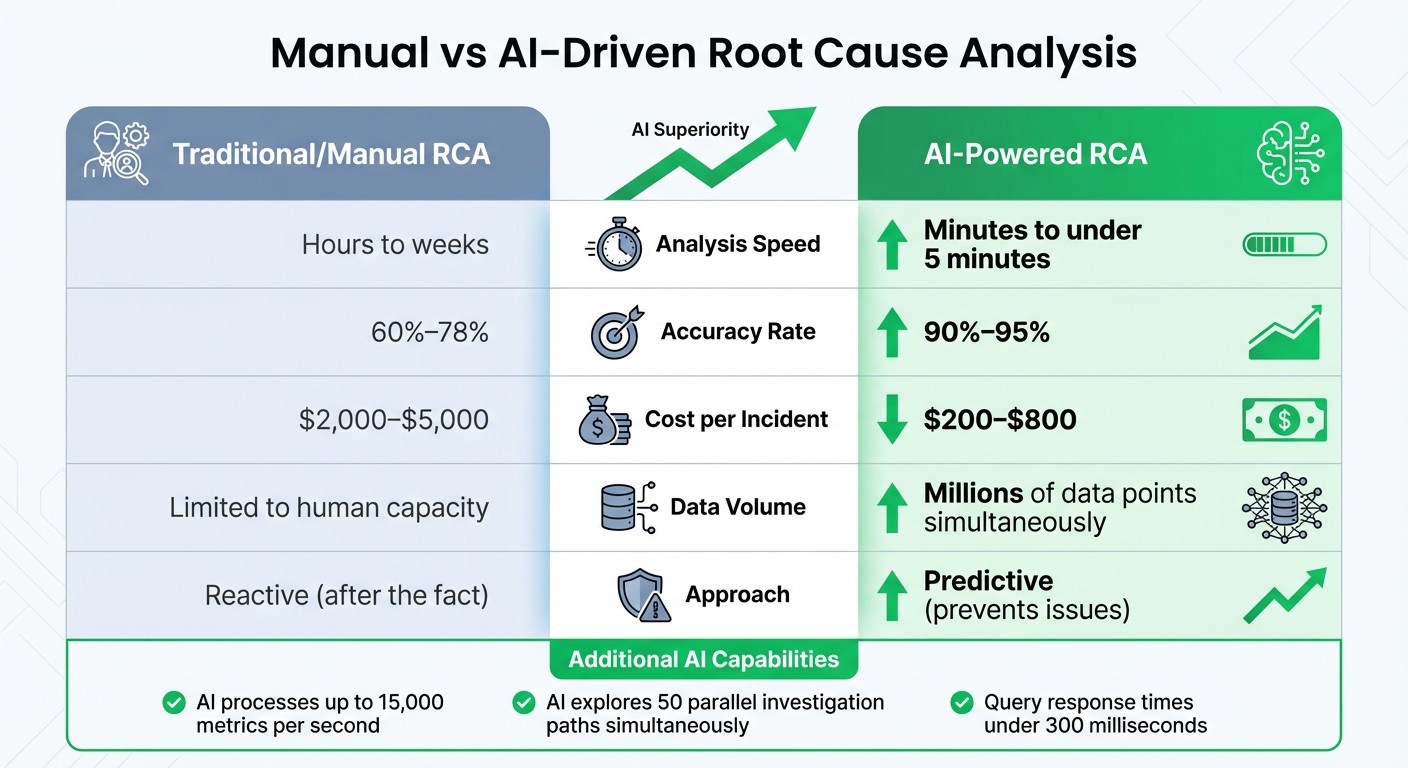
Manual vs AI-Driven Root Cause Analysis: Speed, Accuracy, and Cost Comparison
Problems with Manual Methods
Manual root cause analysis (RCA) often requires engineers to spend countless hours - or even days - sifting through logs and attempting to reproduce issues. This not only stretches downtime but also delays critical product launches. However, the real challenge lies beyond just the time commitment; it’s about the limits of human capacity when dealing with today’s complex systems.
A major drawback of traditional RCA is confirmation bias. Teams sometimes focus on evidence that aligns with their assumptions, which can lead to addressing only surface-level issues - like high latency - without identifying deeper problems, such as garbage collection pauses or memory allocation bottlenecks.
Modern systems churn out millions of data points from a variety of sources, making it nearly impossible for humans to process all the information or spot hidden patterns across logs, metrics, and traces. The shift to microservice architectures has further complicated things. With so many interconnected components, no single engineer can fully grasp the entire system. Adding to the challenge, the quality of manual analysis often depends on the expertise of the person conducting it, which can lead to inconsistent results across teams. These limitations highlight why AI-driven solutions are gaining traction as a more effective approach to root cause analysis.
Benefits of AI-Driven Analysis
AI-driven RCA takes a completely different approach, addressing the shortcomings of manual methods. These systems can handle enormous data loads, processing up to 15,000 metrics per second with query response times of under 300 milliseconds. Instead of working through a single path, AI can explore 50 parallel investigation paths at the same time. This allows it to uncover complex, interrelated causes that humans might miss.
As Nikolay Sivko, founder of Coroot, put it:
People were not looking for more dashboards or charts. What they really wanted were answers, guidance, and clear suggestions on what to do next.
The results speak for themselves. In 2025, Citic Pacific Special Steel adopted an AI-based RCA system for its blast furnace operations. By analyzing process parameters in real time, the company saw a 15% increase in throughput and an 11% reduction in energy consumption. Similarly, BMW utilized AI alongside digital twin technology in its battery pack assembly process. This enabled the company to reduce alignment-related production issues by 30%, thanks to simultaneous data analysis from robotic arms, conveyor belts, and alignment sensors.
The advantages of AI become even clearer when comparing it to traditional methods:
AI-driven analysis not only speeds up the process but also delivers higher accuracy, reduces costs, and shifts the focus from reactive troubleshooting to proactive problem prevention. It’s a game-changer for industries dealing with complex systems and high stakes.
AI Techniques for Root Cause Analysis
When it comes to addressing performance gaps, AI applies precise methods to identify inefficiencies that hinder business success.
Automated 5 Whys Analysis
The traditional 5 Whys method relies heavily on human memory and interviews, which can introduce bias and leave gaps in understanding. AI transforms this process by automating the questioning sequence and integrating a "Three-Legged" analysis: Occurrence (why the failure happened), Detection (why monitoring systems missed it), and Systemic (why management processes allowed it to persist).
Instead of depending on human input, AI uses event logs, timestamps, and system data to trace failures back to their source. As Xuan Liao, Global VP of Marketing at Skan, puts it:
AI-powered root cause analysis runs the 5 Whys against complete process data - tracing failures to their true source in minutes, not months.
For instance, if a Service Level Agreement (SLA) breach occurs, AI can quickly identify whether the issue stems from a broken integration, undocumented process changes, or resource limitations. Following this, AI employs process mining to reconstruct workflows and validate the findings.
Process Mining and Anomaly Detection
Process mining digs into event logs from systems like ERP, CRM, and BPM platforms to map out how work actually flows through an organization - often revealing discrepancies from documented procedures.
This technique focuses on three key areas: Discovery (creating process models from raw data), Conformance (spotting deviations from intended workflows), and Enhancement (refining processes based on data insights). AI calculates metrics like throughput time, path frequency, and idle durations to zero in on bottlenecks.
For example, a global electronics manufacturer reduced defects by 25% after discovering, through process mining, that quality checks were skipped during certain shifts. Similarly, a bank slashed loan processing times by 40% after identifying rework loops caused by inconsistent document formats.
With anomaly detection, AI continuously monitors operational metrics and flags deviations from historical norms in real time. This enables businesses to quickly address issues like SLA breaches, recurring errors, or rework loops. One insurance company, for example, cut its claims rework rate from 30% to 3% in just two weeks, saving US$2.3 million annually by uncovering pricing database mismatches.
Predictive and Causal Analysis
Building on diagnostics and anomaly detection, AI also predicts potential problems before they escalate. While traditional statistics highlight correlations, causal AI pinpoints cause-and-effect relationships. This is key because correlations often highlight symptoms, not root causes.
Machine learning models analyze both historical and real-time data to forecast inefficiencies. By monitoring early warning signs - like rising cycle times or declining first-time resolution rates - AI can flag potential issues early. For instance, in 2025, Citic Pacific Special Steel used AI-driven causal analysis to optimize blast furnace operations, boosting throughput by 15% and cutting energy use by 11% through real-time adjustments.
Meta has also developed "Hawkeye", a system combining heuristic retrieval with a Llama 2 model fine-tuned on 5,000 examples. This system achieved 42% accuracy in identifying root causes for code changes in its web monorepo. Similarly, Chipotle Mexican Grill adopted AI-driven predictive root cause analysis during the COVID-19 pandemic to handle online order surges, reducing mean time to resolution (MTTR) by 50% through automated triage and ticket routing.
AI further employs Natural Language Processing (NLP) to analyze unstructured data from customer feedback, support tickets, and maintenance logs. This approach uncovers recurring systemic issues that might otherwise go unnoticed. By relying on statistical evidence rather than human perception, AI achieves 95% accuracy compared to 78% with traditional methods.
Common Performance Gaps and How AI Detects Them
Performance gaps represent the difference between actual results and desired goals. Despite 93% of organizations recognizing the importance of driving performance, only 44% feel their current programs meet this objective. The financial impact is staggering - large industrial plants can lose as much as US$129 million annually due to system downtime, while equipment failures like conveyor motor seizures can cost over US$9,200 per hour in lost production.
AI has emerged as a powerful tool to pinpoint and address these gaps with precision.
6 Types of Performance Gaps
AI identifies six key categories of performance gaps that traditional methods often overlook:
Process inconsistencies: When teams perform the same task differently, it leads to unpredictable results and quality issues.
Resource constraints: Bottlenecks occur when access to tools, knowledge, or decision-making authority is limited to specific individuals.
Data validation errors: Mistakes in capturing critical information during early stages of a process can cause failures later on.
Change management issues: Performance often dips after system updates that haven't been adequately tested.
Undocumented workarounds: Known as "Shadow IT", this involves personal spreadsheets or manual workflows outside official systems.
Process drift: Over time, minor shortcuts accumulate, causing deviations from standard operating procedures.
By identifying these gaps, AI provides the foundation for targeted solutions.
AI Detection Methods
AI employs three core techniques to detect performance gaps effectively:
Anomaly detection: This method monitors operational metrics in real time, flagging deviations like service level breaches or repetitive rework.
Process intelligence: By analyzing actual execution data across systems, AI uncovers discrepancies between how work is documented and how it’s actually performed.
Predictive modeling: AI uses trends, such as rising cycle times or falling first-time resolution rates, to predict potential issues before they escalate.
Traditional root cause analysis often falls short, identifying just 14% of problems since it focuses on isolated causes rather than interconnected factors. AI, on the other hand, operates with remarkable speed and precision - responding to queries in under 300 milliseconds and identifying issues in about 300 seconds. This efficiency allows AI-driven monitoring to prevent 60% to 80% of potential incidents.
The financial benefits are equally impressive. Companies using AI for root cause analysis have reduced their mean time to resolution by 50% within just two months of implementation.
"Failing to differentiate among employees - and holding on to bottom-tier performers - is actually the cruelest form of management there is".
The same logic applies to performance gaps. By identifying and addressing these issues early, AI helps prevent morale drops, high turnover costs, and disengagement - problems that currently leave only 21% of employees globally engaged.
This level of precision sets the stage for implementing tailored, AI-driven strategies to close these gaps effectively.
Rebel Force's 4-Phase Enablement Process

Improving performance isn't just about spotting gaps; it's about addressing them with a clear, AI-driven strategy. Rebel Force's four-phase process is a great example of this. It identifies constraints, crafts tailored solutions, executes them with expert teams, and verifies success through measurable ROI. This method has been applied to over 220 processes, delivering an average ROI of 70%. By leveraging AI's ability to quickly diagnose issues, this process drives meaningful operational improvements.
Phase 1: Diagnose
Everything begins with identifying constraints - not by choosing tools. Rebel Force dives into operational data and workflows to pinpoint the exact bottleneck causing inefficiencies. AI and data experts analyze performance metrics to uncover the root problem, ensuring the focus is on fixing the real issue instead of just addressing surface-level symptoms.
Phase 2: Design
Once the bottleneck is clear, Rebel Force creates a customised enablement plan. This roadmap is built around AI automation and analytics, connecting technology to business goals. It includes operating rhythms and performance dashboards that provide real-time insights, ensuring the solution is scalable and aligned with long-term objectives.
Phase 3 & 4: Execute and Validate
Execution and validation are handled by Rebel Flow Units - teams made up of specialists like Enablement Leads, AI/Data Experts, Process Designers, Creative Technologists, and Performance Analysts. They work in 12-week sprints, using Critical Chain Project Management to break down silos and reduce multitasking. During this stage, specific metrics like throughput, resolution times, and financial outcomes are closely monitored. For instance, organizations have seen a 50% reduction in mean resolution time within just two months.
The goal is to leave internal teams fully capable of managing the process independently. As Nik Korstanje, former CFO at Blijkgroep, put it:
"Rebel Force, through their fractional leadership, achieved this by creating a unified approach - from strategy to reporting, all within one integrated system."
Best Practices for AI Root Cause Analysis
Using AI for root cause analysis takes more than just plugging in a system - it requires careful planning, effective teamwork between humans and AI, and a commitment to ongoing improvement. When done right, the results can be transformative. Here's how to set yourself up for success.
Preparing Your Data Infrastructure
AI is only as effective as the data you feed it. With modern organizations juggling an average of 21 observability tools, solving problems can quickly become overwhelming. The first step? Break down those data silos. Bring together information from IoT sensors, maintenance logs, ERP systems, and even handwritten notes into a single, unified platform. This is especially important since 80% to 90% of enterprise data is unstructured - and often holds the key to understanding why something went wrong.
Standardizing how you collect telemetry data is another must. Protocols like OPC UA or MQTT can help, and synchronizing timestamps across systems ensures AI can accurately connect the dots between events. Don’t forget to clean your data: removing outliers, fixing gaps, and standardizing formats all make a big difference. For critical equipment, use sensors to track metrics like vibration, temperature, and pressure. And if you're dealing with high-speed data streams, set up real-time pipelines capable of processing up to 15,000 metrics per second. This allows for immediate anomaly detection, cutting down on delays caused by waiting for retrospective analysis.
A solid data infrastructure like this lays the groundwork for effective collaboration between humans and AI.
Building Human-AI Collaboration
AI isn’t here to replace your engineers - it’s here to help them make better decisions. As Sebastian Traeger from Reliability.com puts it:
"AI augments human judgment by providing data-driven insights. Instead of replacing engineers, AI strengthens decision-making by presenting clearer, faster evidence for identifying failure causes".
Think of AI as a diagnostic partner that processes massive amounts of data, while your engineers bring their expertise to validate and interpret the findings. Establishing feedback loops is crucial. When technicians confirm or correct AI diagnoses, accuracy typically improves by 10% to 15% each year. This partnership ensures that AI-driven insights lead to real, actionable results.
AI also helps by cutting through the noise. It filters out irrelevant alerts and false positives, so your team can focus on the issues that matter most. Plus, integrating AI with your CMMS (Computerized Maintenance Management System) can streamline workflows, automatically generating maintenance tickets complete with actionable recommendations.
Monitoring and Improving Over Time
Even the best AI systems need regular upkeep to stay effective. One way to ensure your AI remains sharp is by backtesting. Compare its suggestions against the outcomes of 5–10 resolved incidents to see how well it’s performing. Precision is especially important in high-pressure environments like incident response, where false positives can waste valuable time and erode trust. Aim for accuracy levels above 80%.
To keep your AI honest, perform hallucination checks. Test it with questions about non-existent services or future dates to make sure it understands the boundaries of its knowledge. Regular audits of your data pipelines, model recalibrations, and automated retraining will help your AI stay aligned with your evolving systems and objectives.
Conclusion
AI-driven root cause analysis is reshaping how businesses tackle performance issues. By pinpointing the actual root causes with up to 95% accuracy - compared to 78% with manual methods - it significantly improves efficiency. Resolution times drop from hours to under five minutes, and incident costs shrink from $2,000–$5,000 to just $200–$800. Considering that 80% of downtime costs stem from delayed problem identification, AI’s ability to prevent 60–80% of potential incidents before they disrupt operations offers a clear advantage.
Beyond these operational gains, AI scales effortlessly alongside growing data demands. It processes millions of data points from IoT sensors, maintenance logs, and system records, revealing patterns that might escape human analysis. For example, leading companies have successfully used AI to reduce assembly errors and improve production throughput.
FAQs
What data do I need to start AI root cause analysis?
To kick off AI root cause analysis, start by collecting detailed datasets that can expose patterns and connections tied to performance issues. Some valuable sources include system logs, sensor readings, maintenance histories, and operational metrics.
Another crucial step is data labeling - assigning tags such as "defective" or "normal" to outcomes. This process allows AI to learn effectively from previous cases. Keep in mind, the accuracy of AI diagnostics heavily depends on the quality and variety of the data you provide.
How does AI tell root causes from simple correlations?
AI pinpoints root causes by combining techniques like causal inference, pattern recognition, and domain knowledge. Here's the key: while correlation simply highlights relationships between variables, causation digs deeper to uncover direct influence.
Using tools like causal modeling or approaches such as the "5 Whys", AI sifts through massive datasets to separate coincidence from genuine cause-and-effect relationships. This process not only sharpens diagnostic accuracy but also cuts down on false positives, making it a powerful tool for problem-solving.
How can we ensure AI RCA stays accurate as systems evolve?
As systems grow and change, ensuring the accuracy of AI-driven root cause analysis (RCA) requires consistent effort. Start by validating models regularly against real-world data and past incidents. This step helps confirm that the AI is still delivering reliable results.
To measure precision, compare the AI's findings to known outcomes. The goal? High accuracy. This reduces the risk of false positives, which can lead to unnecessary fixes or overlooked problems.
Keep an eye on performance metrics like precision and recall. These indicators show how well the system is identifying issues and avoiding errors. Regular updates to the model - using feedback and adjustments based on system changes - are crucial to avoid performance drift. This ensures the AI stays in sync with current operations and continues to provide meaningful insights.