
Operational Excellence
AI in Dynamic Constraint Monitoring Systems
AI-driven constraint monitoring systems are changing how businesses manage operations. Unlike older methods that rely on fixed rules, AI systems learn from data, predict issues, and adjust to complex processes. This shift has led to faster problem-solving, reduced costs, and improved efficiency. Between 2024 and 2025, the adoption of AI monitoring systems grew from 42% to 54%, with companies reporting productivity gains of 20–40%.
Key takeaways:
Accuracy: AI identifies bottlenecks 60% faster than manual methods.
Scalability: AI handles complexity without requiring more manual rules.
Cost Savings: AI can cut shipping costs by 15–30% and reduce cycle times by up to 70%.
Challenges: High initial investment and less transparency compared to rule-based systems.
AI's real value lies in enabling businesses to focus on high-impact decisions, while routine tasks are managed automatically. The question isn't whether to adopt AI, but how quickly companies can implement it to stay competitive.
How to Build a Reliable AI Monitoring System Before Your Model Fails
1. Traditional Constraint Monitoring Methods
For years, businesses have leaned on manual processes and rule-based systems to monitor constraints. These systems operate by using predefined rules to trigger alerts when specific conditions arise. While they work well in stable, predictable environments, their shortcomings become evident as operations grow more complex. Key challenges include their inability to adapt, inaccuracies, scalability issues, and high long-term costs.
Adaptability
One major drawback of traditional systems is their rigidity. When business requirements shift, these systems often demand extensive manual recalibration, which can sap productivity and delay progress . Nick Budhai, an author and consultant at Mindset, highlights this limitation:
"Every system has a constraint. AI helps us find it faster".
Traditional methods also tend to miss less obvious bottlenecks, such as delays in legal reviews, vendor inconsistencies, or internal approval processes. This lack of flexibility underscores why businesses are increasingly turning to AI for its ability to adapt to changing conditions.
Accuracy
Accuracy is another area where traditional methods fall short. These systems often rely on a single "case notion", which ignores the interactions between multiple entities. This limitation can lead to errors and unreliable insights . For instance, in IT service management, it's estimated that 60% of tickets are misrouted before they even reach the correct team.
Scalability
As businesses expand, the complexity of managing traditional systems grows exponentially. Each new variable or process introduces additional rules, making the system harder to manage and more prone to inconsistencies. Giovanni De Gasperis and Sante Dino Facchini from Università degli Studi dell'Aquila explain:
"As system complexity and the number of monitored variables increase, the required number of rules required grows rapidly. Managing hundreds of interdependent rules becomes onerous".
Furthermore, standard techniques like alignment-based conformance checking have exponential time complexity, making them impractical for large-scale operations. When the number of variables multiplies, manual efforts to close communication gaps quickly become unmanageable.
Cost Efficiency
While traditional systems may appear cost-effective at first, they often lead to significant long-term expenses. The need for frequent redesigns and expert intervention drives up costs over time . In contrast, AI-powered monitoring systems can identify machine bottlenecks up to 60% faster than manual time-and-motion tracking, offering a more efficient alternative.
2. AI-Driven Constraint Monitoring Systems
AI-driven systems are transforming how constraints are monitored. Instead of relying on rigid, predefined rules, these systems use heuristic learning to identify key variables and simplify complex problems. When no ideal solution is available, AI adjusts constraints based on learned priorities, offering a flexibility that traditional systems lack.
Flexibility
One of AI's standout features is its ability to uncover hidden constraints that humans might miss. Traditional methods depend on explicitly programmed rules, but AI models can detect subtle patterns within data. For instance, object-centric constraint graphs (OCCGs) allow AI to monitor multiple interactions simultaneously - like those between orders, items, and deliveries - rather than focusing on isolated scenarios. This approach addresses a major flaw in traditional systems, which often deliver misleading insights by analyzing cases in isolation.
Brian Emerson, Chief Product Officer at New Relic, highlights this shift:
"When you start embedding AI into applications, non-deterministic things start happening. Failures are kind of silent. You need to understand behavior patterns; that's a very different world than 'are things red, yellow, or green'".
This adaptability enhances how accurately these systems can interpret and respond to complex datasets in real time.
Precision
AI-based monitoring systems significantly outperform traditional methods in identifying bottlenecks. They can predict machine behavior under stress up to 60% faster. Tools like process mining map millions of workflow events, exposing hidden delays and constraints that manual methods often miss. For example, an automotive plant using AI-optimized systems saw an 18% boost in throughput without adding new machinery. Similarly, a large U.S. retailer increased daily throughput by 14% by using AI to predict load variability in its outbound sorter.
Scalability
AI systems don't just improve accuracy - they scale effortlessly as businesses grow. Instead of adding rules, they learn patterns, making them inherently more efficient. AI-enhanced constraint solvers, for instance, can cut compilation times by 40-60% while generating more effective code by learning from past iterations. Adoption of AI monitoring systems rose from 42% in 2024 to 54% in 2025, with companies embedding AI into workflows reporting productivity gains between 20% and 40%. Logistics firms using AI-driven constraint programming have also achieved shipping cost reductions of 15-30%.
Cost Savings
The benefits of scalability extend to cost savings. By shifting from traditional polling-based monitoring to event-driven cron-based systems, businesses can eliminate 100% of API costs tied to status checks. In IT operations, AI-driven routing has lightened workloads for constrained teams, cutting resolution times by 25-35%. In finance, AI has streamlined document-heavy processes, reducing cycle times by as much as 70%. A 2020 study of 442 businesses using Theory of Constraints-based AI systems reported a 198% average productivity increase and an 87% reduction in Work-in-Progress.
Advantages and Disadvantages
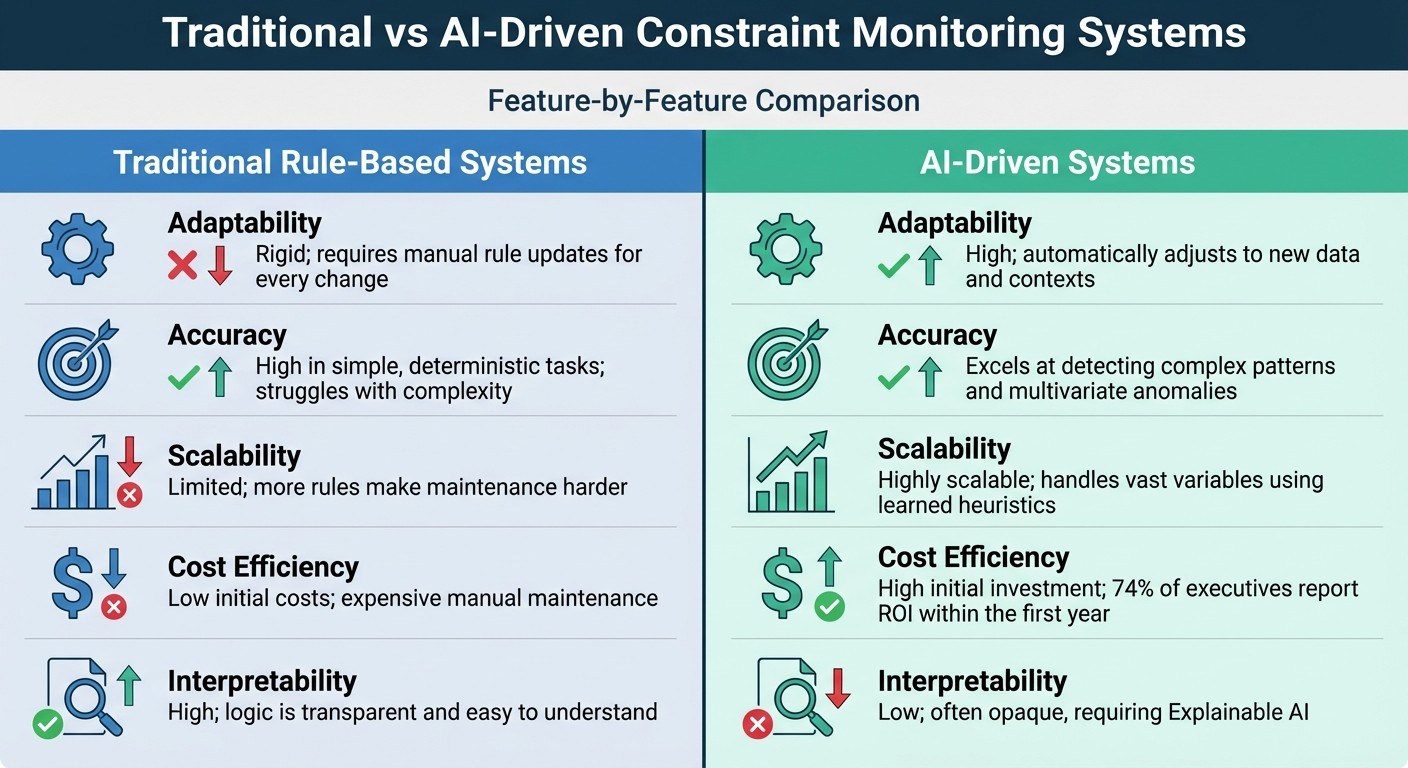
Traditional vs AI-Driven Constraint Monitoring Systems Comparison
Traditional systems and AI-driven systems each bring their own strengths and challenges, making it essential for organizations to evaluate them carefully. Traditional systems thrive in predictable, stable environments. They are highly transparent - every "if-then" rule can be traced and audited with ease. Additionally, their setup costs are relatively low since they rely on pre-existing expert knowledge rather than requiring vast datasets. But there's a downside: they're rigid. Any process change means manually updating rules, which drives up maintenance costs over time.
AI-driven systems, on the other hand, offer a different dynamic. They can adjust automatically to new data and evolving conditions through continuous learning. These systems excel at identifying hidden multivariate patterns that often escape human notice, which helps reduce false alarms. Giovanni De Gasperis from Università degli Studi dell'Aquila highlights this shift:
"The future of industrial monitoring is in intelligent, integrated systems that leverage both expert knowledge and data-driven insights".
However, AI systems come with their own challenges. They require significant upfront investment in specialized skills and infrastructure. Moreover, their "black box" nature makes them less transparent, often requiring Explainable AI techniques to meet regulatory and operational standards.
Here’s a side-by-side comparison to illustrate the differences:
The financial dynamics of AI systems stand out. A striking 74% of executives report achieving ROI within the first year of deploying AI agents, and by the end of 2025, 85% of enterprises are expected to have implemented AI agents.
Dr. Lisa Lang, President of Science of Business, provides a thought-provoking perspective:
"AI does not eliminate constraints. It moves them upstream. When execution becomes cheap, the bottleneck is no longer speed or tools. It's problem selection, framing, and system design".
This insight underscores a critical point: organizations need to cultivate Critical Systemic Judgment - the ability to define and frame problems effectively. AI magnifies the impact of both well-made and poorly made decisions.
Case Study: Rebel Force's AI-Integrated Enablement Systems
Rebel Force has developed a structured framework that focuses on achieving measurable business outcomes. Their methodology is divided into four key phases - Diagnose, Design, Execute, and Validate - each targeting specific operational bottlenecks to streamline processes and improve performance.
The process begins with the Diagnose phase, where AI and data specialists analyze organizational data to identify the primary constraint hindering operational flow. This step combines rapid AI detection with manual contextual reviews to ensure accuracy. Once the constraint is identified, the Design phase comes into play. Here, a tailored Enablement Blueprint is created, integrating automation and analytics to address the identified bottleneck effectively.
In the Execute phase, cross-functional teams - called Rebel Flow Units - implement AI-driven workflows during focused sprints that last between 12 and 48 weeks. These teams consist of AI specialists and process designers who collaborate with the client’s staff, ensuring the new systems integrate smoothly with existing operations. Finally, the Validate phase uses AI tracking to measure key metrics such as ROI, throughput, and "compound learning" - a term Rebel Force uses to describe the insights gained from each cycle to refine future processes. This systematic approach reflects the precision and flexibility that AI-driven systems can offer.
The results of this methodology speak for themselves. Rebel Force has reported a 70% ROI and has successfully optimized over 220 processes. In another use case, Rebel Concept saw a three- to fourfold increase in speed for Design for Manufacturing and Assembly services by leveraging AI-driven scripts compared to traditional methods. Projects are delivered using fixed-price sprints with clear ROI targets, avoiding the unpredictability of hourly billing. A standout feature of Rebel Force’s approach is their exit strategy: they ensure client teams are fully trained to manage the AI processes independently once the project ends. This self-sufficiency allows organizations to scale and continue improving their systems long after the initial implementation.
Conclusion
Traditional methods are increasingly being replaced by AI-driven systems that are more flexible, precise, scalable, and cost-effective. Companies adopting AI have reported productivity boosts of 20–40%, while finance leaders using AI to handle document-heavy workflows have seen cycle times drop by as much as 70%.
This transformation highlights a shift in focus. Instead of prioritizing execution speed, AI's role pushes constraints upstream to what Dr. Lisa Lang, President of Science of Business, calls "Critical Systemic Judgment." This allows organizations to redirect human expertise towards high-impact, strategic decisions while relying on AI to manage routine, high-volume tasks.
Cost savings are another major benefit. For example, logistics companies using AI-driven constraint programming have achieved 15–30% reductions in shipping costs. Similarly, event-driven monitoring can completely eliminate monitoring API costs by cutting out unnecessary polling processes.
For businesses in the U.S. Virgin Islands and elsewhere, AI offers an opportunity to break through operational barriers. By targeting high-friction processes, companies can unlock immediate benefits. The key lies in identifying individuals with strong critical judgment and equipping them with powerful AI tools to amplify their impact. As Satya Nadella aptly put it:
"The real value of AI shows up when it allows organizations to do things they could not afford to do before".
The real question isn't whether to adopt AI-driven systems - it’s how quickly organizations can implement them to remain competitive in an increasingly automated world.
Rebel Force serves as a compelling example of this shift. Their success with AI in dynamic constraint monitoring illustrates how these technologies can revolutionize operations, driving measurable results and long-term growth.
FAQs
What data do we need to start AI constraint monitoring?
To get started with AI constraint monitoring, you’ll need object-centric event logs (OCELs). These logs track interactions between multiple objects, such as orders, items, and deliveries. They should include detailed, time-stamped events and specific attributes for each object. With this data, AI can create object-centric constraint graphs (OCCGs), analyze how objects interact, and pinpoint violations. This provides a clear understanding of process constraints and actionable insights for improvement.
How can AI monitoring be made explainable for audits?
To ensure AI monitoring is clear and accessible for audits, it's essential to use detailed logging and tools that make decision-making easier to understand. Some key practices include:
Logging AI activities: This involves tracking decision flows and tool usage to provide a clear record of the system's operations.
Visual dashboards: These help present complex processes in an easy-to-digest format for auditors and stakeholders.
Feature attribution methods: Techniques like SHAP (SHapley Additive exPlanations) can highlight which inputs influenced specific decisions.
Additionally, real-time anomaly detection and customized metrics can pinpoint biases or irregularities as they happen. These steps not only improve transparency and traceability but also ensure the system complies with audit standards. By implementing these practices, organizations can build trust and maintain accountability in ever-changing environments.
How fast can we get ROI from an AI monitoring rollout?
ROI from implementing an AI monitoring system can often be seen in as little as 90 days. These systems help businesses cut down on outages, reduce unnecessary alerts, and speed up repair times. By detecting and resolving issues more quickly, companies can achieve noticeable gains in efficiency and save on operational costs.