
AI Enablement
How to Align Culture with AI Transformation Goals
Organizations often invest heavily in AI but fail to see results because their workplace mindset isn't ready to support it. 86% of employers expect AI to reshape their business by 2030, yet 0% of HR leaders feel fully prepared for implementation. The gap? It's not the tech - it’s how people and processes adapt to it.
Here’s the takeaway: For AI to deliver results, you need to align your goals with how your team works and thinks. This means:
Building trust by showing employees AI is there to support - not replace - their roles.
Encouraging safe experimentation with AI tools, so people feel comfortable learning and trying new things.
Setting clear, measurable goals tied to business priorities, like improving productivity or reducing errors.
Offering role-specific training to ensure everyone knows how to use AI effectively.
Establishing governance systems to monitor AI’s impact and ensure ethical use.
Companies like Morgan Stanley and McKinsey have seen success by involving employees early, providing hands-on learning, and clearly communicating AI’s purpose. The result? Adoption rates as high as 98%, proving that when people feel supported, they embrace new tools.
Want to make AI work for your business? Start with your team. Evaluate where they stand today, address barriers like fear or unclear communication, and create a shared vision for how AI fits into your company’s future.
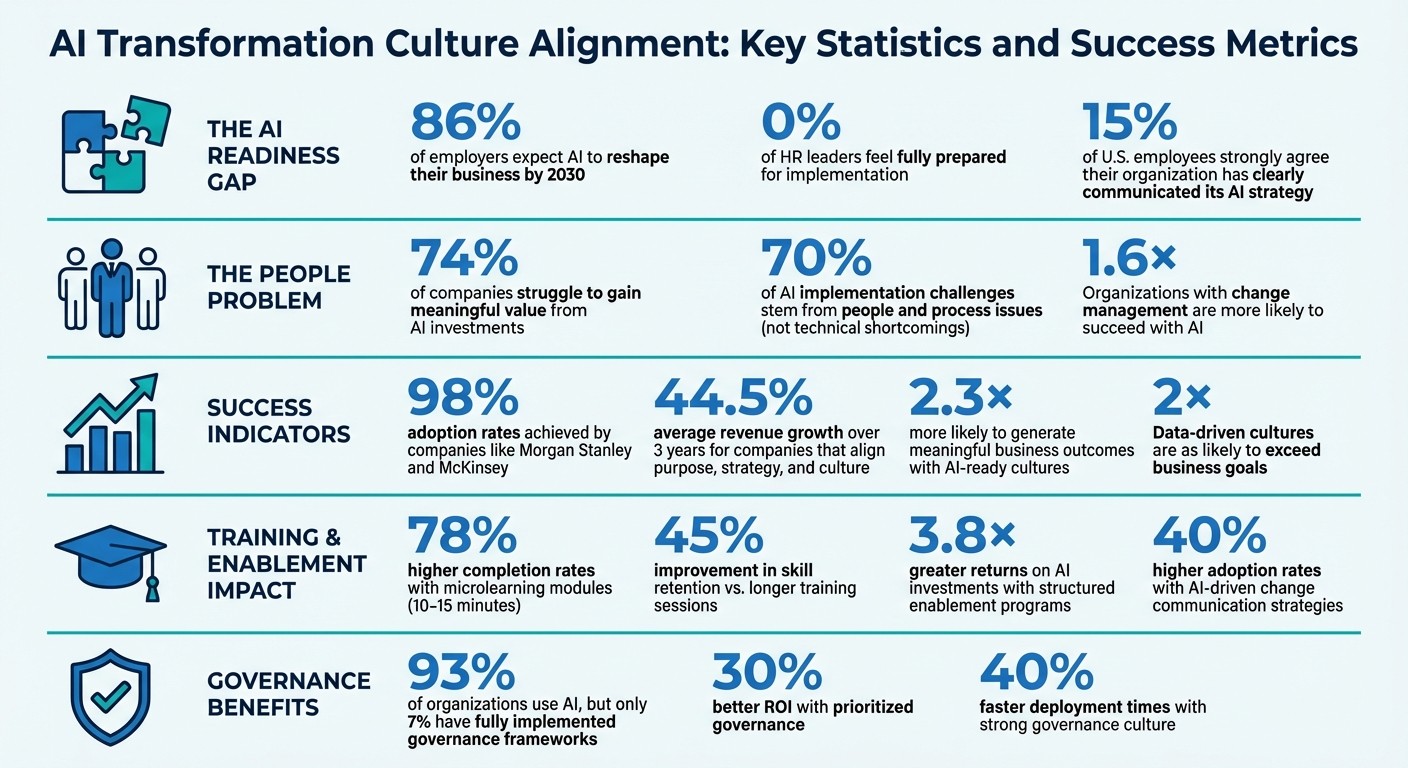
AI Transformation Culture Alignment: Key Statistics and Success Metrics
How Can You Ensure AI Transformations Align with Your Organization’s Goals? | Karie Willyerd
Assessing Your Current Culture for AI Readiness
Evaluating your organization's readiness for AI isn't about ticking off a checklist. It's about understanding the attitudes, behaviors, and structures that influence success. Here's a reality check: about 74% of companies struggle to gain meaningful value from their AI investments, and nearly 70% of challenges in implementing AI stem from people and process issues, not technical shortcomings.
Investing in change management can make a big difference - it increases your chances of AI success by 1.6×. But it all starts with taking a good, hard look at your organization's cultural landscape.
Using Data to Understand Your Culture
Your organization generates cultural signals constantly, and these can provide valuable insights. AI-powered sentiment analysis is one way to tap into these signals. Using Natural Language Processing (NLP), tools can analyze employee communications across platforms like Slack, email, and feedback forms to uncover patterns of stress, resistance, or alignment with your organization's values. Tools like Glint, Culture Amp, and Microsoft Viva Insights help track emotional trends, stress levels, and value alignment in real time.
But sentiment alone isn't enough. You also need to assess specific readiness factors. Tools like the Korn Ferry AI Impact Score can measure leadership alignment, digital literacy, mindset, and psychological safety - key predictors of whether your team will embrace AI. And these aren't just "soft" metrics. Data-driven cultures are shown to be twice as likely to exceed business goals.
Andrew Beers, Chief Technology Officer at Tableau, puts it bluntly: "In order for there to be AI success, people will have to change their relationship with data".
This shift in mindset is often reflected in how teams measure success. Are they moving from activity-based metrics, like "number of reports generated", to impact-based metrics, such as "quality of insights delivered"? That transition is a strong indicator of AI readiness.
Before rolling out AI on a larger scale, consider running a telemetry test to ensure your dashboards accurately track usage, time-to-competence, and task quality. Without measurable data, you're essentially guessing.
These insights help pinpoint potential roadblocks, allowing you to address them before they hinder your AI adoption efforts.
Identifying Barriers to AI Adoption
Barriers to adopting AI often hide in plain sight - in fears, outdated systems, and siloed structures. Start by examining how well your organization communicates its AI strategy. Only 15% of U.S. employees strongly agree that their organization has clearly communicated its AI strategy. Without understanding the "why" behind AI, resistance is almost guaranteed.
Fear can also be a telling sign. Interestingly, high-performing organizations report twice as much fear about AI compared to low-performing ones. This fear, when paired with strong change management, can actually signal a willingness to embrace bold, transformative goals. The key isn't eliminating fear but addressing it with open communication and comprehensive training.
Watch out for red flags like these: decisions driven by hierarchy or intuition instead of data, departments hoarding data and budgets, training treated as a one-and-done compliance exercise, or leaders leaving AI strategy entirely to IT without personal involvement. These patterns suggest a culture that isn't ready for AI.
Eileen Vidrine, Chief Data Officer for the U.S. Department of the Air Force, highlights the importance of collaboration: "It's really about working together, building collaborative, trusted partnerships. In organizations where that may be lacking, it's imperative to support trust- and relationship-building to break down silos".
Take a closer look at how AI will impact specific roles and tasks. Instead of focusing on broad job descriptions, identify which steps will be removed, added, or shifted. This detailed view can help you anticipate where resistance might arise and where extra support is needed. To manage the changes effectively, establish a cross-functional forum with representatives from HR, IT, Legal, and Operations. This team can coordinate your change initiatives and avoid "change fatigue" by limiting overlapping efforts.
Defining AI Transformation Goals and Aligning Culture
After evaluating your organization's readiness for change, the next step is to define what AI transformation means for your business - and ensure that everyone is aligned. This isn't just about drafting a tech roadmap; it's about tying AI to your company’s core mission and making it an integral part of everyday operations, not a standalone effort.
Using the insights gained from your cultural assessment, set clear and actionable AI goals that align with your top business priorities. For example, focus on objectives like reducing customer churn, boosting revenue, or enhancing operational efficiency. Avoid vague ambitions such as "improve decision-making" and instead aim for specific milestones like "achieving 90% forecast accuracy" or "automating 50% of invoice processing". These precise goals not only enhance accountability but also reflect a cultural shift toward measurable, data-driven achievements. The next step is to rally your team around these objectives by crafting a shared vision.
Creating a Shared Vision for AI
A shared vision isn’t something that can be achieved with a single memo from leadership. It requires a well-thought-out narrative that addresses both the business case for AI and the concerns of employees. According to research, employees are 4.7 times more likely to feel comfortable using AI when they strongly agree that their leaders have a clear plan for it. Yet, only 15% of U.S. employees report that their organization has communicated a clear AI strategy. Leaders need to explain AI’s role in simple, relatable terms. What will change? What will stay the same? How will AI enhance employees' ability to perform rather than just speed up processes?
Encouraging transparency is also crucial. When senior leaders openly share their own AI experiments - including challenges and failures - it reinforces the importance of safe experimentation.
Organizations that align their purpose, strategy, and culture around AI have seen an average revenue growth of 44.5% over three years. Achieving this requires appointing a C-suite executive sponsor to champion AI initiatives, secure funding, and mediate cross-departmental issues. It also involves reevaluating performance metrics. Replace measures that reward "busyness" (like hours worked or the number of reports produced) with metrics that emphasize impact, such as the quality of insights generated or the number of problems effectively solved.
Once your vision is clear, the next step is to integrate AI into your organization’s core values.
Embedding AI Into Core Values
For AI to truly take root, it must be aligned with your organization’s values, decision-making processes, and recognition systems. For instance, if customer service is a key value, AI should be framed as a tool that enhances service quality rather than merely a cost-saving measure. Statistics show that companies with AI-ready cultures are 2.3 times more likely to generate meaningful business outcomes from their AI investments.
Start by developing an AI playbook that outlines governance principles, data ethics, and operational guidelines. This document should be dynamic, evolving based on what your organization learns over time. Establish AI ambassador networks by selecting respected team members from various departments to mentor others and provide feedback to leadership. Additionally, link AI initiatives to incentives by incorporating AI-related metrics into performance reviews and recognizing teams that excel in leveraging AI effectively.
When culture and AI goals are aligned, technology adoption becomes a seamless part of your organization’s daily operations rather than a disconnected project.
Building AI Capabilities Through Targeted Enablement
Once your vision and values are aligned, the next step is ensuring your workforce is equipped with the skills to drive AI transformation. Interestingly, 70% of AI implementation challenges stem from people and process issues, not technical shortcomings. Tackling these challenges means focusing on empowering employees with the right, role-specific AI skills.
Investing in AI Training and Upskilling
Training works best when it’s tailored to the specific needs of each role. A marketing manager, for instance, doesn’t require the same AI expertise as a software developer or a finance analyst. Companies that succeed in this area often use persona-based training modules. These modules are designed for different roles - like Users, Leaders, Enablers, and Builders - ensuring that employees gain skills directly relevant to their day-to-day work.
Take Cisco’s "AI for Everyone" program, launched in fiscal 2025, as an example. It offered four persona-based modules, making AI education accessible to employees across various functions, regardless of their technical background. Similarly, Microsoft’s Copilot enablement program, rolled out from 2023 to 2025, trained 180,000 employees using role-specific learning paths to ensure AI became deeply integrated into every function. Another standout example is Unilever, which trained 30,000 employees on generative AI tools in just eight months through a structured enablement program.
How you deliver training matters just as much as the content itself. Microlearning modules, which are short, focused lessons lasting 10-15 minutes, have been shown to boost completion rates by 78% and improve skill retention by 45% compared to longer sessions. These bite-sized lessons allow employees to learn without disrupting their workflow. Pair this with hands-on sandboxes where teams can experiment with AI tools on low-risk projects, creating a safe space for practical learning.
To make AI fluency a lasting part of your organization, integrate it into your performance systems. When AI skills are factored into hiring, performance reviews, and promotions, employees understand that these competencies are essential, not optional. Organizations with well-developed AI enablement programs see 3.8 times greater returns on their AI investments compared to those with less structured approaches.
Leveraging Rebel Force Enablement Programs

Building AI expertise requires a systematic approach that links training to measurable outcomes. Rebel Force’s 4-phase enablement process - Diagnose, Design, Execute, and Validate - offers a clear framework for this. It ensures AI capabilities are developed with a focus on addressing real challenges and delivering tangible results, all while reinforcing the shared vision established earlier.
Diagnose: Identify gaps in technical skills, workflows, decision-making, and cultural readiness for AI.
Design: Create a customised enablement plan that aligns AI capabilities with specific business goals, ensuring training is practical and relevant.
Execute: Deploy dedicated enablement teams to work alongside internal staff, providing hands-on support to accelerate adoption.
Validate: Measure success through clear metrics to ensure your investment translates into improved performance.
This approach aligns with the 10-20-70 rule, which highlights that successful AI transformations allocate 10% of resources to algorithms, 20% to technology and data, and 70% to people and processes. By focusing heavily on enablement, organizations can achieve 25-30% faster implementation timelines and 40% higher adoption rates. Whether through 12-week Enablement Sprints for quick results or year-long programs for gradual change, the goal remains the same: building skills that stick and deliver measurable business outcomes.
Establishing Governance and Monitoring for Long-Term AI Integration
To make AI integration successful over the long haul, oversight and consistent tracking are non-negotiable. Building governance structures that align with your organization's values and AI goals is key. Without clear frameworks and monitoring systems, even the most skilled teams can lose direction. These structures ensure that AI's performance and its broader impact are regularly assessed.
Creating AI-Specific Governance Frameworks
Not all AI systems require the same level of scrutiny. For example, a chatbot summarizing meetings doesn't carry the same risks as an AI system approving loans or screening job candidates. By classifying projects based on risk, you can avoid overloading low-risk initiatives with unnecessary bureaucracy while giving high-stakes systems the attention they require.
Governance works best when it's a team effort. Data and AI teams must collaborate with legal, compliance, privacy, security, and business stakeholders to create practical frameworks. These frameworks should rest on four ethical pillars:
Fairness: Reducing bias in decision-making
Transparency: Making AI decisions understandable
Accountability: Assigning clear responsibility
Privacy and Security: Safeguarding sensitive data
Here’s a stark reality: while 93% of organizations use AI in some capacity, only 7% have fully implemented governance frameworks. This disconnect often leads to underwhelming results. On the flip side, companies that prioritize governance as part of their culture - not just as a compliance exercise - report 30% better ROI and 40% faster deployment times. As Neil MacGregor puts it:
"Governance without culture is just paperwork."
Operational controls are vital. Use tools like ethical-by-design checklists, mandatory release gates, and human-in-the-loop protocols for high-risk decisions. Incident response playbooks can help quickly address issues like bias or data breaches. Keeping standardized documentation - such as system summaries, data lineage, and evaluation results - ensures you're always audit-ready.
Many organizations start by adopting existing frameworks rather than creating policies from scratch. The NIST AI Risk Management Framework and ISO/IEC 42001 standards are great starting points that can be tailored to fit specific needs. Quarterly reviews help keep governance frameworks up to date as technology and regulations evolve, such as with the EU AI Act. Establishing an AI Center of Excellence can also centralize expertise while giving individual business units the freedom to execute.
Once these tailored frameworks are in place, the next focus should be on continuous monitoring to track both technical and cultural performance.
Monitoring Progress with Continuous Evaluation
After setting up your governance framework, the next step is to keep tabs on how well it’s working. This involves monitoring both the technical performance of your AI systems - like detecting model drift or bias - and the business outcomes they’re meant to achieve, such as ROI, customer satisfaction, or faster decision-making cycles.
Real-time dashboards can be a game-changer. By pulling data from communication tools, HR systems, and project management platforms, they give you a clear view of how AI is being used across the organization. But don’t just measure activity - focus on impact. For instance, instead of counting how many reports were generated, assess the quality of insights or how quickly decisions are being made.
Cultural health is just as critical as technical performance. Track qualitative metrics, such as how many employees can clearly explain your AI principles or how often governance questions come up during team discussions. Companies that use AI-driven change communication strategies see 40% higher adoption rates, and those with strong governance cultures report significant time savings - up to 70% for audit preparation and 60–80% for creating model documentation. These efforts reinforce psychological safety and adaptability, keeping cultural alignment intact.
Take Singtel, for example. In October 2024, the company partnered with Nanyang Technological University to launch the "AI Acceleration Academy", training over 10,000 employees. They implemented monitoring systems to track AI literacy and skill development across the organization. This structured approach ensures that training efforts translate into measurable improvements.
AI adoption isn’t a one-and-done process - it evolves through stages: Foundation (0–6 months), Piloting (6–18 months), Scaling (18–36 months), and Transformative (36–48 months). Your monitoring systems should adapt as your organization progresses through these phases. Regular audits for algorithmic bias and human-in-the-loop checks ensure that AI recommendations align with ethical standards before they’re put into action.
Conclusion
Bringing culture in sync with AI transformation isn’t just a nice-to-have - it’s what separates expensive, unused tools from systems that deliver real business results. Companies that successfully align their purpose, strategy, and culture report an average revenue growth of 44.5% over three years.
To move forward, focus on three key actions:
Assess your current culture: Use data to uncover barriers and pinpoint areas for improvement.
Develop capabilities through targeted training: Role-specific education can drive a 61% increase in discretionary effort.
Establish strong governance frameworks: Organizations that excel here see a 30% higher ROI and a 40% faster time-to-production.
This approach ensures you’re tracking meaningful outcomes, not just activity. Instead of counting how many AI tools you’ve rolled out or how many training sessions you’ve completed, measure tangible results - like faster decision-making, fewer errors, and increased revenue. Data-driven organizations are twice as likely to exceed their business goals significantly.
But remember, culture change is a process, not an event. As your AI initiatives grow, your governance, monitoring, and team enablement strategies must evolve too. The most successful organizations treat AI as part of an ongoing cultural journey, using feedback to refine their strategies. They invest in change management, which makes AI projects 1.6 times more likely to surpass expectations. They also foster an environment where experimentation feels safe and adaptability is part of the norm.
When culture and AI goals align, you’re not just deploying new tools - you’re creating an organization ready to thrive in an ever-changing technological landscape.
FAQs
How can we tell if our culture is AI-ready?
An organization prepared for AI thrives on learning, teamwork, and data-driven choices. You’ll notice this readiness when leadership actively backs AI projects, employees are eager to expand their knowledge, and teams from different departments work seamlessly together.
Other signs? A culture that values transparency, encourages creative thinking, and isn’t afraid to learn from failure. Companies that tackle employee concerns head-on, promote AI understanding, and keep the conversation open about ethical considerations are usually well-positioned to embrace AI successfully.
How can we reduce employee fear of AI?
To ease employee concerns about AI, prioritize trust and transparency. Start by communicating openly about AI's role in the workplace - emphasize how it complements tasks rather than replacing jobs. Offer clear examples of how AI can make roles more efficient or less repetitive.
Provide step-by-step training to ensure employees feel equipped to work alongside AI tools. Breaking lessons into smaller, manageable chunks can make the learning process less intimidating. Encourage peer-to-peer learning, where colleagues share tips and experiences, creating a support system within the team.
Actively seek feedback from employees during the transition. Show them how AI aligns with the company's goals and their own professional growth. This approach fosters collaboration and helps build confidence as the organisation integrates AI into its processes.
What should we track to prove AI ROI?
To show the return on investment (ROI) from AI, focus on tracking key metrics like financial gains, revenue increases directly tied to AI, reductions in operational costs, and how quickly results are achieved. It's also important to keep an eye on usage rates, how well employees are adopting AI tools, and the tangible outcomes of AI-driven projects. These metrics provide a clear picture of AI's impact and help refine efforts to align with broader strategic objectives.