

AI Enablement
What Is an Enablement Blueprint and Why You Need One
An Enablement Blueprint is a structured plan to help organizations effectively integrate AI into their operations. With 92% of enterprises planning to increase AI investments in the next three years, many still struggle to achieve meaningful results. This framework addresses common challenges, such as fragmented rollouts and unclear objectives, by focusing on three key areas:
Technology: Embedding AI into workflows rather than treating it as an add-on.
Processes: Streamlining operations to improve efficiency and reduce manual effort by up to 30–80%.
People: Ensuring teams are prepared for AI adoption, from leadership to employees.
Without a clear strategy, 80% of AI projects fail, and only 30% move beyond the pilot phase. A well-designed blueprint ensures AI aligns with business goals, tracks ROI, and drives measurable outcomes like faster cycle times, higher accuracy, and cost savings. Whether it’s automating repetitive tasks or improving decision-making, this approach transforms how organizations operate.
Key benefits include:
Reducing errors and saving time
Boosting revenue through better processes
Enhancing team productivity
This article explains how an Enablement Blueprint works, its core components, and how to build one for your organization.
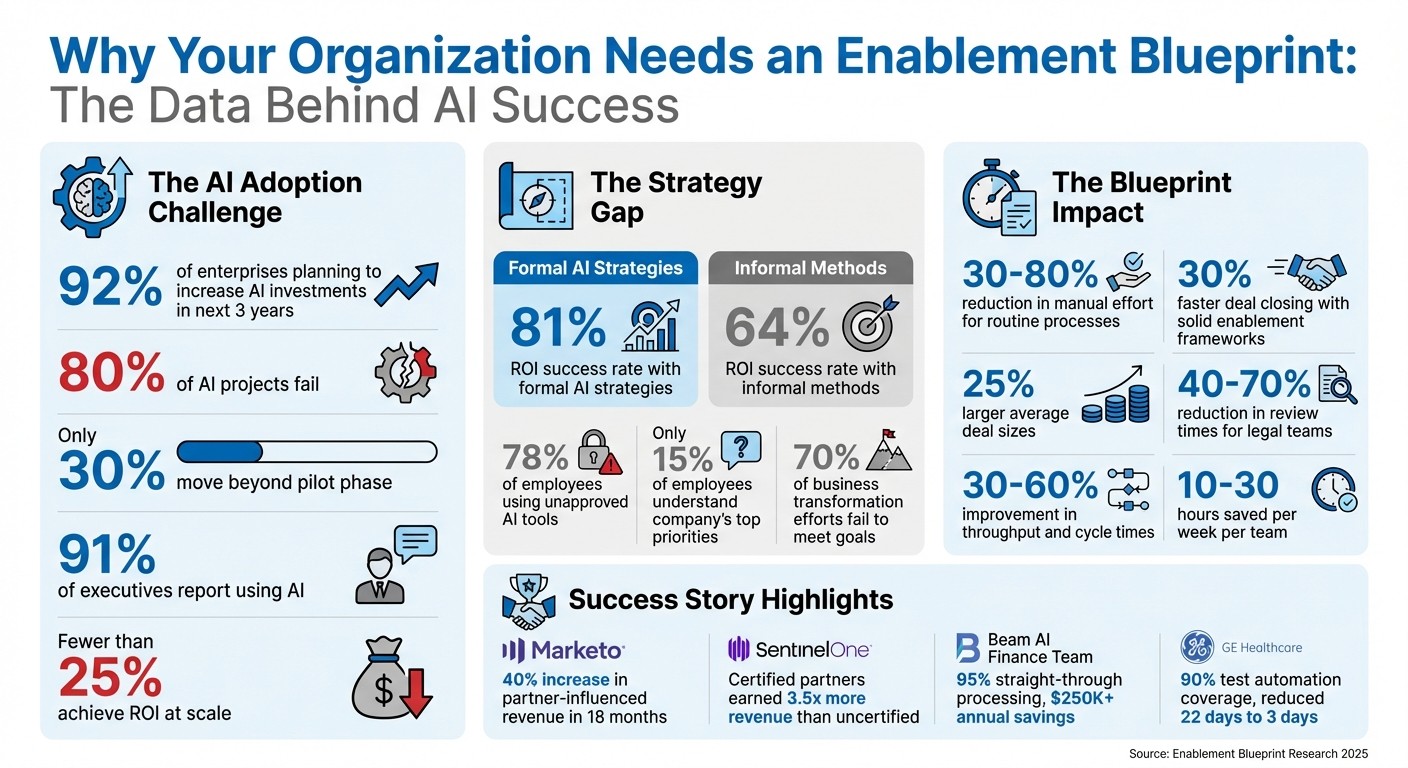
AI Enablement Blueprint: Key Statistics and Success Metrics
What Is an Enablement Blueprint?
Definition and Purpose
An Enablement Blueprint is an execution-focused methodology designed to modernize how organizations operate, serving as a kind of "operating system" for integrating AI into business processes. At its core, it’s a roadmap that bridges where your organization is today and where it wants to go with AI-driven operations.
The main goal of this blueprint is to move away from isolated AI experiments and toward fully integrated, transformative systems. When AI is treated as a "bolt-on" solution, it remains disconnected from core workflows. But with "built-in" AI, the technology becomes an integral part of the process architecture, enabling enterprise-wide transformation. As Dan Diasio, EY Global AI Consulting Leader, puts it:
"EY.ai Value Blueprints takes a different approach by looking to build the organization of the future from the ground up, with autonomous systems fully integrated - not just added on later."
This framework addresses common pitfalls in AI adoption, such as fragmented rollouts and unclear objectives. It ensures that AI integration aligns with business priorities. This is especially crucial given that 95% of HR leaders report limited involvement in AI implementation, and nearly 50% of work activities could technically be automated. Without a structured plan, companies risk creating chaotic, disconnected systems - akin to the "Winchester Mystery House" effect, where tools are added without a cohesive strategy.
Understanding this framework lays the foundation for exploring how it can deliver measurable results.
Key Features of an Enablement Blueprint
An effective Enablement Blueprint is built around three interconnected components:
Data-driven diagnostics: This step evaluates your organization’s readiness by mapping current processes, identifying inefficiencies, and assessing technical capabilities. It creates a clear starting point for AI integration.
Tailored process design: This involves crafting AI-driven workflows with clearly defined roles and responsibilities. Whether it’s leveraging large language models, robotic process automation, or hybrid solutions, this phase focuses on designing workflows with built-in triggers and safeguards. Structured AI blueprints can save teams 10–30 hours per week in specific areas, while improving throughput and cycle times by 30–60%.
ROI tracking: Measuring the impact of AI is essential. This includes tracking metrics like cycle times, error rates, hours saved, and financial outcomes. For instance, in December 2025, a global healthcare client partnered with EY to implement an AI Value Blueprint for their "Order to Cash" process. By automating and streamlining workflows, they reduced manual tasks, improved customer self-service, and enhanced revenue protection, while freeing up working capital.
The blueprint typically unfolds in four to six phases, covering discovery, process prioritization, data readiness, workflow design, and ongoing governance. This structured approach ensures that AI integration delivers tangible business benefits.
Try This AI Enablement Sprint Blueprint to Innovate Faster ⚡
Why Your Organization Needs an Enablement Blueprint
While 91% of executives report using AI, fewer than 25% manage to achieve ROI at scale. Without a clear strategy, businesses often fall into reactive habits that fail to align with their core objectives.
Consider this: Around 70% of marketing content goes unused, and sales teams waste valuable hours hunting for the information they need. Meanwhile, 78% of employees are already using unapproved AI tools, often exposing sensitive company data to compliance risks.
An Enablement Blueprint offers a structured approach to these challenges, linking AI adoption directly to measurable outcomes. Companies with formal AI strategies are 81% more likely to see positive ROI, compared to just 64% for those relying on informal methods.
Take Marketo, for example. In April 2025, they introduced a structured enablement plan, tailoring tools and strategies for different partner categories. The result? A 40% increase in partner‑influenced revenue within 18 months. Similarly, SentinelOne implemented a tiered certification system for partners. Those achieving the highest certification level earned 3.5 times more revenue than uncertified partners in just six months.
As Kunal Pandya, Founder & CEO of Sales Velocity Labs, aptly points out:
"Without a clear strategy where your enablement activity is connected directly to business outcomes, enablement stays undervalued and far from the decision-making table".
A well-defined blueprint ensures every initiative contributes to growth, efficiency, and competitive advantage. It provides a roadmap for meaningful, measurable transformation.
Driving Measurable Outcomes
The power of an Enablement Blueprint lies in its focus on results, not just activity. Traditional methods often track surface-level metrics like training hours or participation rates. In contrast, a blueprint shifts attention to what truly matters: pipeline velocity, win rates, cycle times, and revenue growth.
This focus is crucial because 70% of business transformation efforts fail to meet their goals. Instead of relying solely on lagging indicators, a blueprint emphasizes "lead measures" - predictive actions that teams can directly control.
The benefits are clear. Organizations with solid enablement frameworks close deals 30% faster and see 25% larger average deal sizes. For example, in 2025, Beam AI introduced a Three‑Way Match System for a finance team spending over 30 hours weekly on manual tasks. The result? 95% straight‑through processing, zero payment errors, and annual savings of over $250,000.
Legal teams also reap rewards. AI-driven clause reviews cut review times by 40–70%. Another company processing over 10,000 documents monthly implemented a Beam AI system, achieving 99.9% accuracy, 90% faster processing speeds, and saving more than 50 FTE hours for higher-value tasks.
These examples highlight how a blueprint can drive impactful, efficient automation.
Improving AI‑Driven Process Automation
AI automation thrives when applied to complete workflows. A blueprint helps identify the best candidates for automation by evaluating tasks based on volume, repeatability, and impact.
AI automation can reduce manual effort by 30–80% for routine processes. For example, AI-driven orchestration allows contact centers to resolve 40–60% of routine queries, freeing up time for more complex tasks.
Rachel Woods, Founder of DiviUp, explains the value of this approach:
"The real value comes when you automate entire processes - scaling what your team does best and unlocking 'infinite time' for the work only humans can do".
A blueprint also addresses common challenges like model drift, integration debt, and data readiness. By following a phased approach, organizations can monitor AI performance, manage ethical risks, and retrain models every 4–8 weeks to keep drift below 5%. Best practices suggest allocating 40% of initial funds to data preparation and integration, 30% to tools, and 20% to talent.
Enabling Scalable Business Transformation
Long-term growth requires more than quick fixes - it demands a foundation for ongoing transformation. A blueprint provides this by documenting the current state, defining future goals, and outlining the resources, timelines, and KPIs needed to bridge the gap.
This is especially important given that only 15% of employees typically understand their company’s top priorities. Without a shared framework, transformation efforts often become fragmented. A blueprint unites teams with a common language and clear direction.
Companies that empower their teams during multi-action transformations achieve 30% higher financial gains compared to those taking incremental steps. Structured approaches like the 4 Disciplines of Execution - focusing on key priorities, acting on lead measures, keeping score, and maintaining accountability - help ensure every effort contributes to sustainable growth.
Scalability becomes even more apparent with content adoption. Sales reps in well-organized environments locate content 3× faster, boosting efficiency by 26%. In such settings, adoption rates for Sales Plays are also 35 percentage points higher.
Finally, a blueprint prevents the digital replication of inefficient processes. By standardizing workflows before automation, businesses avoid embedding outdated methods into new technologies. As Gokhan Guley and Allison Stunja from Jabian Consulting emphasize:
"Business processes should be used as the blueprints to guide that journey".
Core Components of an Enablement Blueprint
A successful Enablement Blueprint is built on three key pillars, each addressing common pitfalls that cause most AI projects to fail. These include issues like misaligned stakeholders, poor data quality, and inadequate measurement systems.
Data-Driven Diagnostics
The process starts with a Current State Evaluation that catalogs processes, data systems, and stakeholders to establish a performance baseline. Teams track metrics like cycle time, cost per transaction, and error rates to identify areas where manual work drains resources.
This approach shifts AI initiatives from scattered pilot projects to a more structured, prioritized pipeline. Typically, organizations map out 50–100 processes and use a scoring model to identify the 20 workflows that account for 80% of manual effort.
Data readiness is another essential factor. As the saying goes, "AI fails fast on bad plumbing". Diagnostics help uncover issues like integration debt and poor data quality before deployment, preventing delays. For instance, in November 2025, GE Healthcare used an AI testing framework to create 240 automated tests in just three days - a task that previously took 22 days. This effort resulted in 90% test automation coverage and significantly reduced maintenance costs.
Once the groundwork is laid and clear baselines are set, the next step is to embed AI into workflows intentionally.
AI Integration and Tailored Process Design
After identifying opportunities through diagnostics, the focus shifts to designing processes that fully integrate AI. Instead of simply layering AI onto existing systems, the goal is to embed it at the core of operations.
A modular architecture plays a vital role here. This approach uses predefined, plug-and-play components, making it easier to integrate AI into new use cases. Todd Edmunds, Global CTO for Smart Manufacturing at Dell Technologies, highlights the importance of this shift:
"a paradigm shift"
in how organizations deploy plug-and-play tools.
Central to this design is an orchestration layer that coordinates requests, dependencies, and contextual information. This ensures seamless interaction between AI agents, data sources, and applications, avoiding the creation of new silos.
Dedicated Teams and ROI Tracking
With AI-powered processes in place, the final step is to assemble dedicated teams and establish robust ROI tracking mechanisms. These blueprints depend on specialized talent - success managers who blend technical AI skills with change management expertise. Their role is to guide organizations through both operational and cultural adjustments.
ROI tracking is broken into four key areas: Efficiency (time saved), Revenue (sales conversion improvements), Risk (compliance and security), and Experience (eNPS/CSAT). This layered approach ensures a focus on meaningful outcomes rather than superficial metrics. Ongoing measurement keeps workflows reliable and well-governed. Real-time dashboards provide visibility into metrics like task volumes, success rates, and hours saved, showcasing the business value delivered.
ROI Layer | Key Metric | Business Impact |
|---|---|---|
Efficiency | Time saved per task | (Time saved × Employee cost) - AI cost |
Revenue | Sales conversion rate | Incremental revenue from personalized outreach |
Risk | Compliance incident rate | Value of fines or data breaches averted |
Experience | eNPS / CSAT | Retention and loyalty; reinvested time in strategy |
Building on the core components outlined earlier, Rebel Force refines its approach with a structured 4-phase process designed to ensure effective execution.
Rebel Force's 4-Phase Enablement Process

Rebel Force’s Enablement Blueprint is implemented through four carefully designed phases, guiding organizations from initial analysis to measurable outcomes. Each phase builds on the one before, creating a clear path from diagnosis to ROI. This structured approach tackles a common challenge: nearly 80% of AI projects fail to meet expectations, often due to poor execution strategies.
Phase 1: Diagnose
The Diagnose phase begins with a deep dive into key departmental processes. Using tools like process mapping, time studies, and log analysis, teams measure cycle times and error rates. Workflows are evaluated based on frequency, pain points, and data readiness, resulting in a prioritized list of automation opportunities. The focus is on identifying the top 20 workflows that account for 80% of manual effort. Baseline KPIs are then established to guide the automation strategy. These insights lay the groundwork for a more targeted design phase.
Phase 2: Design
Building on the diagnostic findings, the Design phase creates a customized roadmap for AI deployment. This roadmap spans 6–18 months and focuses on implementing a minimum viable AI solution rather than attempting to automate everything at once. During this phase, decision-making logic is documented, and clear guidelines are established for when AI should defer to human oversight. Deliverables include system architecture diagrams, resource plans, and "AI Playbooks" - detailed SOPs outlining task execution for AI agents. As Rachel Woods, Founder of DiviUp, puts it:
"The real value comes when you automate entire processes - scaling what your team does best and unlocking 'infinite time' for the work only humans can do."
Phase 3: Execute
In the Execute phase, AI agents are integrated with core systems like ERP, CRM, and data warehouses, with permissions carefully scoped to ensure secure operation. Pilot programs are launched in "shadow mode", where AI provides recommendations but humans retain decision-making authority. This approach fosters trust and validates AI performance before granting full autonomy. The goal is to reduce manual process steps by 30–50%. To ensure reliability, teams establish data contracts to prevent schema drift and use both deterministic checks and generative reasoning to validate AI actions in real time.
Phase 4: Validate
The Validate phase focuses on ensuring long-term success. Production pipelines are set up to monitor performance, detect data drift, and flag SLA breaches in real time. Alerts are configured for issues like latency exceeding 200 milliseconds or accuracy dropping by more than 5%. Monitoring dashboards provide visibility into task volumes, success rates, and hours saved. Organizations receive detailed ROI reports and a 12-month roadmap for scaling AI solutions from pilots to full production. This phase confirms that implemented changes deliver measurable improvements in efficiency, revenue, risk management, and employee satisfaction.
How to Build Your Own Enablement Blueprint
Assess Organizational Readiness
Before diving into AI integration, it’s crucial to evaluate where your organization currently stands. Start by securing a C-level sponsor who can champion the initiative, provide funding, and articulate the vision for AI adoption. This leader’s support ensures the strategy has both credibility and momentum within the organization. Alongside this, appoint a Directly Responsible Individual (DRI) - a program director tasked with managing the enablement process and overseeing the lifecycle of AI tools.
To get a clear picture, assess your organization across ten critical areas: strategy, leadership, data, technology, talent, ethics, culture, operating models, finances, and partnerships. This evaluation helps uncover potential gaps that could hinder progress. For instance, only 21% of companies currently have adequate GPU capacity for their AI needs, while 78% of employees are already using unauthorised AI tools - often involving sensitive company data.
To focus your efforts, identify 50–100 workflows and zero in on the top 20 that account for 80% of manual work. Use metrics like cycle time and error rates to establish a baseline for improvement. A comprehensive readiness assessment can often be completed in just 10 days.
Define Goals and Map AI Use Cases
Every AI initiative should be tied directly to a business goal. Avoid treating AI as a tech experiment; instead, align each use case with a clear objective. For each, document three elements: the Goal (the general purpose), the Objective (the specific outcome you’re aiming for), and the Success Metric (a measurable indicator of success). Organizations with formal AI strategies are far more likely - 81% versus 64% - to see a positive ROI.
Prioritize potential use cases using an impact-versus-complexity matrix. Focus on initiatives with a payback period of under 12 months. Classify each use case by its ROI category: Enablement (adding new capabilities), Cost Savings (reducing expenses), or Productivity Gains (freeing up time for strategic tasks). Start small and practical by targeting low-risk, high-clarity processes. This approach builds confidence and momentum before tackling more complex workflows. Remember, about 50% of work activities are technically automatable. With clear goals and mapped use cases, you’ll be ready to apply the structured framework to make your blueprint a reality.
Apply Rebel Force's 4 Phases
Use the four-phase framework - Diagnose, Design, Execute, and Validate - to guide your blueprint development. This structure ensures a smooth transition from analysis to actionable results. Plan for 3–5 pilot projects, focusing on creating minimum viable AI solutions rather than attempting large-scale automation from the start. Early pilots should enhance human decision-making, which helps build trust in AI while verifying its effectiveness. Don’t dismiss less successful use cases entirely; as AI technology evolves, previously challenging projects may become feasible.
Track and Measure Outcomes
Once your pilots are up and running, track their progress closely to ensure they’re delivering the expected results. Set up dashboards to monitor metrics like task volumes, success rates, and efficiency improvements. These tools help you measure the impact of your blueprint against the KPIs established during the Diagnose phase. Generate detailed ROI reports and create a roadmap to scale successful pilots into full production.
Keep in mind that AI’s efficiency gains often translate into higher-quality work, rather than just cost reductions. Monitor key areas like efficiency, revenue, risk, and employee satisfaction to ensure your blueprint is delivering value across the board. This ongoing evaluation will help you refine your strategy and sustain its impact over time.
Conclusion
An Enablement Blueprint can be the difference between AI pilots that fizzle out and those that drive lasting transformation. Consider this: while 91% of middle-market executives are already using AI, fewer than 25% manage to achieve ROI at scale consistently. As one industry leader aptly stated:
"Companies fail at AI adoption because they treat it like installing software when it's actually rewiring how people work".
This quote highlights the importance of a well-structured approach. A blueprint helps shift organizations from random experimentation to streamlined, autonomous processes, all while addressing eight critical pillars. With 78% of employees already using unapproved AI tools, the real question isn’t whether AI will change your operations - it’s whether you’ll steer that change thoughtfully or let it unfold without direction.
The numbers speak for themselves: organizations with formal AI strategies report positive ROI 81% of the time, compared to just 64% for those relying on informal methods. Starting with manageable tasks like meeting summaries or drafting emails can help you gain early wins, build trust, and turn skeptics into advocates. Since AI maturity remains a challenge for many leaders, the urgency to establish a competitive edge cannot be overstated.
In short, an Enablement Blueprint lays the groundwork for scalable AI success. With 92% of enterprises planning to boost AI investments over the next three years, those that focus on building human infrastructure - not just purchasing software - will come out ahead. Start small, track your progress rigorously, and let your blueprint guide an enterprise-wide transformation.
FAQs
What should my first AI workflow be?
When implementing your first AI workflow, focus on a specific, high-impact process that’s ripe for automation. Start by taking a close look at your existing workflows to pinpoint areas that slow things down or create inefficiencies. The ideal target? A repetitive, data-heavy task that has clear ownership - think invoice approvals or data entry.
As you design the workflow, make sure to include clear decision points, triggers for human involvement, and measurable outcomes. This structure not only helps streamline the process but also ensures the results are easy to track. By starting here, you’ll quickly see benefits like improved accuracy and efficiency, all while setting the stage for more advanced AI integration down the line.
How long does it take to see ROI?
The timeline for experiencing ROI from an Enablement Blueprint varies based on your organization's goals and how well the plan is implemented. Many companies notice measurable outcomes within a few months to a year, especially when AI tools are seamlessly woven into daily workflows and aligned with broader strategic goals. The key to success lies in having a well-defined plan and executing it consistently to suit your specific operational requirements.
What roles do we need to run this?
To put an Enablement Blueprint into action, assembling a team with diverse expertise is crucial. You'll need strategic leaders to outline clear objectives, technical experts such as AI engineers and data scientists to develop the necessary solutions, and change management professionals to ensure smooth adoption within the organization. Governance roles are also vital to uphold compliance and ethical standards. Collaboration across different functions helps align efforts with business goals and ensures seamless integration across teams.