
Operational Excellence
5 Signs Your Organization Has Flow Problems
When your organization struggles with flow, it impacts productivity, morale, and revenue. These issues often show clear warning signs, and addressing them early can prevent larger disruptions. Here are five key indicators that your workflows might be out of sync:
Recurring Bottlenecks: Delays in approvals or overwhelmed processes slow everything down.
Uneven Resource Allocation: Some teams are overworked while others remain underutilized.
Slow Decision-Making: Excessive approval layers create frustrating delays.
Inconsistent Output: Errors and rework signal broken or misaligned workflows.
Low Employee Engagement: Disengaged teams lead to reduced productivity and higher turnover.
The good news? Tools like Rebel Force leverage AI to identify and fix these problems, offering solutions like process mining, predictive analytics, and automation to streamline workflows and improve efficiency. These tools help you spot issues early, reallocate resources effectively, and keep your organization running smoothly.
5 Signs Your Organization Has Workflow Problems
1. Repeated Bottlenecks in Process Execution
Observable Symptoms Within the Organization
Bottlenecks often show up when certain stages of a process become overwhelmed, leading to backlogs that seem impossible to clear. Deadlines are missed because one critical step slows everything down. Under pressure, teams may make mistakes, creating a frustrating cycle of rework and delays. Another common sign? Processes grind to a halt when approvals depend on a single person. These symptoms point to deeper inefficiencies that ripple through the entire operation.
Skyler Badenoch, CEO of Hope for Haiti, captures the essence of this challenge:
"As an organization grows, communication starts to bottleneck. At Hope for Haiti, we've seen those inefficiencies hurt us: when we can't run like a well-oiled machine, we're not serving as many people as we could be - and it's our responsibility to improve upon that."
Impact on Operational Efficiency
When bottlenecks slow down processes, the entire operation suffers. Resources sit idle, costs creep up, and productivity takes a hit. Experts refer to this as an "invisible drag", where teams and tools aren't being fully utilized. Over time, these inefficiencies snowball, spreading beyond the initial problem and causing widespread issues across departments. The result? A system that feels sluggish and underperforming at every level.
Potential for Resolution Using AI-Driven Tools
Tackling bottlenecks is crucial to getting operations back on track. AI-driven tools like Rebel Force can make a huge difference by identifying and addressing these choke points before they escalate. Here's how:
Process mining pinpoints hidden friction in workflows.
Predictive analytics anticipate workload spikes, allowing resources to be reallocated in advance.
Automation eliminates repetitive tasks, speeding up execution.
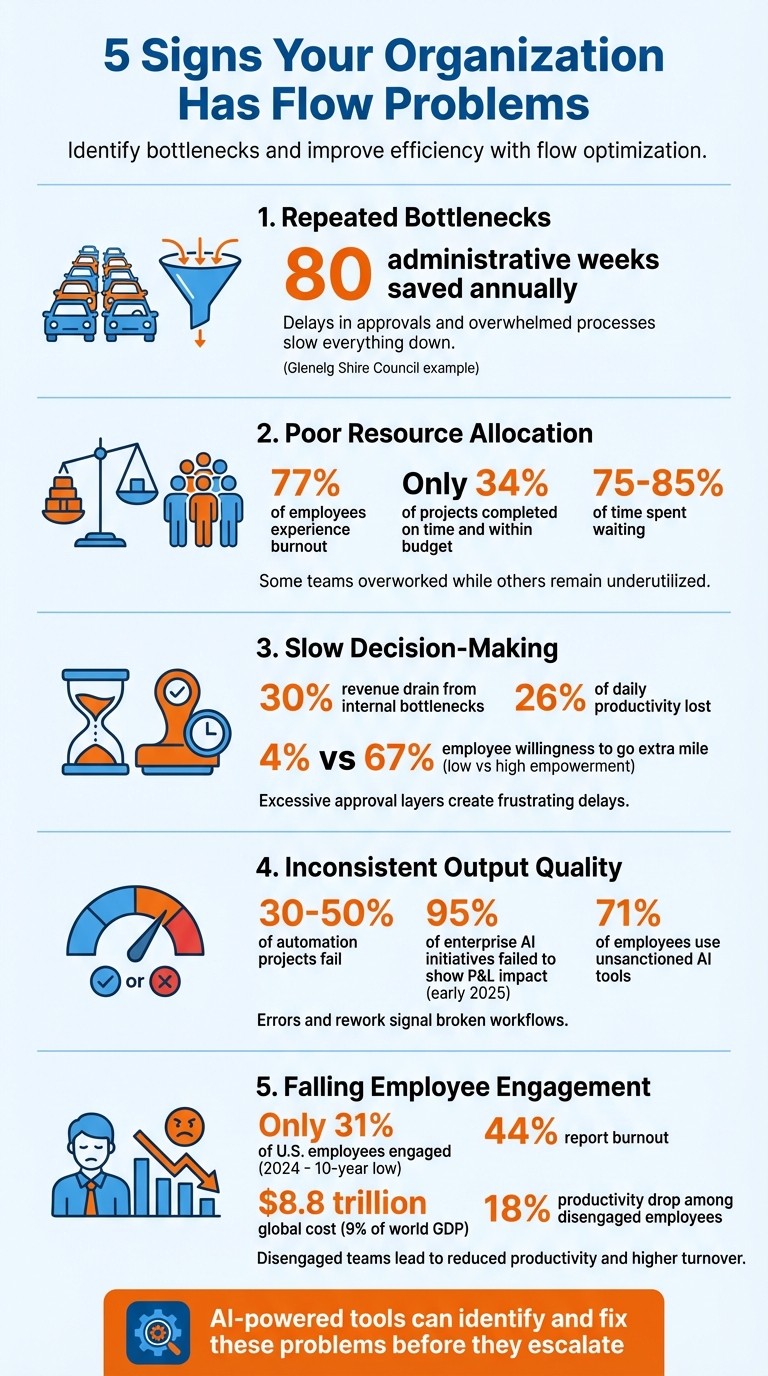
Real-world examples show the impact of these solutions. Glenelg Shire Council saved 80 administrative weeks annually, reducing some tasks from an hour to just 10 minutes. Similarly, Todd Energy automated 13 core processes in six months, eliminating manual delays.
Start by using AI for anomaly detection to flag slow-moving tasks. Then, create response playbooks so your teams can act quickly when alerts are triggered. With these tools in place, your operations can flow more smoothly, avoiding the costly disruptions bottlenecks create.
2. Poor Resource Allocation Across Teams
Observable Symptoms Within the Organization
When resources are unevenly distributed, it’s like throwing a wrench into the gears of your organization. The signs are often glaring. Some team members are completely swamped, while others with similar skills sit idle. You might see top talent wasting time on basic tasks, while less experienced employees are left struggling with assignments beyond their expertise. Another common issue is constant task-switching - teams juggling multiple projects at once. This not only drains focus but also increases the likelihood of mistakes. And then there’s the dreaded waiting game: work piles up in queues, stalled by bottlenecks like delayed manager approvals or unavailable specialists.
Frequency and Recurrence of the Issue
This isn’t just a one-off problem. Poor resource allocation tends to stick around, creating a ripple effect that worsens over time. Consider this: 77% of employees report experiencing burnout, often due to chronic workload imbalances. The stats paint a grim picture - only 34% of projects are completed on time and within budget. What’s more, most product teams operate at just 15–25% flow efficiency, meaning that work is stuck idle 75–85% of the time, waiting for approvals or other dependencies. It’s a cycle that eats away at productivity and morale.
Impact on Operational Efficiency
The fallout from poor resource allocation hits both your bottom line and your team’s effectiveness. Rising costs from overtime, rework, and last-minute fixes are just the tip of the iceberg. Failed projects and unhappy clients lead to revenue loss, while burnout-induced turnover drives up hiring and training expenses. Even a single bottleneck can grind progress to a halt - when one key resource is unavailable, others get stuck waiting, unable to move forward. On the flip side, organizations that address these inefficiencies can achieve 20–30% faster time-to-market. Fixing these issues isn’t just about balance - it’s about improving speed and effectiveness.
Potential for Resolution Using AI-Driven Tools
AI tools like Rebel Force can completely change the game when it comes to resource management. With real-time dashboards, Rebel Force gives you a clear view of task queues and individual workloads, making it easy to spot who’s overworked and who’s underutilized. Predictive analytics take it a step further, forecasting workload spikes so you can adjust before problems arise. Its advanced competence management system matches tasks to the right people by evaluating skill levels - ensuring experienced staff handle complex jobs while simpler tasks go to junior team members. Plus, you can set up intervention playbooks that outline exactly how to respond when AI flags potential delays. It’s a smarter, more proactive approach to keeping teams balanced and productive.
3. Slow Decision-Making Cycles
Observable Symptoms Within the Organization
When routine decisions are bogged down by excessive layers of approval, it’s a red flag. Employees might find themselves waiting days - or even weeks - for sign-offs on relatively simple matters, such as lower-level hiring, standard expense approvals, or minor project tweaks. This creates a cycle where teams hesitate to act without managerial input, even when leaders lack the local context to make the best call. The result? Lower-quality outcomes and a growing reliance on executives to handle decisions that could easily be delegated. If no choice is made without a manager’s stamp of approval, it’s a clear sign of a deeper issue.
Frequency and Recurrence of the Issue
This isn’t just an occasional problem - it can become embedded in the company’s DNA. Internal bottlenecks can drain up to 30% of revenue and eat away at 26% of employees’ daily productivity. For example, if more than 30% of a leader’s decisions could have been made by others with proper authority, you’re likely dealing with a bottleneck. Worse still, only 4% of employees are willing to go the extra mile in environments with low empowerment, compared to 67% in workplaces where they feel trusted and enabled. When routine decisions require CEO approval, the organization falls into an "escalation trap", slowing progress across the board.
Impact on Operational Efficiency
Delays in decision-making are like turning a four-lane highway into a single-lane road - everything slows down. This inefficiency leads to missed deadlines, idle resources, and increased costs, from bloated inventory to overtime expenses and lost billable hours. Beyond financial setbacks, constant reliance on managerial approval stifles employees’ ability to develop their judgment and ownership. Instead of fostering innovation, the workplace becomes a culture of order-followers. As business coach Dominic Monkhouse aptly states:
"If everything matters, nothing matters".
Organizations often confuse coordination with control, adding unnecessary approval steps that kill agility and responsiveness. Fixing this issue requires more than just better processes - it demands smarter tools to streamline decision-making.
Potential for Resolution Using AI-Driven Tools
Rebel Force tackles slow decision cycles head-on by cutting out manual handoffs that can stretch timelines by weeks or months. With predictive flow analytics, the system forecasts workload spikes and identifies bottlenecks before they snowball, allowing resources to be adjusted proactively . Its process mining capabilities dig into event logs to uncover sources of friction and unnecessary rework. Additionally, anomaly detection highlights slow-moving tasks early, preventing minor delays from escalating into major problems. Rebel Force doesn’t just stop at identifying issues - it enables you to create intervention playbooks, turning AI insights into fast, actionable solutions rather than just another dashboard of data.
4. Inconsistent Output Quality and Volume
Observable Symptoms Within the Organization
Inconsistent output quality often points to deeper issues within an organization's workflow. When errors spike or projects repeatedly require rework, it's a sign that processes are misaligned. This unpredictability - whether a project wraps up smoothly or demands multiple revisions - disrupts efficiency. In automated workflows, "silent failures" are another red flag. These occur when a process completes but delivers incorrect results, often going unnoticed until the errors surface downstream. A particularly telling symptom is when employees start using personal tracking tools because the official systems "just don’t work as they should." If more than 10–15% of workflows need manual intervention, it’s clear that the current processes aren’t keeping up with operational demands. These problems don’t just slow things down; they create ripple effects that lead to larger inefficiencies.
Frequency and Recurrence of the Issue
This isn’t a rare or isolated problem. In fact, 30%–50% of initial automation projects fail because teams attempt to automate processes that are flawed from the start. The rise of AI has compounded this issue - by early 2025, about 95% of enterprise generative AI initiatives failed to show any measurable impact on profit and loss due to poor integration. Additionally, 71% of employees admit to using unsanctioned AI tools, citing that the official systems don’t align with their actual work needs.
Impact on Operational Efficiency
When output quality is inconsistent, teams are forced into costly cycles of rework. This diverts skilled employees from focusing on strategic priorities, even as dashboards falsely suggest that everything is running smoothly. Automating broken processes only exacerbates the issue. Instead of improving efficiency, it scales the problems, leading to quicker mistakes and more expensive failures. As Donald La, Growth Lead at Fluency, puts it:
"If you automate a broken process, you get marginal improvement at best, possibly worse outcomes if the AI misses the nuances that made the inefficient process work".
Potential for Resolution Using AI-Driven Tools
Rebel Force offers a solution to inconsistent output by using process mining to map out actual workflows based on digital activity. This helps identify where quality issues arise and where production slows down. The platform continuously tracks metrics like precision, recall, and error rates, catching problems early before they escalate. During workload surges, predictive analytics come into play, forecasting spikes and recommending optimal staffing levels to sustain output. Additionally, the system’s autonomous workflow adaptation can reroute problematic tasks and scale resources dynamically, ensuring a steady flow even during disruptions. Unlike rigid systems, this platform adjusts to changes, maintaining consistent quality even under fluctuating demand.
5. Falling Employee Engagement and Retention
Observable Symptoms Within the Organization
When employees become disengaged, it shows in their behavior. They may respond more slowly, hesitate to take initiative, and deliver work that feels rushed or incomplete. Instead of being proactive, they stick to the bare minimum, often spending hours just searching for information. Emails and messages might go unanswered for long periods, and virtual meetings can feel lifeless, with cameras off and little participation. These individuals often wait for detailed instructions instead of stepping up for extra responsibilities, leaving their more engaged coworkers to shoulder the load. Other signs include showing up late, frequent absences, and avoiding team activities altogether.
In extreme cases, disengagement takes a toll on productivity. Employees can spend nearly 20% of their workweek - essentially a full day - just trying to locate the information they need. This frustration often spirals into higher turnover rates.
Frequency and Recurrence of the Issue
Employee disengagement isn't just a rare hiccup; it's a growing concern. In 2024, engagement levels in the U.S. hit a ten-year low, with only 31% of employees feeling connected to their work. At the same time, nearly half of U.S. workers (44%) reported feeling burned out. The financial impact is staggering: disengaged employees cost U.S. businesses between $4,000 and $21,000 per person in lost productivity and turnover. On a global scale, this adds up to an estimated $8.8 trillion - around 9% of the world’s GDP.
Impact on Operational Efficiency
Disengagement directly affects how well teams perform. Productivity drops by 18% among disengaged employees. Teams with low engagement levels also face 32% more quality issues and 63% more safety incidents compared to their highly engaged counterparts. As Ryan Pendell, Senior Workplace Science Editor at Gallup, explains:
"Engagement is not a characteristic of employees, but rather an experience created by organizations, managers and team members".
Without addressing these engagement issues, operational efficiency will continue to suffer.
Potential for Resolution Using AI-Driven Tools
AI-powered tools like Rebel Force can help tackle these challenges head-on. Through real-time sentiment analysis, the platform monitors internal communication channels to detect shifts in employee morale before they lead to resignations. It also uses predictive turnover models to analyze performance and engagement data, identifying employees at risk of leaving with an accuracy rate of 20–30%. For example, if the system notices a 30% drop in messaging activity or slower response times, it can recommend tailored interventions, such as adjusting workloads or scheduling check-ins.
THIS is Why You're Still Slow Even With AI (The Bottleneck Moved--Here's What to Do About It)
Using AI to Fix Flow Problems
Once key flow disruptions are identified, AI can step in to help restore and fine-tune operations. Unlike traditional manual root cause analysis, AI continuously monitors digital signals from your ERP, CRM, and operational logs. This proactive approach helps you address potential issues before they impact productivity, rather than reacting after the damage is done.
Rebel Force has developed a four-phase process to transform how organizations operate:
Diagnose: AI analytics identify hidden bottlenecks and inefficiencies by analyzing key workflow metrics.
Design: Workflows are standardised, and tasks are broken down to avoid automating flawed processes.
Execute: AI tools are implemented with precision, whether to inform teams, recommend actions, or automate tasks.
Validate: Outcomes are measured against baseline performance, ensuring ROI while creating feedback loops for continuous improvement.
This structured approach turns operational weaknesses into actionable solutions, ensuring every insight leads to meaningful change.
AI-powered analytics act as a "Flow Radar", offering early warnings about potential problems. These systems consolidate data from platforms like Jira, Azure Boards, and GitHub, translating complex metrics into plain-language diagnostics and practical recommendations.
Rebel Force provides two implementation options tailored to organizational needs. Enablement Sprints are focused 12-week programs that quickly eliminate constraints and drive results. On the other hand, Enablement Programs spread the transformation over 12 months, allowing for a more gradual pace. Both options include a dedicated enablement team, ROI tracking, and the same four-phase process, giving you the flexibility to choose between rapid outcomes or steady progress.
Conclusion
Flow issues don’t just disappear - they grow. When bottlenecks, misaligned resources, sluggish decision-making, inconsistent results, or employee burnout are ignored, they spiral into larger structural challenges that hinder scalability. Small frustrations can solidify into entrenched inefficiencies, making them far more difficult to resolve over time. On top of that, poor data quality and clunky processes can siphon off 15–25% of annual revenue.
The solution? Shifting from reactive problem-solving to proactive prevention. This begins with achieving clear visibility. When you can see where workflows smoothly and where they stall, you’re already one step ahead. Layer in AI-driven monitoring, and you’ll catch potential issues before they turn into full-blown crises.
"AI-driven workflow automation moves organizations beyond reactive firefighting... transforming the process of improvement from sporadic crisis response into a strategic, predictive capability." - anly.ai
This kind of proactive oversight sets the stage for meaningful change. Rebel Force’s structured four-phase approach - Diagnose, Design, Execute, Validate - translates operational weaknesses into measurable improvements. Whether through their 12-week Enablement Sprint for quick wins or a more gradual 12-month Enablement Program, the formula remains consistent: zero in on constraints, standardize best practices, apply AI with precision, and confirm ROI.
Success doesn’t depend on having perfect processes. It’s about spotting the early signs of flow issues and addressing them head-on with targeted, AI-powered strategies. By tackling bottlenecks, resource misalignments, slow decision-making, and employee disengagement, organizations can position themselves for long-term, sustainable growth.
FAQs
How can I measure “flow” in my organization?
To get a sense of "flow" in your organization, zero in on flow metrics - these measure how work moves through your processes. The main ones to keep an eye on are:
Flow time: How long it takes to complete tasks from start to finish.
Flow velocity: The amount of work completed over a specific period.
Flow efficiency: The ratio of value-added work to the total cycle time.
Keeping tabs on things like cycle times, queue lengths, and user feedback can also shine a light on bottlenecks and help refine workflows.
What data does Rebel Force need to spot flow problems?
Rebel Force needs detailed information on several key areas: process activities, workflow stages, approval times, task completion statuses, and system performance metrics. Gathering this data is essential for spotting inefficiencies and pinpointing bottlenecks that may be slowing down operations.
How fast can AI improvements show ROI?
AI advancements can start showing returns on investment (ROI) in as little as 30 days - provided they’re carefully tracked and evaluated. Collecting data promptly is crucial for gauging the success of automation efforts. This allows businesses to fine-tune processes and achieve better outcomes. With an effective strategy, companies can pinpoint inefficiencies early on and make adjustments that lead to tangible business gains.