

Operational Excellence
How AI Detects Bottlenecks in Business Processes
AI is transforming how businesses identify and solve bottlenecks. Traditional methods rely on manual work and assumptions, but AI uses data to pinpoint slowdowns, predict future issues, and recommend fixes. Here's how it works:
Data Analysis: AI examines workflows using event logs, timestamps, and system data to map processes and find inefficiencies.
Bottleneck Detection: It identifies delays, rework loops, and deviations in real-time, making problem areas clear.
Predictive Insights: By analyzing historical patterns, AI forecasts potential bottlenecks days in advance.
Optimization: Recommendations and automation reduce delays, improve efficiency, and cut costs.
For example, companies have reduced cycle times by up to 70% using AI tools. Whether it's streamlining approvals or syncing data across departments, AI ensures smoother operations and faster results.
Step 1: Use Process Mining to Map Workflows
Build Current Process Maps from Data
Process mining takes raw data from systems like ERP, CRM, and BPM tools and uses it to map out workflows. To do this, it requires three key data points for every event: a Case ID (a unique identifier for each process instance), an Activity Name (the specific step taken), and a Timestamp (when the step occurred). With these elements, AI algorithms piece together the actual workflow.
The result is a visual representation - often in the form of a Petri net or BPMN diagram - that depicts every variation, loop, and parallel activity within a process. By pulling together scattered data and organizing it into a time-sequenced view, AI simplifies what would otherwise be a tedious manual task. In fact, using process mining tools can cut the time spent documenting and verifying processes by an incredible 93%.
"Process mining moves beyond theoretical process maps to reveal the actual, lived experience of operations, providing an unprecedented level of insight." - Shashikant Kalsha, QodeQuay
This visual map often reveals surprising insights. For instance, a process with a 5-day cycle time might only involve 2 hours of actual work, with the rest of the time spent waiting. Once the workflow is clearly mapped, teams can move on to identifying inefficiencies and deviations.
Find Deviations and Bottlenecks
After mapping the workflow, AI takes the analysis further by identifying inefficiencies and deviations. It distinguishes between active work and idle queue time, uncovering areas where delays or bottlenecks occur. Rework loops - where tasks repeatedly cycle back for corrections (e.g., Review → Correct → Review) - are also flagged. Additionally, AI reveals the unexpected complexity of processes. For example, what should be a straightforward 8-step order-to-cash process might actually involve as many as 147 unique paths. On average, real-world processes have 3–10 times more variations than organizations anticipate.
AI also detects conformance deviations, such as skipped approval steps, tasks handled by unauthorized individuals, or incorrect task sequences (e.g., shipping goods before payment is received). These deviations can have a significant impact. For instance, a manufacturing company using Celonis analyzed 400,000 transactions and found that 23% of purchase orders bypassed a mandatory three-way matching step - something traditional audits completely missed. Similarly, a financial services company discovered that 31% of invoices were processed by five or more people, triggering an 11-day manual review loop due to mismatched PO numbers. By fixing the intake logic, they eliminated this issue in 89% of cases.
"The real process almost never matches the documented one." - DEV Community
Step 2: Combine Data from Multiple Sources
Connect Data Across Departments
AI leverages data connectors to gather real-time information from various systems - like ERP platforms, CRM databases, manufacturing logs, and IoT sensors - bringing everything together in one place. This eliminates the need for manual data entry and the delays that come with it. Instead of relying on weekly reports or manually compiled spreadsheets, AI ensures continuous data synchronization across departments. The result? Everyone operates using the same up-to-date information.
A critical element here is standardized telemetry models. Think of these as a "flight recorder" for processes, capturing essential details for every document or action - like who was involved, when it happened, quality metrics (such as OCR confidence scores), and the actions taken. AI then applies LLM-based event normalization to turn inconsistent logs and unstructured notes into a structured, unified format. For example, a sales team’s note about "lead qualification" and a finance team’s entry on "credit check complete" can be transformed into comparable data points on a shared timeline.
Take Spectrum Science, for instance. In 2024, they integrated their disconnected accounting and project management systems using centralized middleware. Before this, their finance team spent over 20 hours each week compiling reports from multiple sources. Post-integration, they gained real-time data access and cut report generation time by those same 20 hours weekly. This shift significantly improved their ability to make timely executive decisions. It’s a clear example of how AI-driven data integration can streamline operations and eliminate repetitive tasks.
Identify Hidden Dependencies and Inefficiencies
Once data is unified, AI can uncover bottlenecks that often arise when departments operate in silos. For example, variant clustering groups process paths, like contract approvals, to highlight inefficient handoffs between teams. By analyzing the combined data, AI might reveal that a machine’s reduced throughput isn’t due to mechanical failure but to scheduling errors upstream. Alternatively, it could show that overdue maintenance constraints are unknown to planning teams.
"When planning doesn't know a machine's lower throughput stems from overdue maintenance, or maintenance fixes issues actually caused by upstream scheduling errors, valuable time is wasted." - Datagrid Team
Another example of hidden inefficiencies can be seen in the interplay between legal and finance teams. Integrating contract repositories with ERP and CRM systems can pinpoint bottlenecks in vendor onboarding or revenue recognition caused by errors during data transfers. For instance, a professional services client of AIQ Labs faced delayed billing due to mismatched project data between Asana and QuickBooks. After implementing a custom integration to sync project milestones with invoice triggers, the company reduced payment delays by 65%. This highlights how AI can expose inefficiencies that remain invisible when departments analyze data in isolation.
These insights set the stage for real-time monitoring, which is explored in the next step.
Step 3: Set Up Real-Time Monitoring and Anomaly Detection
Configure AI for Live Metric Tracking
After unifying your data, the next step is to enable AI for real-time monitoring of workflows. This involves tracking key metrics like cycle time, throughput, resource usage, and error rates to quickly identify bottlenecks. Unlike static thresholds, modern AI tools use dynamic baselines that adapt to seasonality, trends, and day-of-week patterns. For example, the system won’t mistakenly flag a natural slowdown during a holiday weekend as an issue.
AI systems excel at spotting anomalies. They can flag tasks that exceed twice their p95 baseline for latency - even if they still succeed. Similarly, they alert on error patterns when failure rates climb above 20% or spike unexpectedly. Resource anomalies, like a 50% surge in token usage or excessive CPU consumption, are also flagged. Sometimes, a process might appear successful but still incur inefficiencies, such as tripling costs unnecessarily.
"A recipe can return HTTP 200 with a correct output and still cost 3x what it should... Execution Insights tracks token usage at the recipe level and detects when costs diverge from baselines." - JieGou
AI also uses causal knowledge graphs to map relationships between metrics. For instance, it can show how "Deal Count" impacts "Revenue", helping trace bottlenecks back to their source. When an anomaly is detected, automated root cause analysis kicks in, using concentration analysis to pinpoint whether the issue is tied to specific regions, products, or entities. To maximize efficiency, configure your AI to rank bottlenecks based on their overall impact, allowing teams to address the most critical problems first.
Once live metrics are set up, the insights gained can be leveraged for diagnosing constraints in the next phase.
Rebel Force's Data-Driven Diagnostics Phase
Rebel Force builds on real-time anomaly detection with a dedicated diagnostics phase designed to identify process constraints. This step zeroes in on finding where the flow breaks before introducing tools or strategies. It’s the cornerstone of their four-phase enablement cycle, ensuring that monitoring aligns with business outcomes rather than just technical metrics.
"Every engagement starts with diagnosis, not design. We identify the core constraint - the point where flow breaks - before touching tools, teams, or strategy." - Rebel Force
During this phase, Rebel Force connects directly to data warehouses like Snowflake or BigQuery. They analyze schemas to create a "causal map" of business metrics. Their teams - comprising Enablement Leads, AI/Data Specialists, and Performance Analysts - use real-time dashboards to monitor overall process health. These dashboards highlight key metrics like cycle time, throughput, and costs, making it easy to spot friction points. The insights from live monitoring feed directly into their constraint discovery process, ensuring that anomaly detection is tailored to your business needs rather than relying on generic thresholds. This diagnostic approach sets the stage for predictive analytics in the next step.
Step 4: Use Predictive Analytics to Forecast Bottlenecks
Analyze Historical Data for Predictions
Predictive analytics offers a powerful way to anticipate bottlenecks before they disrupt your workflow. By analyzing extensive historical data, AI can identify patterns that often precede bottlenecks - such as specific sequences of events or resource constraints. Machine learning models can even flag potential issues 2 to 3 days before they become actual delays.
One particularly effective method is time-in-state analysis. This approach compares the current duration of tasks against historical medians, flagging any significant deviations as potential bottlenecks. Another useful tool is queueing theory, especially Little's Law (WIP = Throughput × Lead Time), which helps predict queue overflows during high-demand periods like quarter-end surges.
"Predictive AI is your business's sixth sense. It uses historical data, machine learning, and smart algorithms to spot trends, find inefficiencies, and forecast outcomes." - Yoroflow
AI enhances these predictions by integrating data from multiple sources, including JIRA state transitions, Git commit activity, CI/CD pipeline metrics, and even communication volume on platforms like Slack or Microsoft Teams. For instance, large pull requests exceeding 500 lines are known to take 3x longer to review. AI uses this historical insight to predict delays as soon as such a pull request is created. By implementing predictive bottleneck detection, organizations can cut the duration of these constraints by 40–50% and improve sprint predictability by 10–15 percentage points.
Ultimately, forecasting delays allows businesses to not only identify potential issues but also take steps to prevent them. These insights pave the way for preemptive adjustments, ensuring workflows remain stable and efficient.
Make Preemptive Adjustments with Rebel Force's Enablement Process
Once forecasts reveal potential bottlenecks, businesses can act before issues escalate. Rebel Force uses these predictive insights to make proactive workflow adjustments. Following the diagnostics phase, the Design phase incorporates forecasted bottlenecks into workflow strategies, creating a detailed plan to address potential problems.
During the Execute phase, Rebel Force's enablement teams - comprising AI/Data Specialists and Performance Analysts - deploy tailored intervention playbooks. For example, if AI predicts a surge in queue depth due to an upcoming procurement push, the team can redistribute workloads or activate additional approval pathways to handle the spike. In the Validate phase, forecasted cycle times are compared to actual outcomes, fine-tuning the AI models and fostering trust across the organization.
Rebel Force’s process ensures that predictive analytics lead directly to actionable changes. By turning insights into immediate interventions, businesses can achieve measurable workflow improvements and maintain operational stability.
Step 5: Conduct Root Cause Analysis and Get Optimization Recommendations
Methods for Root Cause Analysis
Once bottlenecks are identified and forecasted, the next step is figuring out why they happen. AI steps in here with pattern recognition and causal inference to uncover the specific reasons behind delays, instead of just flagging them as issues.
One standout method is process mining, which digs into recurring slowdowns and deviations to pinpoint exact causes. For instance, a healthcare provider used this technique to analyze patient onboarding and found that 45% of registrations required follow-up calls. By redesigning their intake form to address the most commonly incomplete questions, they slashed registration errors by 70%. Similarly, an insurance company discovered that 20% of claims were bouncing between adjusters because of unclear assignment rules. Fixing this routing logic cut claim processing time by 5 days.
Advanced AI tools take it a step further with self-review algorithms, where systems critique their own logic to catch errors before finalizing results. This approach has been shown to reduce errors by as much as 90%. Another powerful tool is the use of digital twins - virtual models that simulate processes. These allow AI to safely identify constraints without disrupting actual operations. For example, in manufacturing, AI can process real-time data from IoT sensors to detect operational deviations that might lead to equipment bottlenecks.
"When bottlenecks are detected, AI uses pattern recognition and causal inference to identify underlying causes, enabling targeted fixes rather than generic troubleshooting." - Datagrid Team
Another approach worth noting is multi-agent systems (MAS). These systems use specialized AI agents that work together across departments. For example, one agent might detect a delay, while another validates compliance or drafts a solution. The adoption of MAS in enterprises skyrocketed by 327% in less than four months during early 2026, reflecting a growing reliance on AI agents as active team members.
With these insights, Rebel Force takes the analysis and translates it into practical, actionable solutions.
Rebel Force's Design and Execution Phases
Rebel Force takes AI-driven insights and turns them into tangible outcomes through a two-step process: the Design and Execute phases.
During the Design phase, Rebel Force creates an "Enablement Blueprint." This blueprint zeroes in on the primary constraint identified during the diagnostic phase. It incorporates root cause insights and structures the operating rhythm using Critical Chain Project Management (CCPM) principles to ensure measurable improvements in throughput.
The Execute phase involves deploying "Rebel Flow Units." These specialized teams work alongside your internal staff to break down silos and eliminate multitasking. Their mission? Focus on one objective at a time to restore efficiency. For example, if procurement delays are traced back to unclear approval routing, the team might implement automated approval pathways for purchases under $5,000.00. A similar approach helped a manufacturing company cut routine order cycle times by 60%.
Execution happens in defined sprints, and the process is designed so that your internal teams can manage the optimized systems independently once the engagement is complete. With over 220 processes successfully enabled and an average ROI of 70%, Rebel Force ensures that AI-driven recommendations lead to long-term operational improvements, validated through their Validate phase.
What Is Process Mining? AI to Find Bottlenecks Fast ⚙️🤖
Comparison of AI Methods for Bottleneck Detection
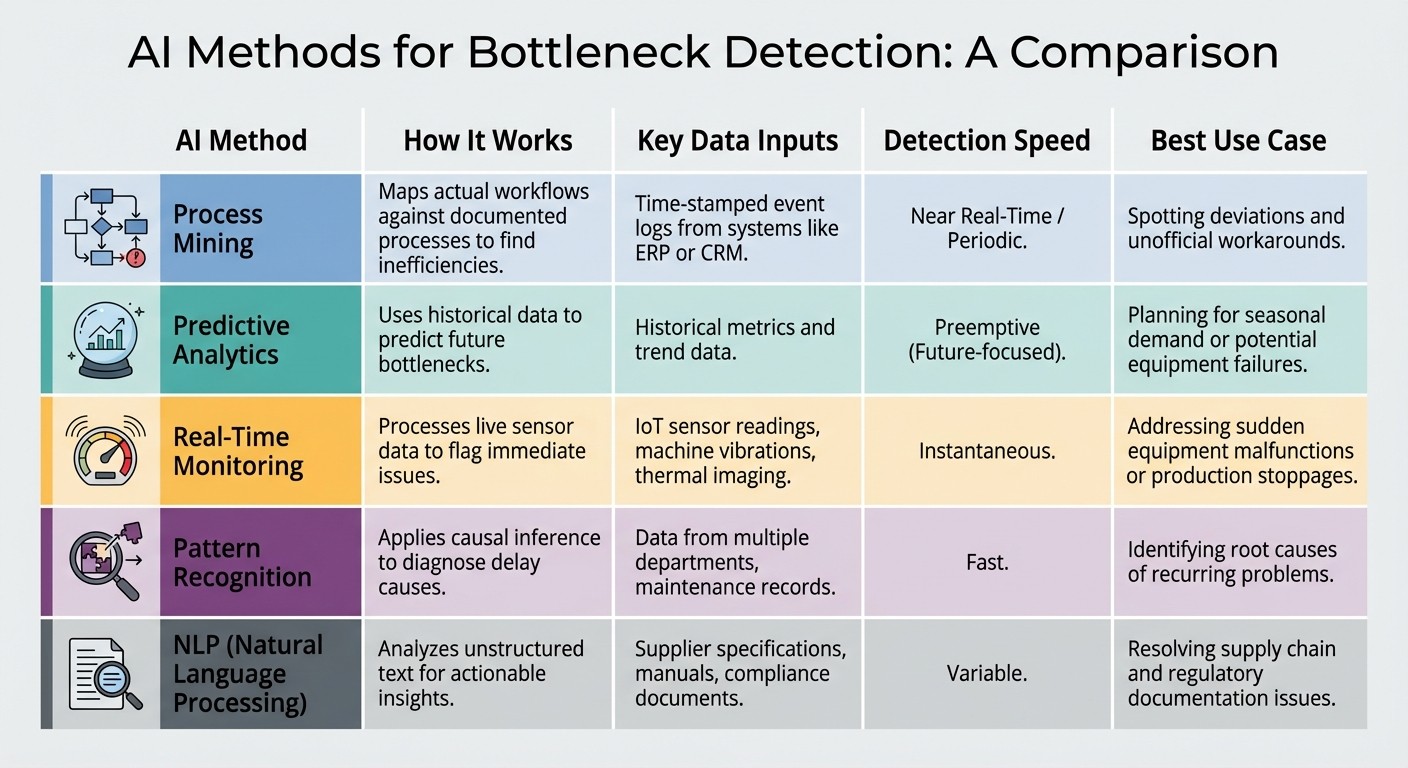
Comparison of 5 AI Methods for Detecting Business Process Bottlenecks
Comparison Table of AI Methods
This section breaks down and compares several AI techniques that play a critical role in pinpointing and resolving bottlenecks in business processes. These methods vary in terms of data requirements, response time, and whether they focus on immediate fixes or long-term improvements.
Process mining highlights discrepancies between actual workflows and documented procedures, exposing unofficial shortcuts or inefficiencies that can slow operations . Predictive analytics takes a forward-looking approach, forecasting potential bottlenecks before they occur, which is especially useful for planning around seasonal demand spikes or scheduled maintenance . On the other hand, real-time monitoring analyzes live data from IoT devices and machinery to detect issues as they happen, making it indispensable for sudden equipment failures or production halts.
For diagnosing root causes, pattern recognition leverages causal inference to uncover why delays are happening rather than just identifying that they exist. Meanwhile, Natural Language Processing (NLP) extracts insights from unstructured text sources - like supplier documents, manuals, or compliance paperwork - helping to address bottlenecks tied to documentation or supply chain coordination challenges.
AI Method | How It Works | Key Data Inputs | Detection Speed | Best Use Case |
|---|---|---|---|---|
Process Mining | Maps actual workflows against documented processes to find inefficiencies | Time-stamped event logs from systems like ERP or CRM | Near Real-Time / Periodic | Spotting deviations and unofficial workarounds |
Predictive Analytics | Uses historical data to predict future bottlenecks | Historical metrics and trend data | Preemptive (Future-focused) | Planning for seasonal demand or potential equipment failures |
Real-Time Monitoring | Processes live sensor data to flag immediate issues | IoT sensor readings, machine vibrations, thermal imaging | Instantaneous | Addressing sudden equipment malfunctions or production stoppages |
Pattern Recognition | Applies causal inference to diagnose delay causes | Data from multiple departments, maintenance records | Fast | Identifying root causes of recurring problems |
NLP | Analyzes unstructured text for actionable insights | Supplier specifications, manuals, compliance documents | Variable | Resolving supply chain and regulatory documentation issues |
This framework allows businesses to combine these methods for better outcomes. For instance, a major global bank used process intelligence to identify rework loops caused by poor report quality. By addressing these inefficiencies, they were able to cut down cycle times and improve compliance.
Conclusion: Using AI to Improve Business Processes
Building on the advanced detection and predictive techniques discussed earlier, this final phase highlights how AI can reshape business operations for better outcomes.
Key Benefits of AI-Driven Bottleneck Detection
AI shifts businesses from reacting to problems toward anticipating and addressing them. By using real-time monitoring and predictive analytics, companies can identify and resolve bottlenecks before they escalate. This proactive approach often leads to impressive financial gains - organizations that adopt AI for process improvements typically see returns on investment ranging from 20% to 200%.
Beyond cutting costs, AI reduces inefficiencies by tackling wasted resources and idle processes. For businesses in the U.S. Virgin Islands that rely on logistics or tourism, AI improves delivery reliability and shortens lead times, which helps build stronger customer relationships and enhances competitive positioning. Additionally, AI automates tasks like document processing and consolidates fragmented data from multiple departments, solving challenges that manual methods can't handle effectively at scale.
Rebel Force integrates these capabilities to deliver consistent, long-term improvements in business operations.
How Rebel Force Supports Business Transformation
Rebel Force follows a structured, four-phase approach to help organizations identify constraints, craft tailored solutions, implement changes, and measure results. During the Diagnostics Phase, automated process mining uncovers hidden workflows and unofficial workarounds. The Design Phase uses AI-powered root cause analysis and simulations to predict the effects of potential process changes. The Execution and Validation phases focus on deploying these solutions with specialized teams while closely monitoring results against predefined metrics.
Whether through focused 12-week Enablement Sprints for quick wins or comprehensive year-long Enablement Programs for deeper transformation, Rebel Force ensures that AI integration aligns with each organization’s goals. Their proven methods turn process insights into actionable improvements, delivering scalable growth and smoother operations tailored to specific needs and timelines.
FAQs
What data do I need to start process mining?
To get started with process mining, you'll need detailed, event-based data from your business operations. This includes elements like timestamps, activity logs, and process steps. These pieces of data are crucial for identifying bottlenecks and inefficiencies in your workflows. Prioritize gathering precise and complete information to ensure the insights you uncover are actionable and reliable.
How does AI tell a real bottleneck from normal slow periods?
AI can spot genuine bottlenecks by examining real-time data from interconnected systems. It identifies recurring workflow constraints rather than temporary slowdowns. Through ongoing monitoring and pattern recognition, AI ensures attention is directed toward persistent issues that disrupt efficiency.
How can we turn AI bottleneck alerts into measurable ROI?
To transform AI bottleneck alerts into tangible returns, focus on using AI-driven insights to identify and tackle the most critical constraints. This approach helps streamline operations and cut down delays. Once AI highlights specific areas for improvement, implement targeted changes to your processes.
Track metrics such as throughput and cost savings to measure the impact of these adjustments. Keep an eye on the results over time to ensure the operational improvements lead to financial benefits, like higher revenue or lower expenses.