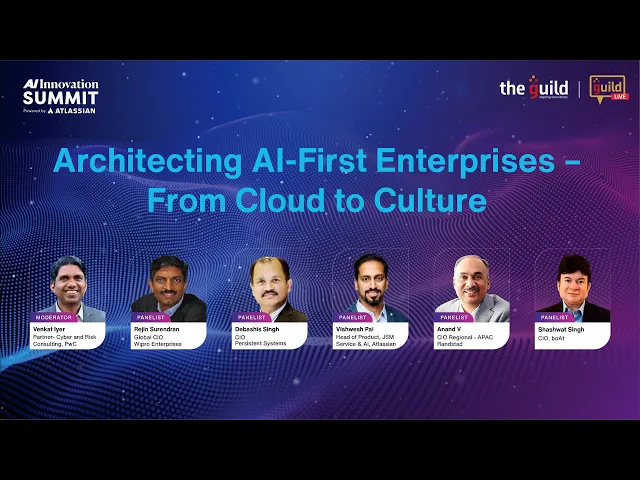

How to Build an AI-First Enterprise Architecture
In today’s hyper-competitive business landscape, the organizations that thrive are those that embrace innovation and integrate cutting-edge technology into their core strategies. Artificial intelligence (AI) is no longer a futuristic concept; it’s a critical enabler of business transformation. But adopting AI successfully requires more than enthusiasm - it demands a robust, AI-first enterprise architecture that drives measurable value.
This article draws on expert discussions around building such architectures, breaking down critical elements, actionable strategies, and potential pitfalls for enterprises looking to scale AI adoption effectively.
The Four Pillars of AI-First Enterprise Architecture
To prepare for AI transformation, enterprises must reimagine their architectures across four core dimensions: business, data, applications, and infrastructure. These pillars, when aligned, form the foundation for long-term, scalable AI success.
1. Business Strategy: Embedding an AI-First Mindset
AI should not be seen as a supplemental tool but as a principle deeply embedded within the organization’s overall business strategy. Decision-makers need to shift their thinking, treating AI as a core driver of innovation and operational efficiency rather than a standalone enabler.
Value Mapping Is Key: AI initiatives must be tied directly to tangible business outcomes. Generative AI, for example, may excite leaders, but without clear value drivers - like revenue growth or cost optimization - it risks becoming a novelty rather than a necessity.
2. Data Governance: The Non-Negotiable Foundation
The success of AI hinges on access to clean, well-governed data. To achieve this:
Master Data Management: Centralize critical organizational data to ensure consistency.
Data Governance Frameworks: Implement policies that standardize how data is collected, stored, and used across the enterprise.
Transparency and Accountability: Build trust by ensuring AI models use unbiased, high-quality data to deliver reliable insights.
3. Application Design: Flexibility Through APIs and Microservices
AI-ready applications must be designed with adaptability in mind. This means:
API and Microservices-Based Architecture: Applications should enable seamless integration with AI services, allowing enterprises to quickly adopt and scale solutions.
Use Case Modularity: Enterprises should build applications that can accommodate AI use cases as they evolve, eliminating the need for complete system overhauls.
4. Infrastructure: Embracing Cloud-Native and CI/CD Pipelines
A robust technology stack is essential for AI success. Enterprises should aim to:
Transition to cloud-native architectures, which offer scalability and flexibility.
Strengthen continuous integration/continuous delivery (CI/CD) pipelines for faster deployment.
Implement DevSecOps principles, ensuring security is baked into the development lifecycle.
The Evolving Hype Cycle of AI
AI adoption has progressed through three distinct stages, each offering unique opportunities and challenges for enterprises.
1. Traditional AI
Comprising early technologies like recommendation engines and deep learning models, traditional AI focused on solving narrow, domain-specific problems. Today, these solutions are widely adopted across industries, providing stable, point-solution results.
2. Generative AI
Generative AI, which gained prominence with tools like ChatGPT, has expanded AI capabilities into text, voice, and even video generation. Its potential lies in applications ranging from automated content creation to real-time customer engagement. This stage represents maturity in adoption, with companies across the SMB, mid-market, and enterprise sectors leveraging it effectively to drive productivity gains.
3. Agentic AI
The latest wave of AI focuses on agentic systems - autonomous agents capable of optimizing workflows, decision-making, and even complex operational tasks. While promising, this area remains underdeveloped in terms of defining success metrics and ensuring ethical accountability.
The People Factor: Preparing Teams for AI Integration
AI transformation is as much a people problem as it is a technological one. Enterprises must address the following challenges to ensure employees are equipped to collaborate with AI systems effectively:
Education and Training: Teach employees how to leverage AI tools in their roles, offering tailored examples for departments like sales, marketing, and recruiting.
Cultural Alignment: Shift organizational mindsets by positioning AI as a tool for augmentation rather than replacement, alleviating fears of job displacement.
Spotlighting Innovators: Encourage employees to experiment with AI, rewarding those who develop creative applications. One standout example shared was a consultant in Japan reimagining a client’s organizational hierarchy using AI-driven insights.
Guardrails for Ethical AI Usage
With AI adoption comes an increased need for ethical oversight. Enterprises must develop robust frameworks to ensure that AI systems are transparent, accountable, and free from bias.
Key Guardrails to Implement:
Data Access Governance: Define who sees what information based on roles. For example, a sales rep and a CEO querying the same system should receive appropriately tailored insights.
Accuracy and Reliability: Industries like finance demand precise outputs, making "AI-generated" disclaimers unacceptable. Systems must meet strict accuracy standards.
Bias Mitigation: AI must eliminate biases, even in areas like job description writing, to promote inclusivity and fairness.
Industry-Specific Challenges
Certain industries, such as manufacturing, face unique hurdles in AI implementation. For instance:
Legacy Systems: Many factories operate with decades-old machinery, complicating data collection for AI use cases like predictive maintenance.
Hybrid Workflows: Operators in older facilities may rely on offline data entry, while new-age factories use real-time AI alerts. Organizations must design solutions that accommodate both scenarios.
These challenges underscore the importance of tailoring AI strategies to fit industry realities rather than adopting a one-size-fits-all approach.
Measuring AI ROI: Redefining Metrics for Success
To ensure AI investments deliver measurable value, enterprises must redefine their key performance indicators (KPIs). For example:
Marketing: Shift KPIs from traditional metrics (e.g., ad spend) to AI-driven efficiencies, such as time-to-market for creative assets or ROI on marketing campaigns.
Operations: Use AI to reduce workflow bottlenecks, optimizing processes like recruitment or supply chain management.
By aligning AI initiatives with clear, outcome-oriented metrics, organizations can better gauge their return on investment.
Key Takeaways
Adopt an AI-First Mindset: Treat AI as an integral part of business strategy, not a standalone tool.
Focus on the Four Pillars: Optimize business, data, applications, and infrastructure to create a scalable AI-ready architecture.
Embrace Generative and Agentic AI: Move beyond traditional use cases to explore innovative applications in text, voice, and workflow optimization.
Prioritize Data Governance: Establish robust frameworks to ensure data quality, ethics, and transparency.
Train and Empower Employees: Provide employees with the tools and knowledge to leverage AI, fostering a culture of innovation.
Build Ethical Guardrails: Ensure accountability, bias mitigation, and role-based access for all AI-driven initiatives.
Tailor AI Strategies by Industry: Address specific challenges in sectors like manufacturing, where legacy systems may limit adoption.
Redefine Metrics: Measure AI success through updated KPIs that reflect productivity gains, cost savings, and revenue growth.
Conclusion
Becoming an AI-first enterprise is not a distant goal but a necessity for organizations seeking sustainable growth in today’s data-driven world. By aligning enterprise architecture with AI principles, embedding ethical practices, and empowering employees, decision-makers can unlock the transformative potential of AI while driving measurable business value.
In short, the future belongs to organizations that don’t just adopt AI - but architect their entire operations around it.
Source: "Panel Discussion: Architecting AI-First Enterprises | AI Innovation Summit | #AIIS" - Guild TV, YouTube, Dec 30, 2025 - https://www.youtube.com/watch?v=1H6zUN-oz_U