Operational Excellence
AI in Real-Time Monitoring: Use Cases
AI-powered real-time monitoring is reshaping industries by providing live insights that help prevent problems before they arise. Businesses are using this technology to reduce downtime, improve efficiency, and save millions annually. Here are the key takeaways:
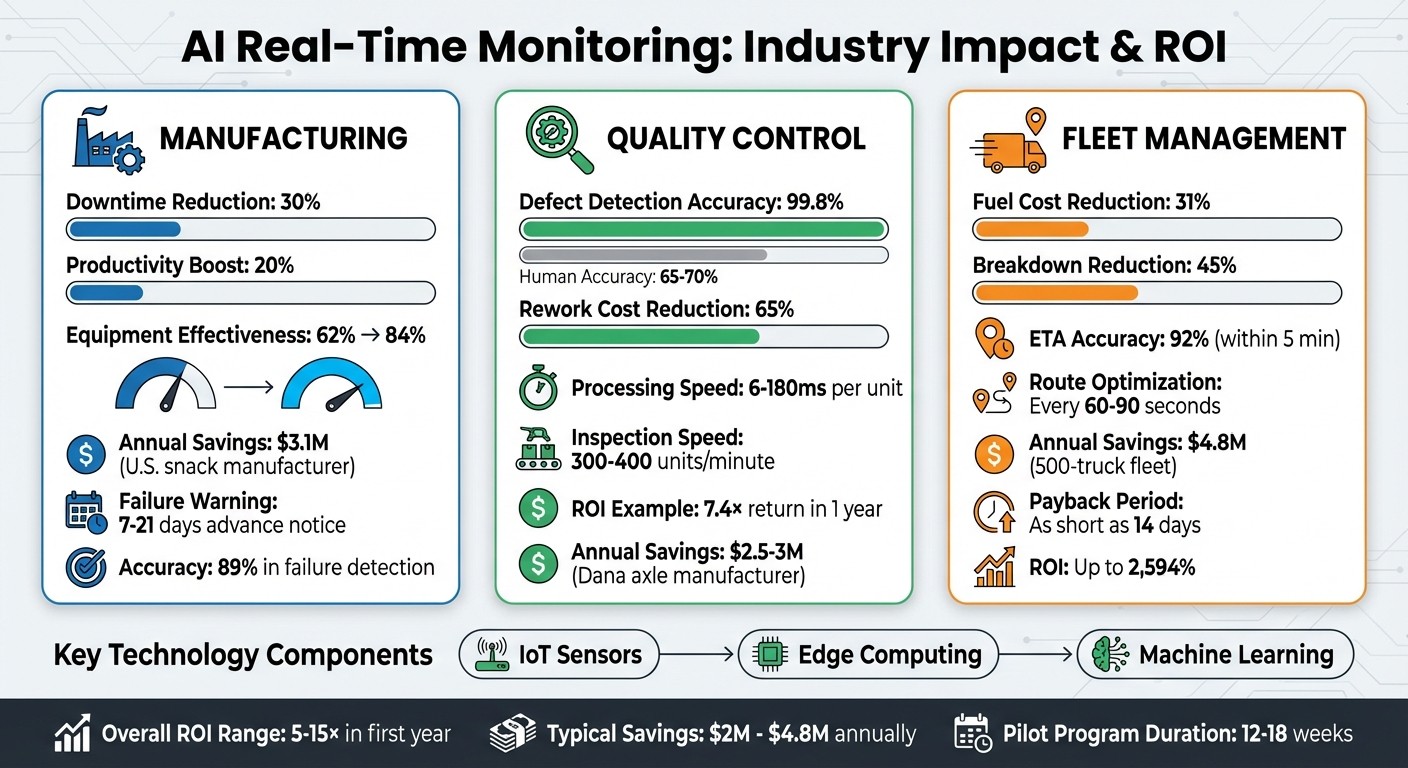
Manufacturing: Companies report up to a 30% drop in downtime and a 20% boost in productivity. One U.S. snack manufacturer increased equipment effectiveness from 62% to 84%, saving $3.1M annually.
Logistics: Predictive systems achieve 89% accuracy in failure detection, offering weeks of advance warning. Meridian Logistics cut vehicle breakdowns by 62%, saving $1.4M in downtime costs.
Retail: AI systems detect equipment issues early, avoiding costly shutdowns and ensuring smooth operations.
The technology combines IoT sensors, edge computing, and machine learning to deliver actionable insights across industries. For example, Rebel Force specializes in AI solutions for logistics and manufacturing, improving workflows and reducing energy costs with scalable, efficient systems. Similarly, AI-powered quality control platforms and fleet monitoring tools are helping businesses cut costs, improve safety, and achieve measurable ROI.
Quick Stats:
AI quality control systems detect defects with 99.8% accuracy, reducing rework costs by up to 65%.
Fleet monitoring platforms lower fuel costs by 31% and reduce breakdowns by 45%, with payback periods as short as 14 days.
AI is transforming operations by making data-driven decisions faster and more precise, ensuring businesses stay ahead in a competitive landscape.
AI Real-Time Monitoring ROI Across Manufacturing, Quality Control, and Fleet Management
1. Rebel Force

Industry Applications
Rebel Force specializes in AI-powered real-time monitoring tailored for industries like logistics, transportation, construction, and energy. Their systems are designed to handle high workloads, such as processing nearly 2,000,000 parcels annually. By leveraging AI algorithms, they optimize workflows and allocate resources efficiently to ensure smooth operations. For logistics and warehousing, their robotic palletizing solution takes automation to the next level by determining the best box placement in real time, streamlining the palletizing process.
In transportation, clients like ProRail use their AI-driven contract assistants to manage national rail infrastructure, while automotive fleet operators such as Ayvens rely on their tender qualification systems to enhance efficiency. Beyond that, Rebel Force's technology aids in infrastructure monitoring, offering features like automated traffic sign detection and real-time housing coordination platforms for government agencies.
Key Features
This platform stands out for its ability to deliver precise, actionable insights. It uses a multimodal AI pipeline that combines CCTV footage with site data, enabling context-aware alerts. Instead of just recognizing objects, the system evaluates situational factors - such as ensuring a spotter is present when heavy equipment is in use - offering targeted guidance while minimizing false alarms.
The technical backbone includes a hybrid GPU–NPU architecture. GPUs handle tasks like data training and video processing, while NPUs provide energy-efficient, high-performance inference. This setup reduces power consumption by up to 50% and lowers heat generation by about 45% compared to traditional GPU-only servers. Additionally, the Rebel Force SDK simplifies the transition from GPU-based systems to NPU environments, eliminating the need for costly overhauls.
Scalability
Rebel Force's solutions are built to scale, demonstrating reliability and efficiency in high-throughput settings. For instance, their system can process up to 450 parcels per hour with over 99% uptime. It also accommodates parcels weighing up to 44 lbs (20 kg), addressing ergonomic challenges in distribution centers. This scalability ensures the platform adapts to dynamic environments and supports real-time decision-making.
For larger organizations, Rebel Force goes a step further by establishing "AI Centers of Excellence." These centers empower companies to expand their AI-driven monitoring capabilities across multiple departments, enabling continuous improvements as operational needs evolve.
AI in Control Towers Explained | Real-Time Smart Monitoring Systems
2. AI-Powered Quality Control Systems
AI-driven quality control systems excel at spotting defects early, which helps streamline operations and prevent small issues from snowballing into major problems.
Industry Applications
These systems are making waves across industries like manufacturing, food and beverage, logistics, and retail. In manufacturing, AI can identify tiny flaws - like micro-cracks as small as 0.08mm or weld defects in electronics - that often slip past human inspectors. For example, a 0.3mm seal gap might seem minor, but it can result in recalls costing between $10 million and $50 million. In March 2023, a food manufacturer in Columbus, Ohio, used Oxmaint's AI Vision to spot a defect at a rate of 300 units per minute. This proactive approach quarantined 840,000 units just 72 hours before distribution, avoiding a potential $12 million FDA recall.
In logistics, AI tools such as thermal monitoring and vibration analysis keep conveyor systems running smoothly, reducing downtime. Retailers use automated systems to monitor vast numbers of SKUs, cutting down on tedious manual checks. A notable example is Dana, a leading axle manufacturer, which implemented the LinePulse machine learning platform between 2024 and 2026. This system analyzed over 200 signals per unit across 20 operations, slashing rework rates by 65% and saving an estimated $2.5 to $3 million.
These examples highlight how AI quality control systems are reshaping industries with precision and efficiency.
Key Features
One standout strength of AI vision systems is their reliability. Unlike human inspectors, who may only catch 65–70% of defects due to fatigue, AI systems boast a 99.8% detection accuracy. They can process units in as little as 6ms to 180ms, ensuring high-speed precision. A Quality Manager at a confectionery company summed it up perfectly:
"The human visual system cannot maintain consistent sensitivity at 400 units per minute for an eight-hour shift. We were asking people to do something they were physically incapable of doing consistently. AI vision doesn't fatigue."
These systems are also cost-effective. Many integrate seamlessly with existing industrial cameras through SDKs, avoiding the need for expensive equipment upgrades. They can link directly to Computerized Maintenance Management Systems (CMMS), automatically triggering maintenance work orders when defect patterns arise. As noted by a Quality Assurance Director in the food industry:
"The AI caught a pattern across thousands of frames that no sampling programme could have caught".
With their ability to adapt to high-speed operations, these systems are a game-changer for industries with demanding production lines.
Scalability
AI quality control systems thrive in high-speed environments, inspecting production lines running at speeds of up to 850 feet per minute. Unlike manual inspections, which often rely on sampling, these systems enable 100% inspection. They also significantly reduce labor costs, cutting inspection-related workforce needs from 40% to just 4% of a plant's total staff. By using edge-native architectures, these systems process data locally, eliminating cloud-related delays and enabling real-time decisions. Additionally, synthetic data simplifies onboarding for new product designs, even when real-world defect data is scarce.
This scalability makes these systems indispensable for high-throughput operations.
ROI Impact
The financial benefits of AI-powered quality control are clear and measurable. For instance, in March 2026, a UK-based premium confectionery manufacturer implemented AI vision across three production lines. Within a year, they achieved a 7.4x ROI by reducing quality reject rates by 38% and improving first-pass yield from 94% to 98.7%. Customer complaints dropped by 61%, and the system eliminated a $2.1 million annual rework cost.
AI systems can also slash warranty claims by up to 78% and reduce scrap or rework costs by over 65%. One automotive parts supplier, for example, saw a 73% drop in customer-reported defects and an 89% cut in internal scrap rates. Their $2.7 million investment delivered $5.04 million in annual savings, representing a 460% ROI over three years. To see quick results, businesses should start by implementing these systems on production lines with the lowest "First Time Through" rates or the highest customer complaint volumes.
3. Real-Time Fleet Monitoring Platforms
AI has transformed fleet monitoring by enabling real-time insights that reduce breakdowns and streamline routes. Much like its application in manufacturing, this technology shifts fleet management from reactive to proactive strategies.
Industry Applications
AI-powered fleet monitoring systems provide updates every 60–90 seconds, tracking vehicle location, engine health, traffic, and driver behavior. These insights help optimize routes and minimize breakdowns.
Take Midwest Express Logistics as an example. In March 2026, this 500-truck carrier adopted the FleetRabbit platform under the guidance of Sarah Chen, VP of Operations. The results? A 31% drop in fuel costs, 45% fewer roadside breakdowns, and annual savings of US$4.8 million. By integrating FleetRabbit with McLeod TMS and EFS fuel cards, the company also saw a 25% improvement in driver retention. Reflecting on the change, Sarah Chen said:
"We were bleeding money and couldn't see where it was going. Our previous telematics gave us dots on a map but zero actionable intelligence."
Similarly, Pacific Coast Distributors, operating a fleet of 220 vehicles, tackled an 8.2% fuel shrinkage issue. Within 60 days of implementing real-time fuel monitoring, they boosted fuel efficiency by 23% and reduced fuel theft by 91%. The system's US$164,000 implementation cost was recouped in just four months, with annual savings reaching US$634,000.
These examples highlight the transformative potential of AI in fleet management. Let’s explore the features driving these successes.
Key Features
Continuous route re-optimization recalculates routes every 60–90 seconds based on real-time traffic, weather, and delivery conditions. This approach can cut fuel consumption by 10–15% compared to static planning. For instance, in January 2026, a regional food distributor faced weather disruptions and driver shortages. Their AI system re-optimized 14 routes in just 90 seconds - a task that would have taken a human dispatcher 35–45 minutes.
Predictive maintenance uses data on engine temperature, vibration, and brake performance to identify potential failures weeks in advance. In March 2026, Meridian Logistics achieved 89% accuracy in predicting issues 2–4 weeks ahead, preventing US$1.4 million in unplanned downtime and cutting emergency repairs by 62%. This resulted in a 797% ROI with a payback period of just 41 days.
Driver behavior scoring tracks patterns like harsh braking, aggressive acceleration, and idling to provide real-time coaching. This reduces at-fault accidents by 34% and lowers risky driving events by 40–60% within 30 days. Marcus Johnson, an OTR driver for Midwest Express Logistics, initially resisted the system but changed his mind after seeing the benefits:
"At first I thought it was just another way to track us. But when I saw my fuel bonus go up $340 in the first month because of the coaching tips, I got it."
AI-generated ETAs are 92% accurate within a five-minute window, compared to 67% accuracy for manual estimates. Additionally, these systems can auto-generate compliance records in just 60 seconds.
With these advanced capabilities, AI platforms are built to adapt to fleets of all sizes.
Scalability
These platforms are designed to scale from small fleets of three vehicles to operations with over 5,000. Small operators can avoid costly breakdowns - which can range from US$5,600 to US$47,000 per incident - while larger fleets benefit from substantial savings through optimized fuel usage and routing.
Modern systems connect seamlessly with existing GPS hardware like Samsara, Geotab, and Motive via open APIs. This eliminates the need for costly hardware upgrades. Cloud-based architectures support centralized management for global fleets, including multilingual AI features for international operations. Additionally, no-code interfaces enable non-technical staff to customize logistics tools without the need for developers.
ROI Impact
AI-powered fleet monitoring delivers impressive returns. Midwest Express Logistics saw a 26× ROI (2,594%) with US$4.8 million in annual savings from its 500-truck fleet. The fleet management software market is projected to hit US$30.5 billion by 2026.
Another success story comes from an Oil & Gas logistics company operating 127 vehicles in the Permian Basin. By using Oxmaint's AI alerts, they reduced critical failures by 73%, preventing US$2.1 million in annual losses and boosting fleet availability to 99.2%. Across the board, payback periods for these systems are short, ranging from 14 days to four months.
To maximize returns, businesses should start by focusing on high-risk vehicles to quickly demonstrate the value of theft or breakdown prevention. Customizing alert thresholds for each vehicle rather than applying fleet-wide standards can prevent "alert fatigue". Integrating telematics with maintenance systems also ensures timely repairs.
Comparison of Features and Performance
Rebel Force takes a thorough approach to monitoring, addressing challenges in manufacturing, quality control, and logistics. Their systems provide detailed technical insights, especially in manufacturing environments where analyzing signals like vibration, pressure, and temperature is crucial for complex assemblies such as axles and transmissions. This level of precision is essential since even a brief production line stoppage can result in losses amounting to hundreds of thousands of dollars.
For quality control, their solutions replace manual inspections with computer vision and unsupervised anomaly detection. These tools excel at spotting "unknown unknowns" without the need for continuous model retraining, making them perfect for high-volume production, where human inspections might miss visual defects. On the logistics side, their real-time fleet monitoring platforms focus on optimizing routes and predicting maintenance needs for vehicle fleets. By integrating AI-powered analytics, Rebel Force ensures smoother operations and improved performance across the board.
The scalability and return on investment (ROI) of these solutions are impressive. Industry data shows a 5–15× ROI within the first year, with savings ranging from US$2 million to US$4.8 million in manufacturing and logistics operations. Advanced anomaly detection systems offer an added advantage, often providing a 7–21 day warning before critical failures occur.
The technology varies depending on the application. Manufacturing platforms use advanced sensor analytics for continuous monitoring. Quality control systems rely on computer vision and multi-agent orchestration to detect issues and trigger automated responses, such as reallocating labor or scheduling coaching sessions. Fleet monitoring integrates GPS and telematics with maintenance systems to keep operations running efficiently.
To ensure success, most providers suggest starting with a 12–18 week pilot program to track key performance indicators (KPIs) before rolling out the solution on a larger scale. This phased strategy allows businesses to demonstrate ROI by addressing a single high-impact bottleneck before expanding to other areas.
Conclusion
Rebel Force's real-time monitoring system brings together manufacturing, quality control, and logistics, providing measurable improvements. One standout feature is its anomaly detection, which gives businesses in the U.S. Virgin Islands an average of 11 days' notice before potential failures. This lead time is invaluable for avoiding costly disruptions.
For industries in the USVI - like rum distilleries or water facilities - keeping energy use in check is critical due to the region's high electricity costs. By continuously monitoring factors like vibration, pressure, and temperature, unexpected stoppages can be avoided, potentially saving hundreds of thousands of dollars. Quality control processes are also enhanced, making inspections more efficient and reducing the chances of missing defects in high-volume production.
On the logistics side, AI-powered analytics improve route planning and predict maintenance needs. This adaptability works across various operational demands, from sensor analytics in manufacturing to telematics for fleet management. As a result, transport and distribution processes in the USVI can run more smoothly, reducing delays and inefficiencies.
To help businesses see tangible results, Rebel Force suggests starting with a 12-week pilot focused on a high-impact bottleneck. This step-by-step approach is ideal for the unique challenges of island operations, where every investment needs clear validation.
FAQs
What data do I need to start real-time AI monitoring?
To kick off real-time AI monitoring, you’ll need a steady flow of data from your equipment. This typically involves sensor data like vibration levels, temperature readings, and process parameters. Devices such as vibration sensors and thermal monitors play a key role in gathering this live information. AI systems then process this data to spot unusual patterns, anticipate potential failures, and improve operational efficiency - all while keeping the monitoring process running smoothly.
How long does a pilot take to prove ROI in the U.S. Virgin Islands?
A pilot program often delivers measurable ROI in about a month in the U.S. Virgin Islands. One example is a distribution center that saw clear results within this timeframe after adopting predictive maintenance solutions. This highlights how quickly these systems can make a noticeable impact.
Should AI monitoring run on-site (edge) or in the cloud?
The decision between on-site (edge) AI and cloud AI monitoring comes down to what your operations require. Edge AI shines in tasks that demand quick reactions, such as predictive maintenance. It processes data locally, delivering instant results without depending on an internet connection. On the other hand, cloud AI is better suited for handling vast amounts of data and scaling models across multiple locations.
In practice, many industries use a mix of both. Edge AI handles immediate, real-time actions, while cloud AI takes care of more in-depth analysis and broader system integrations. This combination ensures both speed and comprehensive insights.