
Operational Excellence
How Anomaly Detection Improves Business Flow
Anomaly detection helps businesses identify and resolve issues before they escalate, saving time, money, and resources. By analyzing data for irregular patterns, companies can reduce downtime, prevent costly failures, and improve efficiency. For example:
Industrial savings: Manufacturers lose $50 billion annually due to unplanned downtime, with some halts costing $1.7 million per hour. Early detection prevents these disruptions.
AI advantages: AI systems reduce false alerts by 30–50% and speed up recovery times by 15–40%.
Real-world impact: A bottling plant avoided $1.2M in losses by addressing a minor issue early. Logistics firms cut costs by 25% with predictive analytics.
This approach is particularly useful in the U.S. Virgin Islands, where high operational costs make efficiency critical. By following a structured process - diagnosing constraints, designing AI models, testing solutions, and measuring outcomes - businesses can achieve measurable improvements in their workflows.
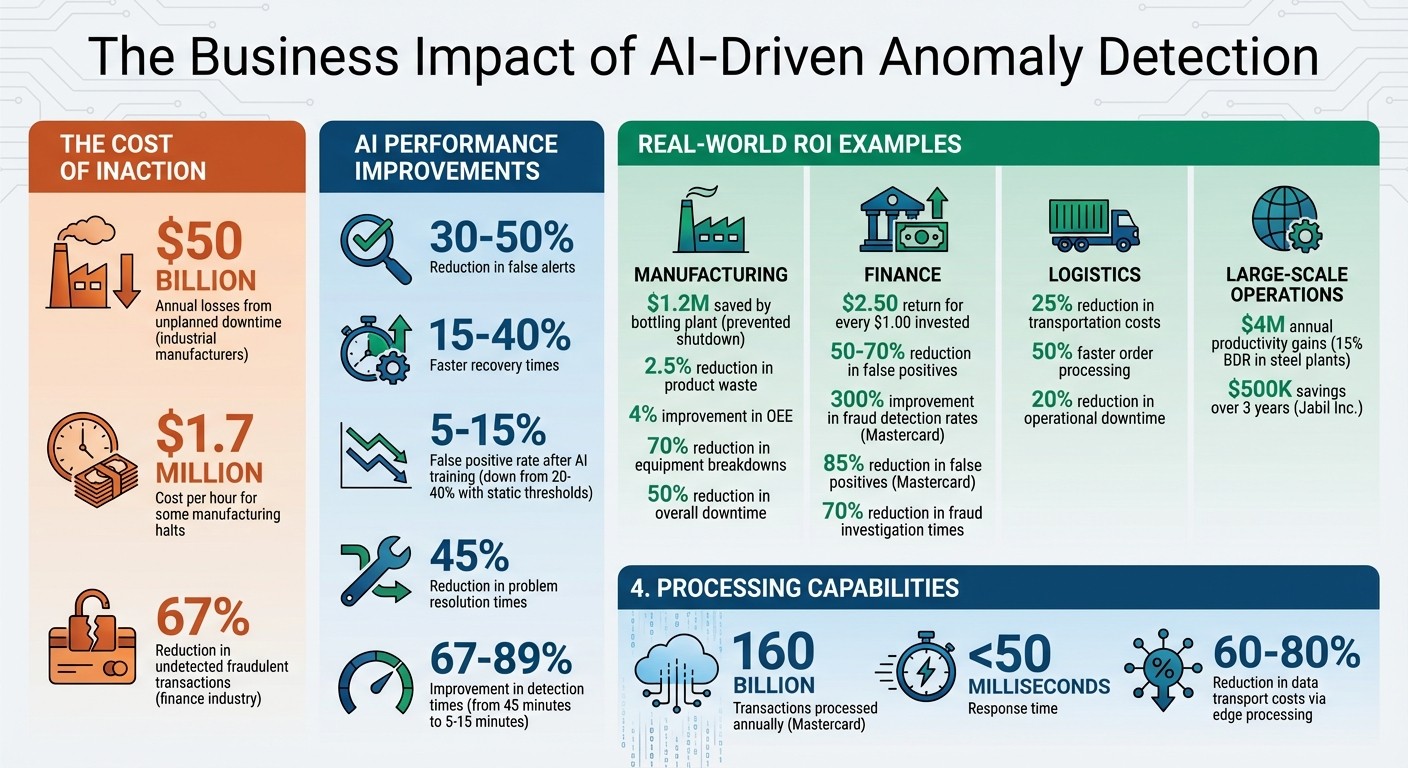
Anomaly Detection ROI: Key Statistics and Business Impact Across Industries
How Anomaly Detection Works in Business Operations
What Is Anomaly Detection
Anomaly detection is all about spotting data points, events, or patterns that stray far from what's considered "normal". By continuously monitoring operations, it flags anything unusual. To figure out what "normal" looks like, the system analyzes historical data or representative samples. Then, it compares incoming data to this baseline, flagging anything that crosses pre-set or learned thresholds as an anomaly.
But not all anomalies are the same. Point anomalies are single, glaring outliers - like a sudden $10,000 charge on a credit card that usually sees $2,000 transactions. Contextual anomalies depend on the situation; for instance, a surge in website traffic on Black Friday is expected, but the same spike on a random Tuesday might raise eyebrows. Then there are collective anomalies, where individual data points seem fine, but their sequence signals trouble - like a string of small, unauthorized login attempts that could hint at a brewing security issue.
The impact of anomaly detection spans industries. In finance, AI-powered systems have cut undetected fraudulent transactions by 67%. In manufacturing, sensors tracking vibration, temperature, and pressure help predict equipment issues before they lead to breakdowns. For logistics in the U.S. Virgin Islands - where shipping delays can ripple through the supply chain - anomaly detection pinpoints inefficiencies and demand changes in real time, enabling quicker adjustments to delivery schedules.
This groundwork opens the door to using AI for even more precise and adaptive anomaly detection.
How AI Improves Anomaly Detection
Traditional systems rely on fixed thresholds, which can quickly become outdated as patterns shift. AI-driven models, on the other hand, use machine learning to adapt continuously, uncovering intricate, non-linear relationships that might escape human analysis.
"AI anomaly detection changes the process from a static set of statistical rules to a more flexible model trained to create a baseline for 'normal.'"
– Michael Chen, Senior Writer, Oracle
AI not only makes anomaly detection smarter but also streamlines operations. Businesses using AI have cut alert noise by 30–50%, slashing false positives from the usual 20–40% range to just 5–15% after proper training. Google's 2023 Site Reliability Engineering studies show recovery times improved by 15–40%, allowing teams to fix issues before they escalate. Mastercard processes up to 160 billion transactions annually with response times under 50 milliseconds, boosting fraud detection rates by 300% while reducing false positives by more than 85%. Similarly, Siemens has shortened problem resolution times by 45% using AI-driven root cause analysis for production monitoring.
AI also handles enormous volumes of data - both structured and unstructured - like logs, sensor readings, and transactions, all at scale. For businesses in the U.S. Virgin Islands, where operational costs are high, this ability to catch small inefficiencies early can prevent them from snowballing into costly problems.
Benefits of Anomaly Detection for Business Flow
Reducing Downtime
Unplanned downtime costs industrial manufacturers a staggering $50 billion annually. Anomaly detection offers a proactive solution, identifying potential problems before they escalate into major failures. Instead of relying solely on scheduled maintenance or reacting to breakdowns, businesses can monitor operations in real time and address issues as soon as deviations occur.
Take the example of an automotive supplier using anomaly detection to monitor vibration, pressure, and current on a 2,000-ton stamping press. The system flagged a minor misalignment nine weeks before it could lead to a failure. A quick four-hour repair during a scheduled die change prevented a 72-hour shutdown, saving an estimated $1.2 million. For businesses in the U.S. Virgin Islands, where shipping delays for replacement parts are common, catching issues early can mean avoiding costly emergency repairs and prolonged disruptions.
But the benefits don't stop at preventing breakdowns - anomaly detection also reveals hidden inefficiencies in operations.
Finding Inefficiencies
Anomaly detection shines a light on subtle process deviations that quietly erode profits. These might include micro-stoppages, unexpected power usage spikes, or small process drifts that lead to defects. For instance, a high-speed bottling plant used DBSCAN clustering to monitor pressure profiles on 100 rotary filler nozzles. This approach identified abnormal nozzles, reducing product waste by 2.5% and boosting Overall Equipment Effectiveness (OEE) by 4%.
Another example comes from Express Fulfillment, which implemented AI-driven predictive analytics with RTS Labs in 2025. This allowed real-time routing adjustments, cutting transportation costs by 25%, speeding up order processing by 50%, and improving on-time deliveries. In the financial sector, AI-based anomaly detection has reduced undetected fraudulent transactions by 67%. These systems also catch errors like misrecorded invoices, billing irregularities, and unusual spikes in utility consumption before they escalate. Together, these insights help businesses in the U.S. Virgin Islands streamline their operations and build resilience into their workflows.
Optimizing Resource Allocation
Beyond preventing downtime and pinpointing inefficiencies, anomaly detection helps businesses use their resources more effectively. It aligns maintenance efforts with actual asset conditions, avoiding the unnecessary replacement of parts that are still functional. This approach trims down both parts and labor expenses. AI-powered root cause analysis also narrows down the specific sensors or variables causing deviations, cutting problem-solving time by up to 45%. This allows maintenance teams to focus on strategic tasks instead of being bogged down by troubleshooting.
Edge processing further enhances efficiency by sending only anomalies and summaries to the cloud, reducing data transport costs by 60–80%. For companies in the U.S. Virgin Islands, these strategies have led to substantial cost savings. In large-scale operations like steel plants, achieving a 15% Beneficial Detection Rate (BDR) can result in annual productivity gains of $4 million. Given the high operational costs in the U.S. Virgin Islands, these savings can make a significant difference to the bottom line. By optimizing resources and improving operational flow, anomaly detection helps businesses in the region stay competitive and efficient.
Steps to Implement Anomaly Detection in Your Business
Step 1: Diagnose Constraints
Start by pinpointing a single high-impact process with clear Service Level Objectives (SLOs) as your testing ground. Document the current metrics, such as Mean Time to Recovery (MTTR), the level of alert noise, and the accuracy of manual alerts. This process often reveals new insights - organisations adopting anomaly detection have reported cutting alert noise by 30–50%.
Next, evaluate your data infrastructure to ensure it provides accurate and consistent information. Standards like OpenTelemetry can help maintain uniform naming conventions, avoiding errors when models correlate data. Collaborate with technical teams to understand the meaning behind sensor readings and the operational logic of the process. Historical data is key here - use it to establish a baseline for normal equipment behavior by identifying the mathematical relationships between data points during standard operations.
Step 2: Design Custom AI Models
Once the constraints are clear, focus on defining what "normal" looks like for your operations. This step forms the foundation of your AI models. For systems with predictable patterns, like turbines or motors, time-series methods that track consecutive states work well. For less predictable systems, such as web servers or customer service queues, methods like Autoencoders can better identify whether a state falls within normal ranges.
Consider examples like Mastercard's Decision Intelligence platform, which processes 160 billion transactions annually in under 50 milliseconds. This system has improved fraud detection rates by 300% while cutting false positives by over 85%. Siemens also leveraged AI for root cause analysis in manufacturing, reducing problem resolution times by up to 45%. Start with one-class learning, which trains models solely on "normal" data. This is particularly useful since historical logs often lack sufficient examples of "abnormal" events.
Step 3: Execute Solutions with Dedicated Teams
Before fully deploying your models, run them in shadow mode for 2–4 weeks. This phase allows the system to observe seasonal patterns and validate its accuracy without triggering actual alerts. Once the model achieves at least 70% alert precision, transition to active monitoring. Falling below this threshold can quickly erode trust in the system.
Rebel Force offers Enablement Sprints that deliver results in just 12 weeks. For a slower approach, their Enablement Programs extend the same process over a year. Both options involve dedicated teams working with your staff to address detected anomalies. Start small, focusing on low-severity alerts, and gradually scale to critical issues once the system has proven its accuracy.
Step 4: Validate ROI and Outcomes
Measure metrics like downtime reduction, alert precision, and resolution time. Studies in Site Reliability Engineering (SRE) show that anomaly detection can speed up recovery times by 15–40%. Adaptive baselines, when properly trained, can also lower false positive rates from the 20–40% range (common with static thresholds) to just 5–15%.
Validate your model by testing it against historically labeled "abnormal" cases rather than using these cases for training. If the model can reliably distinguish known faults from normal operations, it’s ready for practical use. For example, Express Fulfillment partnered with RTS Labs in 2025 to implement AI-powered predictive analytics, achieving a 25% reduction in transportation costs and 50% faster order processing. For businesses in the U.S. Virgin Islands, where operational costs can be high, these kinds of improvements can make a noticeable difference to profitability.
After implementation, continue monitoring and validating outcomes to ensure the system delivers long-term benefits.
AI Agents: Transforming Anomaly Detection & Resolution
Applications of Anomaly Detection Across Industries
AI-driven anomaly detection is reshaping how industries operate, delivering measurable improvements in efficiency, cost savings, and risk management.
Finance: Fraud Detection
For financial institutions managing massive transaction volumes, manual fraud detection is simply not feasible. AI-based systems step in to categorise anomalies and detect unusual transactions, contextual discrepancies, and suspicious patterns. These systems boast an average return of $2.50 for every $1.00 invested, while slashing false positives by 50% to 70%. With advanced machine learning (ML) tools, fraud investigation times have been reduced by as much as 70%, and the identification of true money laundering cases has increased by over 50%.
Unlike older rule-based systems that flag transactions based on rigid thresholds, modern AI adapts dynamically to evolving fraud tactics, uncovering complex patterns autonomously. This means financial institutions can minimise losses while freeing up resources for more targeted investigations.
Manufacturing: Predictive Maintenance
Unplanned downtime is a costly problem in manufacturing, with a single hour potentially costing over $250,000. AI-powered anomaly detection flips the script from reactive maintenance to proactive strategies. By monitoring key metrics like temperature, pressure, and vibration, these systems can detect subtle changes weeks before a failure occurs. The results? Significant reductions in downtime and millions saved in avoided failures.
Take the example of a high-speed bottling plant that used DBSCAN clustering to track pressure profiles across 100 filler nozzles. By identifying deviations from normal patterns, the plant reduced product giveaway by 2.5% and improved Overall Equipment Effectiveness (OEE) by 4%. On a larger scale, predictive maintenance powered by AI can cut equipment breakdowns by up to 70% and reduce overall downtime by 50%. Rebel Force's Enablement Sprints help manufacturers adopt these systems in just 12 weeks, delivering rapid, measurable results.
Operations: Supply Chain and Customer Behavior
Anomaly detection extends beyond maintenance and fraud prevention, playing a crucial role in optimising supply chains and enhancing customer experiences. It can flag potential issues such as logistics delays, supply shortages, or sudden demand spikes before they escalate into costly disruptions. On the customer experience side, the technology monitors system performance metrics to identify problems - like slow app response times - that could lead to customer churn.
In November 2022, Jabil Inc., a global manufacturing leader, rolled out a cutting-edge analytics platform across 100 plants. The initiative improved data quality and streamlined processes, resulting in an estimated $500,000 in savings over three years. Additionally, anomaly detection can spot positive outliers, like a sudden surge in demand for a viral product, allowing businesses to adjust inventory and marketing strategies in real time.
For businesses in the U.S. Virgin Islands, where geographic factors often increase supply chain costs, AI-based anomaly detection offers a way to cut operational downtime by up to 20%. Rebel Force's Enablement Programs, implemented over a year, provide a structured approach to integrating these systems, ensuring consistent improvements in efficiency and workflow optimisation.
Measuring and Scaling Anomaly Detection Impact
Metrics to Measure Success
Once anomaly detection is in place, the next big step is figuring out if it’s actually delivering results. To do that, you need to track the right metrics. One standout metric is the Beneficial Detection Rate (BDR). This measures the percentage of anomalies flagged by AI that are genuinely relevant and impactful. Nikunj Mehta, Founder and CEO of Falkonry, puts it perfectly:
"Anomaly detection isn't just about identifying irregularities; it's about pinpointing anomalies that can genuinely impact your operations".
Here’s why this matters: even a modest BDR of 15% in a large steel production facility can lead to $4 million in annual productivity gains. Beyond just productivity, you should also track metrics like reduced monitoring and troubleshooting costs, quicker resolution times for incidents, and fewer cases of failures spreading through systems. For businesses in the U.S. Virgin Islands, where unplanned downtime costs manufacturers a staggering $50 billion annually, these metrics are crucial for staying competitive.
Once you have a clear picture of performance using these metrics, it’s time to scale the solution across the organization.
Scaling Through Rebel Force Programs

After proving that anomaly detection can cut downtime and boost efficiency, the next challenge is scaling it across the enterprise. Rebel Force offers a structured, four-phase approach - Diagnose, Design, Execute, and Validate - to help businesses expand their use of unsupervised machine learning systems. These systems are designed to detect patterns automatically, without needing constant manual input.
Scaling effectively depends on a few key steps:
Standardizing sensor setups across different locations to ensure consistency.
Creating unified data ecosystems by bringing together fragmented data sources.
Incorporating adaptive learning systems that can adjust to things like seasonal changes.
Rebel Force also provides dedicated enablement teams to guide organizations through this process. This ensures companies can handle increasing data loads and operational complexities, all while maintaining detection accuracy. The result? Businesses not only see measurable returns on their investment but also build a solid foundation for long-term success without overwhelming their teams.
Conclusion
AI-driven anomaly detection is reshaping how businesses operate by moving from reactive problem-solving to proactive prevention. Companies adopting these systems have reported impressive results, including 15–40% faster recovery times, 30–50% fewer false alerts, and in some cases, up to 50% reductions in fraud-related losses. For businesses in the U.S. Virgin Islands, these advancements offer not only cost savings but also improved efficiency in day-to-day operations.
The key to success lies in replacing outdated, rule-based systems with AI that learns and adapts to normal operations, including seasonal variations. This shift helps address costly challenges like unplanned downtime, which we discussed earlier. For instance, organizations using AI-powered root cause analysis have reduced problem resolution times by up to 45%, while detection times have dropped from 45 minutes to as little as 5–15 minutes - a massive improvement of 67–89%.
Implementing anomaly detection systems requires collaboration across maintenance, IT/OT, and data science teams. Partnering with specialists who offer structured implementation plans can ensure a clear return on investment.
Rebel Force’s four-phase strategy - Diagnose, Design, Execute, and Validate - provides businesses with a roadmap to scale anomaly detection without overloading their internal teams. Whether through Enablement Sprints or year-long Programs, this approach delivers measurable results while creating sustainable solutions.
To take the next step in minimizing downtime, optimizing resources, and turning data into actionable insights, visit Rebel Force and start transforming your operations today.
FAQs
What data do I need to start anomaly detection?
To kick off anomaly detection, you'll need a solid foundation of historical data. This could include transaction records, sensor readings, or user activity logs. Such data allows the system to understand typical patterns and spot anything out of the ordinary. The key is to gather data that’s consistent and reliable - this ensures the AI can learn these patterns accurately and flag deviations effectively.
How do I reduce false alerts with AI anomaly detection?
To cut down on false alerts, tweak the sensitivity settings in your anomaly detection models. This helps separate normal fluctuations from actual anomalies more effectively. You can also create and use filter lists to exclude anomalies caused by known but rare processes or applications. These steps not only boost detection accuracy but also reduce unnecessary notifications, making your system more reliable.
How long until anomaly detection shows ROI?
ROI from anomaly detection can often be seen within 3 to 6 weeks. The timeline varies based on factors such as how the solution is implemented and the unique needs of the business. When the approach is designed to tackle major inefficiencies and address specific constraints, results tend to appear even sooner.