Operational Excellence
AI vs. Traditional Value Stream Mapping
Want to optimize your processes faster and more accurately? Here's the deal: AI-driven Value Stream Mapping (VSM) is reshaping how organizations identify inefficiencies compared to manual methods.
Key differences:
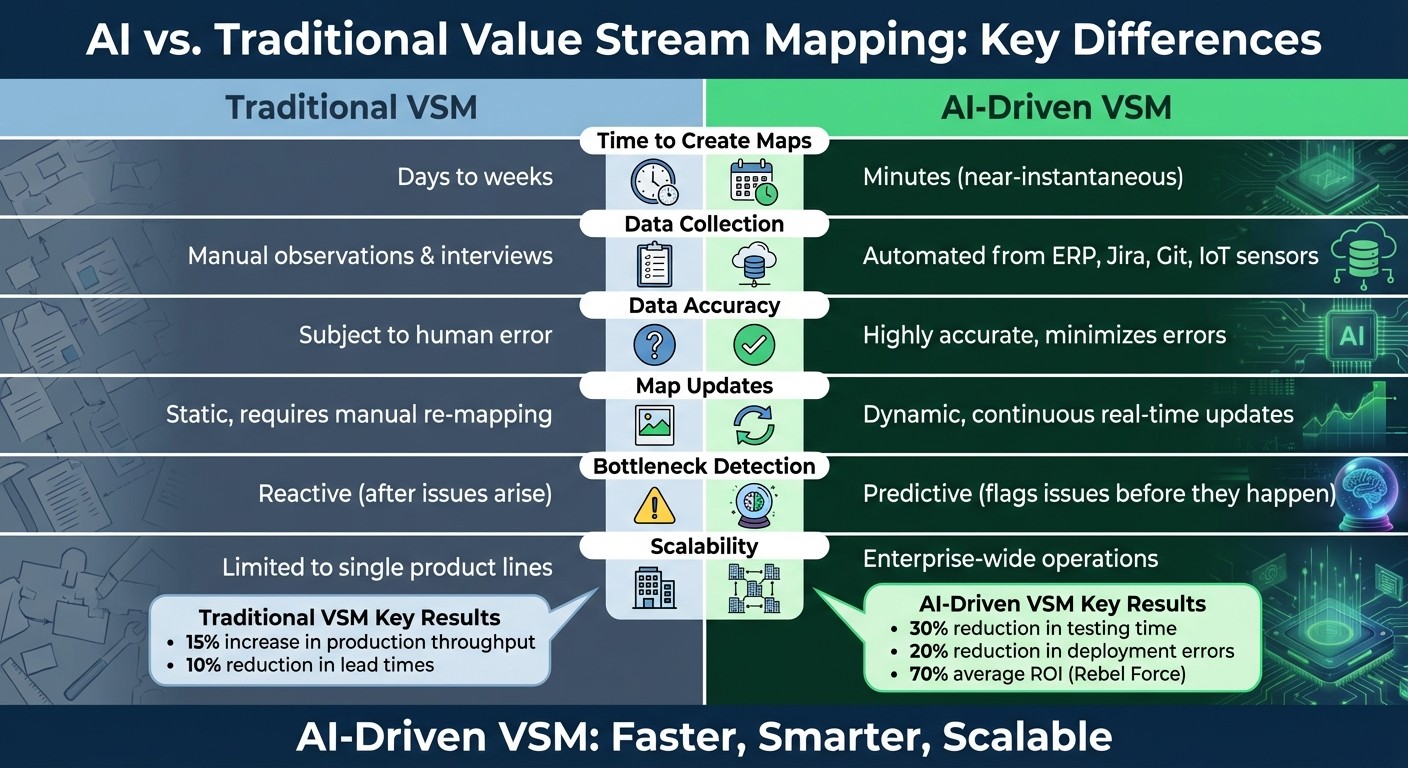
Speed: AI generates maps in minutes, while manual methods take days or weeks.
Accuracy: AI uses real-time data, reducing errors common in manual observations.
Scalability: AI handles enterprise-wide operations, unlike manual VSM, which struggles with large-scale processes.
Proactive Insights: AI predicts bottlenecks and risks; manual methods react after issues arise.
Quick takeaway: If you're still relying on manual VSM, you're likely missing out on the efficiency, precision, and adaptability AI tools bring to the table.
Quick Comparison:
Why it matters: AI not only saves time but also ensures your processes stay efficient and competitive in today's fast-paced world.
AI vs Traditional Value Stream Mapping: Key Differences Comparison
Traditional Value Stream Mapping Process
How the Manual Process Works
The traditional value stream mapping (VSM) process starts by bringing together a cross-functional team that includes both managers and frontline operators. The team’s first task is to zero in on a "product family" - a group of products that share similar processing steps. This focus helps keep the mapping effort manageable and relevant.
A key part of this approach is the Gemba walk, where team members physically move through the workspace to observe how work flows in real time. During this walk, they conduct time studies and interview staff to gather accurate, on-the-ground data. This step is vital because, as Rod Morgan from RPM-Academy points out:
"When you work in the service sector, you'll find that data is very difficult to acquire. We don't typically measure the things that are important".
After spending one to three days collecting data on the floor, the team drafts a current state map using basic tools. This map outlines the flow of materials, the transfer of information, and distinguishes between value-added and non-value-added activities. Typically, a traditional VSM event takes anywhere from two to five days to complete.
Once the current state is mapped, the team shifts focus to designing the future state. They use lean principles and brainstorming sessions to identify areas for improvement and mark problem spots clearly. The process concludes with the creation of an implementation plan, often structured as a Gantt chart that assigns responsibilities, lists resources, and sets timelines for improvements.
For example, a 2007 project at Boeing demonstrated the potential for significant ROI through this process, though it also revealed how time-intensive manual mapping can be. Similarly, a Midwest acute care hospital used VSM to pinpoint "total patient time spent" as a key area for improvement.
While this method is thorough, its reliance on manual effort and static data creates some notable challenges.
Limitations of Traditional VSM
Although traditional VSM provides useful insights, it comes with several drawbacks. One major issue is its static nature. The map represents a single snapshot of how processes are believed to function, but it doesn’t account for ongoing changes. As Bill Detwiler from Celonis explains:
"What you end up with is a static snapshot of how your processes are believed to run, with no assurance of accuracy".
By the time the team finishes mapping and documenting the process - often using Excel - the reality on the ground may have already shifted.
Human error and subjectivity also pose challenges. Relying on interviews and opinions instead of hard data can lead to inaccuracies and gaps in understanding. If mapping happens from an office rather than directly on the floor, assumptions often replace facts, leading to missing or incorrect information. Additionally, manual timing methods, such as using stopwatches and clipboards, are not only time-consuming but also prone to mistakes.
Scalability is another hurdle. Traditional VSM works well for a single product line or department but struggles with large-scale, enterprise-wide operations that involve multiple handoffs and disconnected systems. The process is labor-intensive, requiring significant coordination and manual effort. As a result, it’s often done as a one-time event or annual review. This infrequency means that problems can linger for months before they’re revisited.
These limitations highlight why many organizations are turning to more dynamic, real-time solutions. Advanced, AI-driven mapping tools are gaining traction for their ability to address these inefficiencies while providing up-to-date insights.
AI-Driven Value Stream Mapping Capabilities
How AI Powers Value Stream Mapping
AI is revolutionizing value stream mapping by automating data collection. Traditionally, teams relied on manual Gemba walks to gather information, but now AI can integrate directly with enterprise systems like ERP, Jira, Git, and CI/CD pipelines to pull real-time performance metrics seamlessly.
Using IoT sensors and computer vision, AI can track the movement of goods and workers across the production floor automatically. Meanwhile, Natural Language Processing (NLP) digs into stakeholder communications and customer feedback - areas often overlooked in conventional mapping - to extract actionable insights. This automation eliminates delays caused by manual processes and bridges the "communication gap" and "cultural inertia" that often slow down siloed teams, creating a centralized, objective source of truth.
One of AI's standout features is its ability to update value stream maps in real time. As conditions change on the production floor or within workflows, AI adjusts the maps accordingly. Lance Knight from Broadcom captures this potential perfectly:
"Value streams will become truly flowing rivers of innovation, with AI ensuring that quality, security, and compliance are maintained without becoming bottlenecks".
AI doesn't stop at monitoring - it analyzes patterns to suggest alternative workflows, helping to sidestep production delays or supply chain disruptions. It can even predict equipment failures, enabling proactive maintenance that keeps operations running smoothly. As Lynnette Mitchell-Grady from Wolters Kluwer emphasizes:
"AI changes how we identify and eliminate bottlenecks, predict risks, and use data to make informed decisions".
These dynamic insights are setting the stage for more efficient and measurable operational improvements.
Benefits of AI in Value Stream Mapping
Switching to AI-powered value stream mapping brings clear advantages in speed, accuracy, and scalability. For instance, companies using AI in VSM have reported a 15% boost in production throughput and a 10% reduction in lead times. In software development, automation driven by AI has cut testing times by 30% and reduced deployment errors by 20%. On the manufacturing side, predictive maintenance and optimized machine settings have led to a 5% reduction in total costs.
Accuracy leaps forward with AI. By removing human error and bias from data collection, AI captures precise metrics and identifies waste more reliably than manual methods ever could.
When it comes to scalability, AI truly shines. While traditional VSM might work for a single product line or department, AI can handle operations across an entire enterprise. In fact, over 85% of Fortune 500 companies now use work management platforms with automated reporting and real-time visibility features. AI enables centralized management across departments, standardizing processes and providing a level of visibility that manual methods simply can't match.
The speed advantage is another game-changer. AI can cut mean time to resolution (MTTR) for production issues from hours to mere minutes by instantly correlating error patterns and pinpointing root causes. In agile software environments, AI integration can boost sprint velocity by 20% and improve forecast accuracy by 15%. Even automating estimation tasks can save 30% of the time teams typically spend on manual estimations.
The results speak for themselves: AI is not just improving value stream mapping but transforming it into a faster, smarter, and more scalable process.
Faster Flow Optimisation with Automated Value Stream Maps
AI vs. Traditional VSM: Side-by-Side Comparison
When you compare traditional Value Stream Mapping (VSM) with AI-driven VSM, the differences are striking. Traditional VSM relies on physically walking through the process - visiting each step, observing, and manually collecting data. This can take anywhere from several days to weeks. On the other hand, AI-driven VSM automates this process, pulling data directly from systems like ERP, Jira, and IoT sensors. Once integrated, these systems can generate maps almost instantly.
Another major difference lies in how updates are handled. Traditional VSM produces static maps that represent a single snapshot in time. If processes change, someone has to go back and manually re-map everything. AI-driven VSM, however, updates in real time. It continuously reflects the latest process changes and flags issues as they arise, shifting from static snapshots to dynamic, actionable insights. This makes process management far more proactive and data-driven.
The ability to predict versus react is another key distinction. Traditional VSM identifies bottlenecks only after they’ve caused delays, relying on manual analysis. It also struggles with accuracy, as human error can creep into data collection. AI-driven VSM eliminates these challenges by automating data collection and using pattern recognition to predict future bottlenecks, production delays, or supply chain disruptions. This proactive approach fundamentally transforms how organizations manage their value streams.
Comparison Table of Key Metrics
These differences highlight how AI-driven VSM excels in real-time monitoring, predictive insights, and the ability to scale across complex operations.
Advantages of AI over Traditional Methods
AI brings transformative benefits to Value Stream Mapping (VSM), addressing the limitations of traditional methods. By combining speed, accuracy, and adaptability, AI reshapes how organizations approach process optimization.
Real-Time Monitoring and Automation
One of AI's standout features is its ability to provide continuous, real-time updates by linking directly to operational systems like ERP platforms, project management tools, and IoT sensors. Unlike traditional methods that rely on periodic snapshots, AI ensures teams are always working with up-to-date information.
For example, a global electronics manufacturer saw production lead times drop by 15% and inventory holding costs decrease by 10% after integrating AI with their ERP and IoT systems. The AI system identified inefficiencies immediately, allowing teams to act swiftly and resolve issues before they escalated.
AI also takes over repetitive tasks like data collection, metric calculations, and report generation - tasks that traditionally consumed hours of manual effort. In software development, teams using machine learning-powered automation reduced testing time by 30% and deployment errors by 20%. This freed up engineers to focus on higher-value tasks, such as refining processes and driving innovation.
Predictive Analytics and Bottleneck Detection
Traditional VSM methods often highlight delays only after they’ve occurred. AI, on the other hand, anticipates issues before they arise. By analyzing historical data and patterns, machine learning can forecast bottlenecks, equipment failures, and demand fluctuations, enabling proactive adjustments. For instance, a global manufacturing company boosted production throughput by 15% with an AI-driven VSM system that predicted obstacles and optimized workflows in advance.
"AI changes how we identify and eliminate bottlenecks, predict risks, and use data to make informed decisions." - Wolters Kluwer
AI's predictive capabilities also enhance resource planning. Tools powered by AI have improved sprint velocity by 20% and forecast accuracy by 15%, outperforming manual estimation methods. Teams can better anticipate workload challenges and allocate resources efficiently, avoiding mid-project chaos.
Scalability for Enterprise Needs
Scaling traditional VSM across large organizations often proves challenging. Different departments, locations, and time zones create silos, making it difficult to achieve a unified view of operations. AI resolves this by centralizing data from multiple systems into a single, cohesive platform. This ensures consistent visibility across the enterprise while still allowing for local customization.
The ability to scale effortlessly becomes even more critical as businesses grow. AI-driven platforms maintain consistency and accuracy without requiring a proportional increase in manual effort. As Kent Hansen, Co-Lead of Operational Excellence at Centric Consulting, put it: "What humans could do in weeks, AI mapping could do in days - or even hours". For enterprises managing hundreds of interconnected processes, this speed can mean the difference between staying competitive and falling behind.
AI's ability to integrate, predict, and scale makes it an indispensable tool for organizations looking to optimize their value streams efficiently and effectively.
Rebel Force's AI-Enhanced Approach
Rebel Force leverages AI to boost efficiency and scalability, but they do things a little differently. Instead of sticking to the typical billing models, they’ve adopted a fixed-price approach aimed at removing specific bottlenecks that slow organizational workflows. Their strategy zeroes in on the most pressing constraint in the workflow, using focused tools and methods to ensure every step produces consistent, predictable results.
The 4-Phase Enablement Process
Every engagement Rebel Force undertakes follows a structured four-phase process. Here’s how it works:
Diagnose: They start by digging into data, behaviors, and processes to identify the single bottleneck that’s causing the biggest disruption in workflow.
Design: Next, they create a tailored Enablement Blueprint, specifically designed to address that constraint.
Execute: A dedicated team - called Rebel Flow Units - takes over. This team includes an Enablement Lead, AI Specialist, Process Designer, and Performance Analyst. Together, they implement changes in 12-week sprints, ensuring every adjustment is measurable and impactful.
Validate: Finally, they assess the financial results and gather Compound Learning, which helps guide future improvements.
This method has been applied successfully in over 220 processes. What’s more, Rebel Force works alongside internal staff to restructure workflows around efficiency, ensuring organizations can maintain momentum on their own once the engagement wraps up. This hands-on, phased approach helps deliver results that are not only measurable but also sustainable.
Delivering Measurable ROI
Rebel Force’s enablement process doesn’t just streamline operations - it boosts financial performance in a big way. On average, they report a 70% return on investment (ROI) across their projects. They offer two main engagement models:
Enablement Sprints: These are fast-paced, 12-week cycles designed to tackle a major constraint with a clear ROI target in mind.
Enablement Programs: For organizations that prefer a more gradual transformation, this 12-month option spreads the changes over a longer timeline.
"After merging several entities within our group, we were looking for synergy in our sales operations. Rebel Force, through their fractional leadership, achieved this by creating a unified approach - from strategy to reporting, all within one integrated system."
Nik Korstanje, (Former) CFO, Blijkgroep
On the technical side, Rebel Force integrates AI to handle automation and analytics. Meanwhile, their process designers establish operating rhythms and build dashboards to ensure that AI supports human workflows rather than replacing them. This blend of technology and thoughtful process design creates systems that not only work efficiently today but also scale seamlessly as needs grow.
Key Takeaways and Recommendations
Summary of Key Comparisons
When comparing traditional Value Stream Mapping (VSM) with AI-driven approaches, the contrast highlights how AI reshapes process optimization. Traditional VSM relies on manual observation to create periodic snapshots, while AI-driven methods automate data collection through real-time integration with ERP systems, IoT sensors, and other tools. The impact is clear: AI-powered VSM platforms have shown a 15% boost in production throughput and a 10% decrease in lead times.
AI also shifts VSM from being reactive to predictive. Traditional methods often identify issues only after workflow disruptions occur. In contrast, AI uses machine learning to predict equipment failures, demand changes, and resource constraints before they cause problems. It automates the capture of essential metrics, reducing human error and bias, while overcoming the visibility challenges that arise from departmental silos in traditional setups.
These advancements encourage organizations to rethink how they approach process optimization.
Steps to Transition to AI VSM
If you're ready to embrace the benefits of AI-driven VSM, here’s how to get started:
Pinpoint pain points and define KPIs. Begin by identifying bottlenecks - such as delays, high defect rates, or manual tasks slowing down your processes. Establish clear KPIs like cost savings, improved productivity, or reduced lead times. Having these SMART objectives helps measure ROI and demonstrate value to stakeholders.
Start with a pilot project. Instead of rolling out AI across the entire organization, focus on a high-impact area. Target repetitive, rule-based tasks like data entry or scheduling, which are prone to errors. A pilot allows you to gather feedback, refine the process, and showcase results before scaling up.
Prioritize data quality. AI insights are only as good as the data it analyzes. Make sure your data is clean, consistent, and reliable throughout the transition to ensure accurate outcomes.
Address resistance with training. Position AI as a tool to enhance human expertise, not replace it. As Matt Rebeiro, Strategic Advisor at Process Design Institute, puts it:
"A value stream map should never be designed just for your needs. It should be used as an asset in conversations from the frontline all the way up to executives".
Invest in tailored training for project managers and delivery teams. Establish a governance structure that balances control with flexibility, enabling teams to iterate and improve while staying aligned with organizational goals.
FAQs
What data do we need to start AI-driven VSM?
To get started with AI-driven value stream mapping (VSM), you'll need precise and detailed process data. This includes real-time operational metrics and a clear understanding of each step in your workflow. Crucial data points to gather are cycle times, wait times, inventory levels, and defect rates. Adding extra layers of information - like supply chain data or usage metrics - can help AI pinpoint inefficiencies and streamline value streams more effectively.
How hard is it to integrate AI VSM with our ERP and tools?
Integrating AI-powered value stream mapping (VSM) with your ERP system and tools hinges on your existing architecture and how well it supports AI capabilities. While traditional VSM relies heavily on manual processes, AI-driven VSM leverages automation and real-time data to streamline workflows and identify inefficiencies more effectively.
If your tools don’t support smooth data exchange, you might need to implement solutions like APIs, middleware, or custom interfaces to bridge the gap. For a smoother process and tangible outcomes, consider working with AI integration specialists, such as Rebel Force, who can guide you through the setup and ensure everything works seamlessly.
How do we prove ROI from switching to AI-driven VSM?
To demonstrate ROI from AI-driven value stream mapping (VSM), focus on tracking measurable gains in efficiency, accuracy, and scalability. Key performance indicators like cycle times, throughput, and defect rates should be analyzed both before and after implementation. Using data-backed validation methods - such as those employed by Rebel Force - can help directly connect these improvements to AI adoption. This approach ensures ROI is clearly shown through tangible outcomes like cost savings or increased revenue.