

Operational Excellence
The Complete Guide to Business Process Optimization
Business Process Optimization (BPO) is about improving how organizations function by identifying inefficiencies and fixing them for better results. Unlike basic automation, BPO focuses on the entire workflow, often using AI to handle complex tasks and unstructured data. This approach leads to faster processes, lower costs, and improved accuracy.
Key takeaways:
Cost Savings: U.S. companies lose around $1.3 trillion annually due to manual processes. AI-driven BPO can cut operational costs by 40–70%.
Efficiency Gains: Processes can be completed 50–90% faster, with error reductions of 80–95%.
ROI Examples: Companies often achieve 150–300% ROI in the first year. One firm reduced invoice processing time from 3 days to 4 hours, achieving a 612% ROI in Year 1.
The process involves:
Identifying inefficient workflows.
Analyzing current systems.
Redesigning processes with tools like AI and process mapping.
Testing and implementing changes.
Monitoring and refining for sustained improvement.
BPO also eliminates hidden inefficiencies like "shadow processes", reduces errors, and improves customer satisfaction. Tools like process mining, RPA, and AI-powered platforms play a critical role in achieving these results. Businesses that commit to continuous improvement see lasting benefits, including faster workflows, lower costs, and better-quality outcomes.
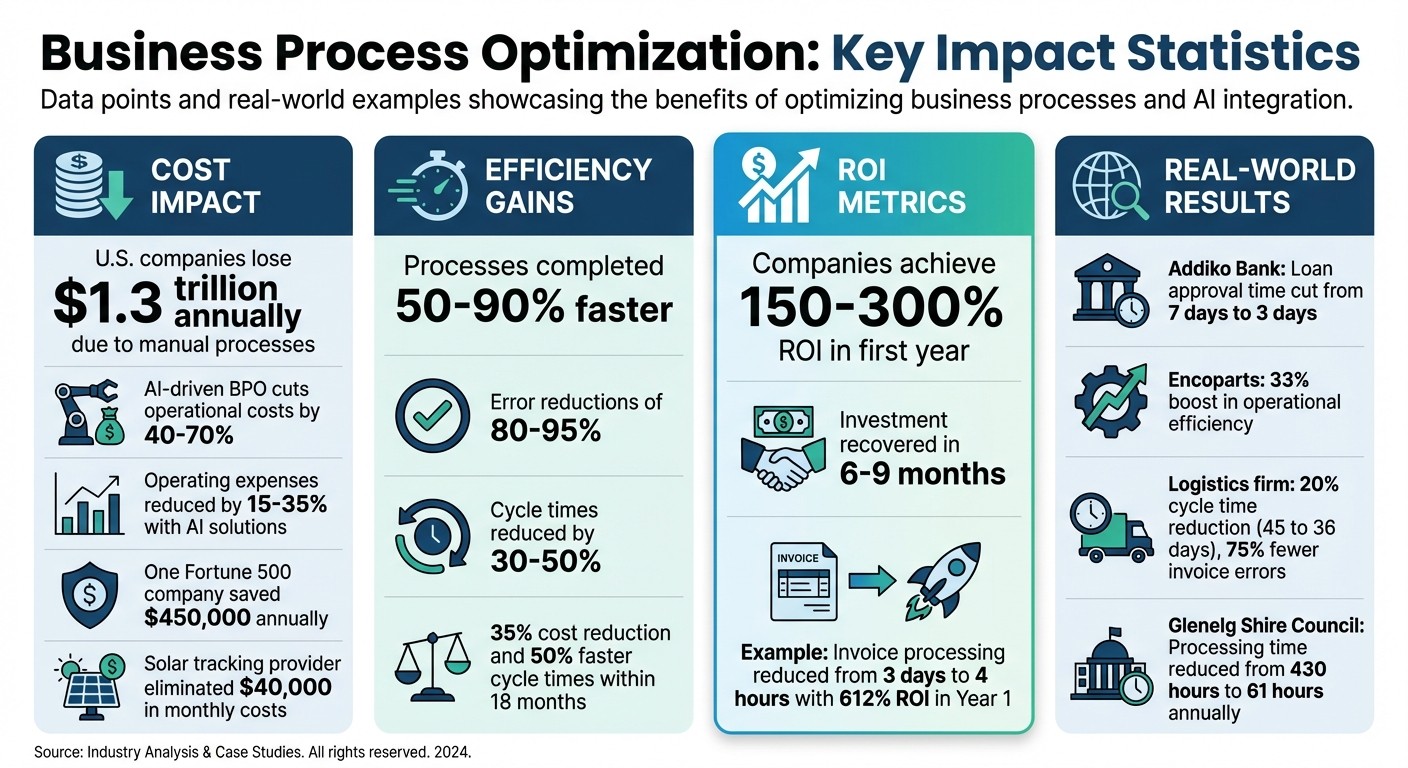
Business Process Optimization ROI and Impact Statistics
How Can AI Be Used To Optimize Business Processes
Benefits of Business Process Optimization
Streamlining business processes can lead to impressive results, such as a 35% cost reduction and 50% faster cycle times within just 18 months. These kinds of improvements give companies a competitive edge in today’s global markets.
Improving Operational Efficiency
When workflows are optimized, results are delivered faster. Take Addiko Bank, for example. In 2023–2024, they integrated their core banking systems and automated documentation processes. This effort reduced their loan approval time from seven business days to just three, cutting customer wait times in half.
Another example is Encoparts' International Purchasing division. By mapping their workflows to identify inefficiencies, they achieved a 33% boost in operational efficiency and sped up their service delivery significantly. AI-powered process optimization often results in a 30-50% reduction in overall cycle and processing times, allowing teams to handle more tasks without increasing staff. This faster pace doesn’t just improve productivity - it also saves money.
Reducing Costs and Waste
Streamlining processes isn’t just about speed; it’s also about cutting costs. For instance, a Fortune 500 company introduced an intelligent digital workplace to simplify tasks like expense management and email processing. The result? They saved over $450,000 annually and freed up more than 7,000 labor hours each year.
AI-driven solutions can slash operating expenses by 15-35%. A U.S.-based solar tracking provider offers a great example: they used three RPA bots to automate their proof of delivery process. In just three weeks, they eliminated $40,000 in monthly costs, boosted quarterly revenue by 65%, and uncovered $16 million in previously unbilled revenue. Most process optimization projects deliver 150-300% ROI within the first year, with businesses typically recovering their initial investment in just 6 to 9 months.
Improving Quality and Customer Experience
Efficiency and cost savings are just part of the story. Optimized processes also ensure consistent quality and enhance the overall customer experience. For instance, Poste Italiane, the Italian postal service, implemented a case management solution to digitize 50% of its documents. This led to a 25% reduction in lead times for key products.
Better processes directly impact customer satisfaction. A global logistics firm used AI process mining to analyze their order-to-cash cycle. They uncovered delays caused by staff shortcuts and made changes that reduced cycle time by 20% (from 45 to 36 days), cut invoice errors by 75%, and lowered manual interventions by 66%. When businesses deliver faster, more accurate results, customers notice - and they stick around.
Frameworks and Methods for Business Process Optimization
When it comes to improving how businesses operate, the right framework can make all the difference. By focusing on eliminating inefficiencies, frameworks like Lean, Six Sigma, and process mapping offer structured approaches to streamline operations. Many businesses in the U.S. Virgin Islands have found success by combining these methods to tackle inefficiencies from multiple angles.
Lean Principles and Waste Elimination
Lean methodology is built around a straightforward idea: get rid of anything that doesn’t add value for your customers. It highlights seven specific types of waste that drain resources: overproduction, excess inventory, waiting time, unnecessary motion, extra transportation, overprocessing, and defects. The MEP National Network has implemented over 80,000 Lean manufacturing projects, leading to savings of more than $18.8 billion. For businesses on the islands, where supply chain challenges and operational costs are often higher, Lean principles can be especially impactful.
The process typically begins with Value Stream Mapping (VSM), which helps visualize every step of a process to pinpoint inefficiencies. From there, businesses can introduce pull systems that ensure production aligns with actual customer demand, avoiding overproduction. The 5S methodology - Sort, Set in Order, Shine, Standardize, and Sustain - organizes workspaces to maximize efficiency. Regular Kaizen events promote continuous improvement, keeping workflows optimized.
"Agile methodology looks to improve the product itself; lean looks to improve the process that delivers products".
While Lean focuses on waste, Six Sigma zeroes in on reducing defects.
Six Sigma and Process Variation Reduction
If Lean is about speed and waste, Six Sigma is all about precision and quality. Its goal is ambitious: no more than 3.4 defects per million opportunities. Using a data-driven approach, Six Sigma follows the DMAIC framework - Define, Measure, Analyze, Improve, and Control - to systematically improve existing processes.
Key tools in Six Sigma include Poka-Yoke (error-proofing) to prevent mistakes and Statistical Process Control (SPC) to detect potential issues before they escalate. To uncover the root cause of a problem, the "5 Whys" technique digs deep into the underlying issues. Many businesses combine Lean and Six Sigma to address both process speed and quality at the same time. For visual clarity, process mapping tools are often used alongside these methods.
Using Process Mapping Tools
Process mapping transforms workflows into visual diagrams, making them easier to understand and improve. The focus is on mapping the current reality - how things actually work today, not how they’re ideally supposed to.
Different types of process maps serve various purposes. Value Stream Mapping (VSM) highlights inefficiencies, while swimlane diagrams show how responsibilities shift across departments. SIPOC diagrams (Suppliers, Inputs, Process, Outputs, Customer) help align everyone involved on the project’s scope early on. To ensure clarity, maps should use standardized symbols and action-oriented language. For example, one healthcare clinic applied VSM and achieved a 43.9% reduction in lead time and an 89% drop in waiting time. These visual tools not only clarify workflows but also set the stage for deeper improvements to come.
Step-by-Step Guide to Business Process Optimization
Here’s a roadmap to help you move from identifying inefficiencies to achieving long-term operational improvements. Each step is designed to deliver measurable results along the way.
Step 1: Identify and Prioritize Key Processes
Start by focusing on the workflows that matter most. Using principles from Lean and Six Sigma, pinpoint processes that frequently stumble - think high error rates, long cycle times, or areas that generate customer complaints. Not every process needs immediate attention; instead, target the ones where changes will make the biggest impact.
To prioritize, assess each process based on its potential business impact, ease of implementation, and associated costs. Data shows that structured optimization efforts can cut costs by 35% and improve cycle times by 50% within 18 months. Begin with simpler, low-complexity tasks that promise quick returns to build momentum and gain stakeholder buy-in.
Look for bottlenecks like data silos, manual errors, or inefficient handoffs. Automated process mining tools can help you analyze event logs objectively, while interviews with employees can uncover unofficial "workarounds" they’ve created. This top-down approach ensures your efforts align with broader business goals.
Once you've identified the key processes, the next step is to map and analyze how they currently function.
Step 2: Analyze Current Workflows
After narrowing down your focus, create a detailed "as-is" map of each target process. This map should outline every step, decision point, and handoff involved. Process mining tools can help you uncover where workflows deviate from the ideal model and identify bottlenecks.
Evaluate each step critically. Does it add value to the user or the organization? If not, it’s time to eliminate it. Pay close attention to handoffs, as frequent role changes can lead to delays and data quality issues. Look for "media breaks" where data is manually transferred between systems - these are prime candidates for automation. Finally, dig into the root causes of delays, whether they stem from manual inputs, poor communication, or inadequate training.
Step 3: Redesign and Test Future Processes
Now that you’ve identified inefficiencies, it’s time to design a better workflow. Start by mapping out the optimal path - the one followed most of the time (around 80%) - to keep things simple. Use clear, action-oriented labels like "Submit request" instead of vague terms like "Request form" to make the process map easier to follow.
Before diving into automation, simplify the workflow. Automating a flawed process only locks in inefficiencies. Remove redundant steps and look for tasks that can run in parallel to reduce cycle times. Incorporate AI to handle unstructured data like emails or documents, and use robotic process automation (RPA) for repetitive tasks. This frees your team to focus on higher-value work.
Before rolling out the new process, test it on a smaller scale. Prototyping and simulations can help you fine-tune the workflow, saving time and resources in the long run. For example, a financial institution reduced loan approval times from seven days to three by unifying its systems during the redesign phase. Testing with a small group helps uncover any flaws before a full rollout.
Step 4: Implement Changes with Rebel Force
Implementation is where many optimization efforts hit a wall. Rebel Force tackles this with a structured four-phase approach:
Diagnose: Identify operational constraints and friction points.
Design: Create a tailored blueprint for improvement.
Execute: Deploy AI and automation solutions through a dedicated team.
Validate: Measure outcomes to confirm the changes deliver the intended results.
Rebel Force offers two options for implementation. If you need quick results, their 12-week Enablement Sprints are ideal for addressing immediate bottlenecks. For more gradual, structural changes, their 12-month Enablement Programs provide a fixed-cost solution.
Step 5: Monitor, Measure, and Scale
Optimization doesn’t end with implementation. To sustain improvements, you need to continuously monitor and refine your processes. Set clear key performance indicators (KPIs) to track progress against your baseline. AI-optimized processes can reduce operating expenses by 15-35% and cut cycle times by 30-50%, but only if you actively track performance.
Feedback loops are essential. AI systems can use real-time data to adjust processes dynamically, while conformance checking ensures actual performance aligns with your ideal "to-be" model. Once a pilot area proves successful, scale the optimized process to other departments or locations, maintaining consistent measurement and refinement.
Regular reviews - quarterly assessments, for instance - will help prevent old inefficiencies from creeping back in. Remember, the goal isn’t perfection on the first try but continuous improvement over time. This ongoing process ensures your operations stay aligned with the evolving demands of modern, AI-driven business strategies.
AI-Driven Tools for Business Process Optimization
AI tools have reshaped how businesses improve processes, especially when dealing with tasks that involve exceptions or complexities beyond the reach of traditional automation. Unlike rigid systems that falter with unstructured inputs, AI can process data from emails, PDFs, and even voice recordings, which are often the biggest hurdles in workflows. This allows businesses to move beyond basic task automation to a complete overhaul of their workflows, seamlessly building on earlier optimization strategies.
Process Mining and Workflow Automation
Think of process mining as workflow detective work. Instead of relying on interviews or guesses about how tasks are completed, these tools dig into event logs from existing systems to uncover the reality of your operations. They don’t just find inefficiencies; they also expose hidden "shadow processes" - those unofficial methods teams often create to get things done.
When paired with robotic process automation (RPA), process mining becomes part of "Hyperautomation" - a blend of AI, RPA, and process mining that enables fully automated workflows. This approach doesn’t just make tasks faster; it eliminates the need for manual intervention altogether. Plus, AI’s ability to handle growing transaction volumes without increasing staff means these optimized workflows can grow alongside your business.
Low-Code Platforms for Custom Workflow Design
Once inefficiencies are identified, low-code platforms make it easy to act on them. These tools allow users - often non-developers - to design and test workflow changes using simple visual interfaces. This means businesses can quickly prototype and refine solutions with small groups before rolling them out company-wide. The speed of these platforms is a game-changer, especially since traditional development cycles often take so long that the original business needs evolve before solutions are ready.
Rebel Force's AI Integration
Rebel Force stands out by using context-aware reasoning, which goes beyond basic "if-then" logic. This capability allows the system to adjust to variations in workflows automatically. By analyzing event logs, Rebel Force maps out actual processes, including those unofficial shadow processes that are often missed.
The platform also handles unstructured data - like invoices, contracts, and customer emails - extracting key information without human input. This makes it especially valuable for departments that deal with high volumes of data, such as Finance (for tasks like invoice processing and reconciliations), HR (for resume screening and onboarding), and Customer Service. Rebel Force uses a four-phase approach to ensure measurable results, with dedicated teams validating performance and tracking outcomes. This structured process bolsters the step-by-step optimization strategies outlined earlier, offering businesses a reliable way to achieve meaningful improvements.
Measuring the Success of Business Process Optimization
To ensure your optimization efforts are hitting the mark, it’s essential to measure the performance of your processes. After implementing optimized workflows and redesigned systems, tracking their success becomes the next critical step. A structured approach to measurement not only validates improvements but also ensures they are sustained over time.
Key Metrics to Track
Once processes have been redesigned and implemented, focusing on specific metrics helps maintain and evaluate their effectiveness.
Efficiency metrics gauge the speed and resource usage of your processes. Metrics like cycle time and throughput highlight how quickly tasks are completed and how efficiently resources are allocated. Resource utilization, in particular, shows whether your team and equipment are being used effectively without causing burnout or overuse.
Quality and accuracy metrics are vital for identifying and addressing issues early. Error rates measure how often mistakes occur, while rework rates track the percentage of work requiring corrections. First Pass Yield (FPY) is a strong indicator of process stability, reflecting the proportion of tasks done right on the first attempt. For example, in September 2023, Glenelg Shire Council significantly improved its Kerbside Waste & Recycling Request process, cutting annual processing time from 430 hours to just 61 hours, saving over nine weeks of full-time labor annually.
Financial impact metrics assess whether your optimization efforts are delivering tangible cost benefits. These include tracking cost per transaction, total cost savings (from reduced labor and improved productivity), and Return on Investment (ROI). Studies show that business process automation can reduce costs by 20–30%. Additionally, avoiding non-compliance costs - often 2.65 times higher than compliance costs - can protect your bottom line. Even a modest 5% increase in customer retention has the potential to boost profits by 25–95%. Customer-facing metrics, like Net Promoter Score (NPS) and Customer Satisfaction (CSAT), ensure that service quality remains a priority as processes evolve.
Rebel Force's Performance Tracking System
Rebel Force takes performance measurement to the next level with its integrated platform, which automates the tracking of key metrics and provides predictive insights. Its four-phase enablement process includes a dedicated validation stage where performance is constantly compared to baselines established during the Diagnose phase. The platform offers real-time visibility into workflows, quickly identifying inefficiencies like manual approval delays, and uses Service Level Agreement (SLA) controls to trigger alerts when tasks exceed acceptable limits.
Rebel Force’s process mining capability reconstructs actual workflows from digital event logs, uncovering hidden processes that manual reviews might miss. By consolidating data from systems like CRM, ERP, and legacy software, the platform demonstrates how process changes impact customer satisfaction and operational costs. It tracks metrics such as step duration, rework rates, and SLA compliance automatically, eliminating manual reporting errors and providing solid evidence of ROI. With its context-aware reasoning, the system not only reviews past performance but also predicts potential issues, such as SLA breaches or bottlenecks, before they occur.
This data-driven approach aligns perfectly with the monitoring and scaling framework discussed earlier. By establishing a continuous feedback loop, Rebel Force ensures that process improvements are not just implemented but also sustained, reinforcing the journey toward long-term operational excellence.
Conclusion: Achieving Long-Term Business Optimization
Optimizing business processes isn't something you tackle once and forget about - it’s a continuous journey of improvement. The most successful organizations pair structured methods like Lean and Six Sigma with AI-powered tools that adjust to real-time changes. Experts emphasize that AI must operate within context, turning raw data into actionable insights. These insights drive measurable outcomes that matter in the real world.
The numbers back it up. Companies that commit to consistent optimization see lower costs and faster processes. For businesses in the U.S. Virgin Islands, these benefits are especially critical. They help mitigate supply chain challenges and enable growth without requiring a proportional increase in staffing - a key advantage in a tight labor market.
But it’s about more than just metrics. True, lasting change depends on fostering a culture of improvement. This includes encouraging employee input, maintaining governance structures like a Center of Excellence, and using tools like process mining to uncover hidden inefficiencies - those unofficial "workarounds" that can quietly erode productivity.
Rebel Force’s four-phase enablement framework - Diagnose, Design, Execute, and Validate - provides a solid foundation for ongoing success. Whether through a 12-week Enablement Sprint for fast results or a 12-month Enablement Program for deeper transformation, the focus remains clear: data-driven solutions, measurable outcomes, and scalable improvements. The framework establishes baselines, creates context-aware strategies, and ensures that progress aligns with key performance indicators.
The future of optimization lies in a partnership between human expertise and AI’s analytical capabilities. Together, they can achieve outcomes that neither could accomplish alone. By applying the strategies, tools, and frameworks discussed here, your business can move beyond short-term wins and embrace long-term improvements that deliver a strong return on investment.
FAQs
What’s the difference between BPO, automation, and RPA?
Business Process Optimization (BPO) is all about refining workflows to cut down on inefficiencies and make processes run smoother. It’s like giving your operations a tune-up to ensure everything functions as effectively as possible.
Automation: Handling Repetitive Tasks
Automation steps in to take over repetitive tasks, using technology to perform them faster and with consistent accuracy. Think of it as a way to free up human effort for more complex and creative work.
Robotic Process Automation (RPA): Bots in Action
Robotic Process Automation (RPA) takes automation a step further. It involves software bots that imitate human actions to handle structured, rule-based tasks. For example, these bots can tackle things like data entry or processing invoices with precision and speed.
In essence, BPO focuses on improving workflows, automation handles task execution, and RPA brings in bots to manage routine, structured activities.
How do I pick the first process to optimize?
To get started, pinpoint the processes that play a key role in achieving your business goals or are causing noticeable inefficiencies. These might include workflows affecting day-to-day operations, customer satisfaction, or those flagged as outdated through metrics or feedback. Take a close look at how these processes currently function and rank them based on factors like potential impact, ease of improvement, and alignment with broader priorities. This approach not only drives measurable progress but also sets the stage for continuous refinement.
What KPIs best prove BPO ROI in my business?
Key performance indicators (KPIs) that show return on investment (ROI) in business process optimization include cost reduction, process cycle time, error rates, and productivity improvements. These metrics offer a straightforward way to assess efficiency and operational success. Keeping an eye on these areas helps you gauge the real impact of your optimization efforts.